17 August 2012

Seven Banks Under Investigation for Global Interest Rate Scandal

Seven international banks have been served with subpoenas over the global interest setting scandal. Barclays, Citigroup, Deutsche Bank, HSBC, JPMorgan Chase, Royal Bank of Scotland and UBS


Original Page: http://www.blacklistednews.com/Seven_Banks_Under_Investigation_for_Global_Interest_Rate_Scandal/21070/0/0/0/Y/M.html

16 August 2012

Colo. shooting lawsuit filed, man blames theater, doctors, and Warner Bros.

"A lawsuit was filed Tuesday, just a few days after the largest mass shooting in the history of the United States, blaming the theater, the doctors of James Holmes, and the film studio Warner Bros. Torrence Brown, Jr. was in Century 16 Theater when James Holmes started his killing spree. Brown was not injured although one of his best friends, A.J. Boik, was fatally shot in the chest. Brown claims to be suffering from extreme trauma."

"Brown's attorney, Donald Karpel, told TMZ that the theater was negligent. The emergency exit door in the front had no alarm and was not guarded. Many believe that Holmes purchased a ticket, entered the theater, propped open the emergency exit from the inside, and then went to his car and returned with four guns."

Continue Reading: http://www.examiner.com/article/james-holmes-lawsuit-filed-man-blames-theater-doctors-and-warner-bros?cid=db_articles

http://sussexcountyangel.wordpress.com/2012/07/24/colo-shooting-lawsuit-filed-man-blames-theater-doctors-and-warner-bros/

Mises

How can five little letters be so blessedly unique and yet so palatable? Imagine that one person could so change the world through small steps, helping to educate the masses on both economics and sociology. Those from the Austrian school help unlearn generations of malicious thoughts and actions from human psyche. Without people who can transcend false paradigms, the species would do well to simply and willingly go extinct by doing the same thing that always hurts. 

Left and Right are both Wrong

Voices in the Dark

Scholars like Rothbard, Mises, Block, Schiff, and Paul are why this new blend of patriotism as dissent will be remembered in history as a lone voice of reason in the darkest hour, even if as well-recognized as Rothbard. I am blessed to have the wealth of information from the Mises scholars, teachers, and authors at my disposal, as am I to have the vocal Rockwell doing his lions's share of the work to reach a wider audience. These voices are those doing there damnedest to find the hundredth monkey through enlightenment.

Why The National Debt will Never Decrease

We are going to have to go to a cashless society to maintain any semblance of sustainability. The Federal Reserve will never raise interest rates. Credit is the new dollar. We will never return to a gold standard. If credit dries up, the house of cards collapses. We won't pay down our national debt or cut government spending, as that would stifle production and consumption. Knowing why everything is wrong doesn't help when that is also the only way to prop it all up. This is the result of moving to a fiat system instead of a resource-based economy. 

Meet Chairman Bernanke's Replacement


Meet Chairman Bernanke's Replacement - Happy Hour In Santa Cruz - Home - The Daily Bail

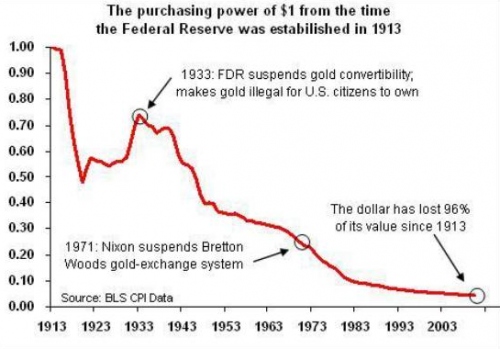
Today in History: the End of the Gold Standard


Fourty-one years ago (actually yesterday), president Nixon severed the connection between the US currency and any resource backing, effectively setting the stage for increased rates of inflation into the future. This was one of the most important decisions in modern financial, economic and monetary history and is a seminal moment in the creation of the global sovereign debt crisis confronting the U.S., Europe and the world in 2012.  The dollar has since fallen from 1/35th of an ounce of gold to 1/1750th of an ounce of gold.


More at the Daily Bail.

On August 15, 1971, President Nixon announced on TV 3 dramatic changes in economic policy. He imposed a wage-price freeze. He ended the Bretton Woods international monetary system.  And he imposed a temporary surcharge (tariff) on all imports. The Bretton Woods system was created towards the end of World War II and involved fixed exchange rates with the U.S. dollar as the key currency - but also a role for gold linked to the dollar at $35/ounce. The system began to falter in the 1960s because of an excess of dollars flowing out of the U.S. which foreign central banks had to absorb. A run on gold in 1968 was stemmed by a patch on Bretton Woods known as the two-tier gold system. All of this was ended unilaterally by the Nixon decision.


The stability of gold in trade was part of what kept the dollar from fluctuating wildly, though increases and decreases in it's value were common. What has been often overlooked since 1933 is the absense of any sustained increase in the value of the dollar. Nixon's actions were simply a nearly unnoticed blip on the race to the bottom.

This inflation is the invisible tax which Mises describes often;

Inflation, an increase in money and credit, is certainly not a means to avoid or to postpone for more than a short time the need to resort to taxes levied on people other than those belonging to the rich minority. If, for the sake of argument, we leave aside all the objections which may be raised against any inflationary policy, we must take into account the fact that inflation can never be more than a temporary makeshift. Inflation cannot be continued over a long period of time without defeating its fiscal purpose and ending in a complete debacle as was the case in this country with the Continental currency, in France with the mandats territoriaux and in Germany with the mark in 1923.

Inflation: An Unworkable Fiscal Policy

IMF Paper Backs Full Reserve Banking!

We’ve been in a state of mild shock since Saturday. We discovered one of the strongest advocates of full reserve banking in the institution where we would expect it least.
 

The International Monetary Fund has released a paper “The Chicago Plan Revisited” that supports the proposals of Irving Fisher – those which are the basis for Positive Money’s proposals - using state of the art economic modelling.

This sounds to be in opposition to the system which is currently in use, built upon the works of economists like Keynes and Krugman. Maybe the IMF knows something that the rest of us don't...

In their summary the authors Jaromir Benes and Michael Kumhof write:

At the height of the Great Depression a number of leading U.S. economists advanced a proposal for monetary reform that became known as the Chicago Plan. It envisaged the separation of the monetary and credit functions of the banking system, by requiring 100% reserve backing for deposits.
But even that backing requirement went away eventually with the end of the Gold Standard. But this system is actually what causes the boom-and-bust business cycles which lead to recessions and depressions.
Irving Fisher (1936) claimed the following advantages for this plan:

(1) Much better control of a major source of business cycle fluctuations, sudden increases and contractions of bank credit and of the supply of bank-created money.

(2) Complete elimination of bank runs.

(3) Dramatic reduction of the (net) public debt.

(4) Dramatic reduction of private debt, as money creation no longer requires simultaneous debt creation.

We study these claims by embedding a comprehensive and carefully calibrated model of the banking system in a DSGE model of the U.S. economy. We find support for all four of Fisher’s claims.

[...]


More: Positive Money » IMF Paper Backs Full Reserve Banking!

15 August 2012

Heirlooms Disappear From BofA Safety Deposit Box

Many consumers often use store valuable possessions in safe deposit boxes assuming it’s secure, but a Danville couple found that’s not always the case.
When Unsa Kamal and her husband Aizad received a letter from Bank of America informing them their box had been drilled opened and emptied, they said they thought it was junk mail. But after carefully reviewing the letter, the Kamals said the bank in fact emptied their safe deposit due to lack of information.
But the bank actually had the social security numbers of the customers on file, so it either lied or simply wanted an excuse to rummage through the private property of private citizens. This is just the latest in an overwhelming collection of reasons to abandon the large and heavily corrupt banking system.
“They claim they didn’t have Social Security numbers, which is not true,” Aizad Kamal said. When they open the account that’s something very basic they ask for and they have that.”
[...] 

ConsumerWatch: Heirlooms Disappear From BofA Safety Deposit Box « CBS San Francisco

14 August 2012

Mutant Butterflies Traced to Fukushima

Butterflies collected from in and around the Fukushima nuclear disaster area suffer from mutations that indicate lasting ecological effects from the radioactive fallout. The butterflies are showing abnormalities in their legs, antennae, and abdomens, and have dents in their eyes, according to a study published in Scientific Reports. Scientists collected the butterflies two months after the disaster and found that 12 percent of the samples suffered from abnormalities, with the rate of mutation increasing each generation. In a follow-up collection last September, scientists noted that the rate of mutation rose to 28 percent, and the number of mutated offspring increased to 52 percent of the sample. "Our results are consistent with the previous field studies that showed that butterfly populations are highly sensitive to artificial radionuclide contamination in Chernobyl and Fukushima," the study said. "Together, the present study indicates that the pale grass blue butterfly is probably one of the best indicator species for radionuclide contamination in Japan." Because sensitivity to irradiation varies between species, there shouldn't be concerns about these type of mutations in humans.

I'm sure there's no threat to humans :/

Via CNN

Rural Utilities Create Zero Jobs Despite $47 Million in Stimulus Funding

A stimulus program designed to create jobs by funding rural utility projects has created only about 12% of the jobs projected at the outset of the program, according to the Agriculture Department's Inspector General.

The IG examined 22 local utilities and government agencies to receive stimulus money. The Rural Utilities Service (RUS), a division of the USDA, projected that the sample of companies would create 3,384 jobs. To date, however, those companies have used their stimulus awards to create a mere 415 jobs.

Some of the recipients have not used their stimulus awards to create a single job. The Wholesale Water Commission of Atchison County, Missouri, for instance, received a $22 million stimulus award, but has yet to even begin construction on the project for which the money was earmarked. Result: no jobs created.

The cities of Elkins, WV; Thomasville, AL; Ruidoso Downs, NM; Big Bend, WV; and City of War, WV, likewise have not created a single job between them, despite having been obligated a combined $47 million in stimulus funding through the RUS.

Wow. That's money well spent. :/

A host of other cities have posted disappointing job performances, as seen in this spreadsheet:

While proponents of the stimulus would likely point to even this tepid job creation as a success, the effectiveness of economic stimulus is generally gauged against alternatives. In this case, the issue is not whether jobs have been created at all, but rather how many jobs these funds could have created if they had not been drained from the private sector or piled on top of the federal government's record-high national debt.

"Every dollar Congress injects into the economy must first be taxed or borrowed out of the economy," explained Heritage's Brian Reidl in a 2010 Backrounder. "No new spending power is created. It is merely redistributed from one group of people to another." That redistribution likely creates few jobs, and may even be a net drag on employment.

But while this RUS program, like a number of the stimulus's attempts at job creation, has performed remarkably poorly, a primary purpose of the President Obama's first legislative initiative was not immediate job creation, as Scribe has noted, but in fact geared towards long-term left wing objectives.


Original Page: http://blog.heritage.org/2012/08/14/rural-utilities-create-zero-jobs-despite-47-million-in-stimulus-funding/

12 August 2012

Lifeboat Hour – Repeat Program – 04/13/10

Related articles


from Progressive Radio Network » Lifeboat Hour | Progressive Radio Network http://prn.fm/2012/08/12/lifeboat-hour-repeat-program-041310/?utm_source=rss&utm_medium=rss&utm_campaign=lifeboat-hour-repeat-program-041310

06 August 2012

Get A Citi Rewards Card, Buy Women

When spending rewards dollars on things like knife sets, LCD TVs and restaurant reservations is just a little too 2011, here comes Citi to spice things up a bit.

Consumerist tries to make some sense of Citi rewards' incentives... and fails:

Is there no limit to what banking rewards programs will cover these days? Flights, hotel rooms, rental cars, electronics, women. Wait -- what?

Consumerist reader F. is a member of Citi's Extra Cash rewards program and saw they could earn 100 points just for taking this survey. But when F. got to this question about "What products or services are you considering purchasing using your Extra Cash?", they noticed that apparently Extra Cash can be spent on adult human females.

Maybe this is a special Citi card only designed exclusively for bankers, in which case it would make perfect sense of course. We would imagine however that only taxpayer bailout cash would be used for female purchases. Anything less would just be uncivilized.

More: http://www.zerohedge.com/news/get-citi-rewards-card-buy-women

Lifeboat Hour – 08/05/12


from Progressive Radio Network » Lifeboat Hour | Progressive Radio Network http://prn.fm/2012/08/05/lifeboat-hour-080512/?utm_source=rss&utm_medium=rss&utm_campaign=lifeboat-hour-080512

05 August 2012

Mitt Romney’s Lie On Obama and Military Voting

The latest big lie from Mitt Romney is a false claim that Obama is suing to prevent members of the military from voting early in Ohio. USA Today reported what the suit is really about:

Rob Diamond, director of veterans and military family voting for the Obama campaign, said Romney is fabricating his claim: “The Obama campaign filed a lawsuit to make sure every Ohioan, including military members and their families, has early voting rights over the last weekend prior to the election.”

Obama political adviser David Axelrod, appearing on Fox News Sunday, said Romney’s claims are “false and misleading,” and that the lawsuit is about “whether the rest of Ohio should have the same right” to early voting as members of the military.

“I think it’s shameful that Governor Romney would hide behind our servicemen and women to try and win a lawsuit to deprive other Ohioans of the right to vote,” Axelrod said.

It was believed after the 2004 election that an insufficient number of voting machines led to long lines in Democratic areas, suppressing the vote, and that if not for this problem Kerry might have beat Bush. It is therefore obviously in the interest of the Obama campaign to do everything possible to facilitate voting in Ohio.

[...]

There is little point in only bashing Obama or Romney,  when they both equally deserve the disapproval of the public. I only hope that someday the general population may finally accept that relying on the government to defend our rights is misplaced trust, as the government is the primary source of infringement upon those rights.

More: http://feedproxy.google.com/~r/liberalvaluesblog/MjjM/~3/hkdYgZA9WpY/

Kevlar Tires Now Required to Traverse ‘Spear-Like’ GMO Crops

The news surrounding GMO crops continues to get further and further outlandish as the crops are increasingly mutated and sprayed with a medley of harsh pesticides, herbicides, and insecticides. The latest news comes from an unlikely source — an automotive publication known as Autoblog. The website reports that farmers who have opted to plant Monsanto's genetically modified seeds have run into one daunting problem (outside of decreased yields and an extremely higher risk of disease): little 'spear-like' stalks from the harvested GMOs are absolutely wreaking havoc on the heavy duty tractor tires.

Described by one farmer as a 'field of little spears', farmers are now turning to kevlar tires. In case you're not aware, kevlar is the same material used in bulletproof vests to protect from gun bullets.

[...]

Read More At: http://theredpillguide.wordpress.com/2012/08/05/kevlar-tires-now-required-to-traverse-spear-like-gmo-crops/

04 August 2012

American Liberalism: The Infantile Disorder

"The approach of a great storm was sensed everywhere. All classes were in a state of ferment and preparation. Abroad, the press of the political exiles discussed the theoretical aspects of all the fundamental problems of the revolution. Representatives of the three main classes, of the three principal political trends -- the liberal-bourgeois, the petty-bourgeois-democratic (concealed behind "social-democratic" and "social-revolutionary" labels), and the proletarian-revolutionary --anticipated and prepared the impending open class struggle by waging a most bitter struggle on issues of programme and tactics. All the issues on which the masses waged an armed struggle in 1905-07 and 1917-20 can (and should) be studied, in their embryonic form, in the press of the period. Among these three main trends there were, of course, a host of intermediate, transitional or half-hearted forms. It would be more correct to say that those political and ideological trends which were genuinely of a class nature crystallised in the struggle of press organs, parties, factions and groups; the classes were forging the requisite political and ideological weapons for the impending battles."

The years of preparation for revolution (1903-05)

Left-Wing Communism: an Infantile

Disorder

V.I. Lenin

April-May, 1920

http://www.zerohedge.com/contributed/2012-08-04/american-liberalism-infantile-disorder

02 August 2012

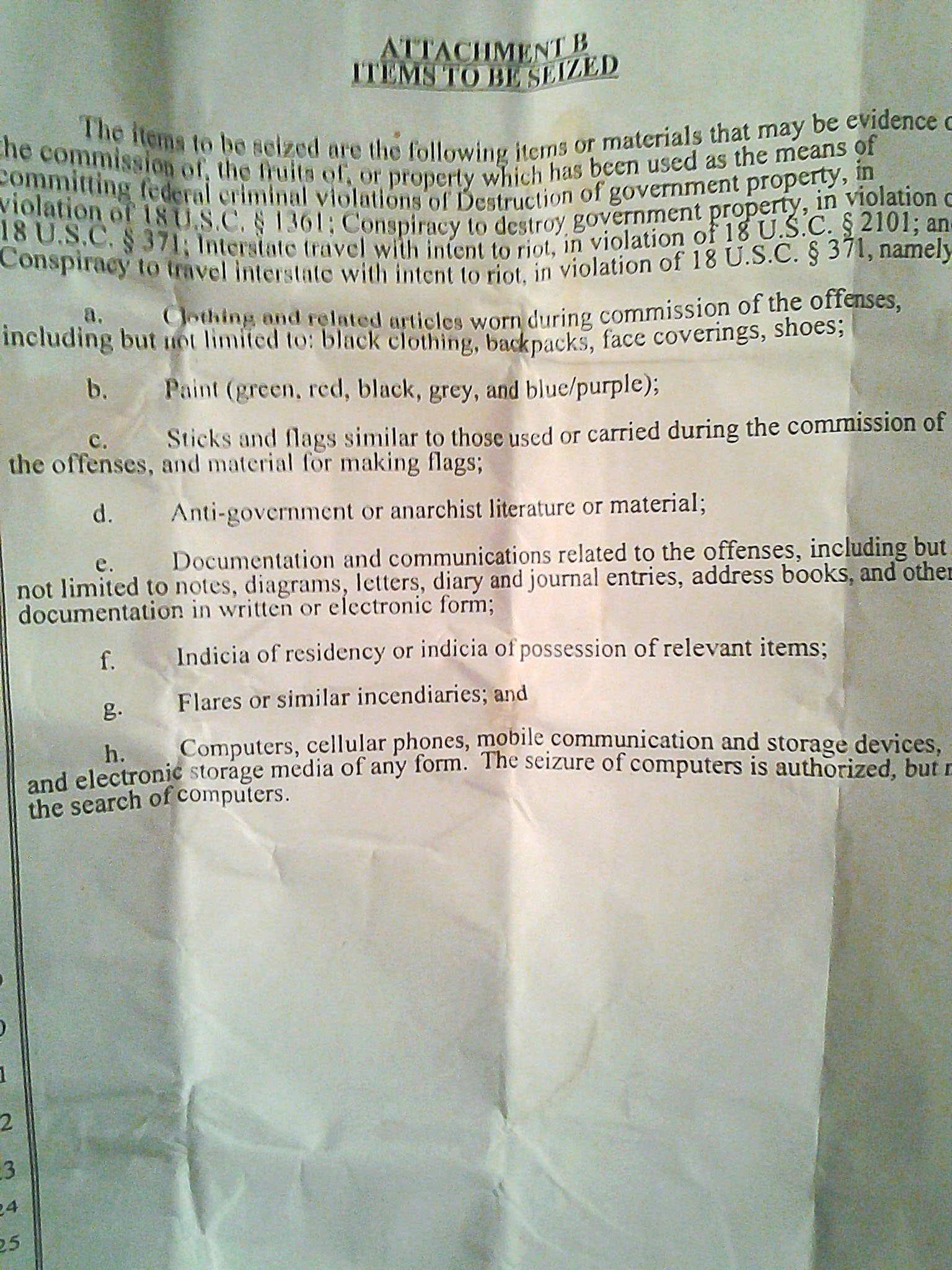
FBI Agents Raid Homes in Search of “Anarchist Literature”

When FBI and Joint Terrorism Task Force agents raided multiple activist homes in the Northwest last week, they were in search of “anti-government or anarchist literature.”

800_portland-search-warrant-anarchist-literature.jpg original image ( 1536x2048)

The raids were part of a multi-state operation that targeted activists in Portland, Olympia, and Seattle. At least three people were served subpoenas to appear before a federal grand jury on August 2nd in Seattle.


In addition to anarchist literature, the warrants also authorize agents to seize flags, flag-making material, cell phones, hard drives, address books, and black clothing.
The listing of black clothing and flags, along with comments made by police, indicates that the FBI may ostensibly be investigating “black bloc” tactics used during May Day protests in Seattle, which destroyed corporate property.


If that is true, how are books and literature evidence of criminal activity?


To answer that, we need to look at the increasing harassment, surveillance, and prosecution of anarchists and political activists associated with the Occupy Movement.
I had no idea that anarchism was illegal...

In some cases, such as the May Day arrests in Cleveland, the FBI has been so desperate to arrests “anarchist terrorists” that it supplied them with bomb-making materials and used an informant to entrap them. The same thing happened in Chicago.


The motivation for these operations, and the instruction that “anarchist” means “terrorist,” is coming straight from the top levels of the federal government. As I recently wrote, new documents show that the FBI is conducting “domestic terrorism” training presentations about anarchists.


The FBI presentation described anarchists as “criminals seeking an ideology to justify their activities.”


This is the guilt-by-association mentality that is guiding FBI and JTTF assaults on political activists; if agents find “anarchist literature” in a raid, it is evidence of criminal activity because anarchism, in and of itself, is criminal activity.


The Seattle grand jury may or may not be investigating May Day protests. What’s clear, though, is that the grand jury is being used as a tool in this criminalization of those suspected as “anarchists.” Grand juries are secretive processes that are frequently used against political activists in order to acquire information. They are fishing expeditions. If activists refuse to testify about their personal beliefs and political associations, they can be imprisoned. Jordan Halliday, for example, was recently released after serving more than six months in prison (and being imprisoned once already for four months) for asserting his First Amendment and Fifth Amendment rights and refusing to provide information about the animal rights movement.


As one organizer with Occupy Seattle said after the raid: “…we are not being raided for connection to any crime, but to some political ideology that the police think we have.


“I was just doing research on the old Pinkerton strikebreaking paramilitaries, so it’s kind of funny, you know, to have that old Red Scare history burst through my front door at six AM.”


FBI Agents Raid Homes in Search of “Anarchist Literature” : Indybay

31 July 2012

The Economic Effects of Minimum Wage Laws

An increase in the Illinois minimum wage would help working families hardest hit by the recession and provide a boost to the economy. During the 2011 legislative session, Illinois lawmakers introduced a measure to increase the state minimum wage across four years to $10.65 per hour, and a similar proposal is expected in the 2012 legislative session. Had it been enacted, S.B. 1565 (97th General Assembly, State of Illinois, 2011) would have given more than 1.1 million of the lowest-paid workers a raise, providing more than $3.8 billion in increased wages for directly affected workers.1

The Illinois minimum wage currently is $8.25 per hour. The legislation as proposed in 2011 would have gradually increased the minimum wage until it reached $10.65 in 2014. It would have increased to $8.90 in 2011, $9.50 in 2012, $10.15 in 2013, and $10.65 in 2014. After 2014, it would have maintained its value with increases tied to inflation. Amid persistent unemployment and the resulting downward pressure on wages, increasing the minimum wage for low-wage workers would be a welcome lift for the economy. An incremental increase also would help working families in Illinois make ends meet in the aftermath of the worst recession in generations.

The benefits of raising Illinois' minimum wage

I can still remember the first job I had in high school. It paid a state-mandated minimum wage of $5.25 and I though it was great that I could earn so much despite having no labor skills to offer. Within a year, the small family business I worked for could not afford to compete and sold out to a larger chain, which then cut the number of workers for that location to maintain profitability. I was able to afford the things I needed and wanted at an early age, but had no idea that those same laws reduced the potential of unemployed laborers to find work.

There is no clearer demonstration of the essential identity of the two political parties than their position on the minimum wage. The Democrats proposed to raise the legal minimum wage from $3.35 an hour, to which it had been raised by the Reagan administration during its allegedly free-market salad days in 1981. The Republican counter was to allow a "subminimum" wage for teenagers, who, as marginal workers, are the ones who are indeed hardest hit by any legal minimum. 

In truth, there is only one way to regard a minimum-wage law: it is compulsory unemployment, period. The law says, it is illegal, and therefore criminal, for anyone to hire anyone else below the level of X dollars an hour. This means, plainly and simply, that a large number of free and voluntary wage contracts are now outlawed and hence that there will be a large amount of unemployment. Remember that the minimum-wage law provides no jobs; it only outlaws them; and outlawed jobs are the inevitable result. 

All demand curves are falling, and the demand for hiring labor is no exception. Hence, laws that prohibit employment at any wage that is relevant to the market (a minimum wage of 10 cents an hour would have little or no impact) must result in outlawing employment and hence causing unemployment. 

If the minimum wage is, in short, raised from $3.35 to $4.55 an hour, the consequence is to disemploy, permanently, those who would have been hired at rates in between these two rates. Since the demand curve for any sort of labor (as for any factor of production) is set by the perceived marginal productivity of that labor, this means that the people who will be disemployed and devastated by this prohibition will be precisely the "marginal" (lowest wage) workers, e.g. blacks and teenagers, the very workers whom the advocates of the minimum wage are claiming to foster and protect. 

The advocates of the minimum wage and its periodic boosting reply that all this is scare talk and that minimum-wage rates do not and never have caused any unemployment. The proper riposte is to raise them one better; all right, if the minimum wage is such a wonderful antipoverty measure, and can have no unemployment-raising effects, why are you such pikers? Why you are helping the working poor by such piddling amounts? Why stop at $4.55 an hour? Why not $10 an hour? $100? $1,000? 

More: The Crippling Nature of Minimum-Wage Laws, by Murray Rothbard

While laborers understandably support a floor for wages, the economic effects are not entirely visible to those workers. The benefits of increasing the wage floor is only really positioned to consider the increased economic benefit to those workers who are employed, and ignores the negative effect of increasing unemployment rates (though, unemployment is increased by taxation of labor earnings as well as other interventionist policies). What wage laws do by setting a minimum level at which producers can compensate workers is to limit the amount of labor that producers can afford. Since wage laws do not also increase the market cost producers receive for goods and services, the net effect is that input costs to producers rise, yet revenue does not. This effect on producers is rarely considered in the arguments on labor wages. It is hard to argue with Rothbard's logic on any subject, including his view that "the minimum-wage advocates do not pursue their own logic, because if they push it to such heights, virtually the entire labor force will be disemployed. In short, you can have  as much unemployment as you want, simply by pushing the legal minimum wage high enough." Interventionism into wage rates increases the inefficiencies of the market and decreases the net economic value to consumers and producers, as well as laborers themselves.

The very essence of the interventionist politicians' wisdom is to raise the price of labor either by government decree or by violent action on the part of labor unions. To raise wage rates above the height at which the unhampered market would determine them is considered a postulate of the eternal laws of morality as well as indispensable from the economic point of view. Whoever dares to challenge this ethical and economic dogma is scorned both as depraved and ignorant. Many of our contemporaries look upon people who are foolhardy enough "to cross a picket line" as primitive tribesmen looked upon those who violated the precepts of taboo conceptions. Millions are jubilant if such scabs receive their well-deserved punishment from the hands of the strikers while the police, the public attorneys, and the penal courts preserve a lofty neutrality.

The market wage rate tends toward a height at which all those eager to earn wages get jobs and all those eager to employ workers can hire as many as they want. It tends toward the establishment of what is nowadays called full employment. Where there is neither government nor union interference with the labor market, there is only voluntary or catallactic unemployment. But as soon as external pressure and compulsion, be it on the part of the government or on the part of the unions, tries to fix wage rates at a higher point, institutional unemployment emerges. While there prevails on the unhampered labor market a tendency for catallactic unemployment to disappear, institutional unemployment cannot disappear as long as the government or the unions are successful in the enforcement of their fiat. If the minimum wage rate refers only to a part of the various occupations while other sectors of the labor market are left free, those losing their jobs on its account enter the free branches of business and increase the supply of labor in them. When unionism was restricted to skilled labor mainly, the wage rise achieved by the unions did not lead to institutional unemployment. It merely lowered the height of wage rates in those branches in which there were no efficient unions or no unions at all. The corollary of the rise in wages for organized workers was a drop in wages for unorganized workers. But with the spread of government interference with wages and with government support of unionism, conditions have changed. Institutional unemployment has become a chronic or permanent mass phenomenon.

Writing in 1930, Lord Beveridge, now an enthusiastic advocate of government and union meddling with the labor market, pointed out that the potential effect of "a high-wages policy" in causing unemployment is "not denied by any competent authority." In fact, to deny this effect is tantamount to a complete disavowal of any regularity in the sequence and interconnectedness of market phenomena. Those earlier economists who sympathized with the unions were fully aware of the fact that unionization can achieve its ends only when restricted to a minority of workers. They approved of unionism as a device beneficial to the group interests of a privileged labor aristocracy, and did not concern themselves about its consequences for the rest of the wage earners. No one has ever succeeded in the effort to demonstrate that unionism could improve the conditions and raise the standard of living of all those eager to earn wages.

It is important to remember also that Karl Marx did not contend that unions could raise the average standard of wages. As he saw it, "the general tendency of capitalistic production is not to raise, but to sink the average standard of wages." Such being the tendency of things, all that unionism can achieve with regard to wages is "making the best of the occasional chances for their temporary improvement." The unions counted for Marx only as far as they attacked "the very system of wage slavery and present-day methods of production." They should understand that "instead of the conservative motto, A fair day's wages for a fair day's work! they ought to inscribe on their banner the revolutionary watchword, Abolition of the wages system." Consistent Marxians always opposed attempts to impose minimum wage rates as detrimental to the interests of the whole labor class. From the beginning of the modern labor movement there was always an antagonism between the unions and the revolutionary socialists. The older British and American unions were exclusively dedicated to the enforcement of higher wage rates. They looked askance upon socialism, "utopian" as well as "scientific." In Germany there was a rivalry between the adepts of the Marxian creed and the union leaders. Finally, in the last decades preceding the outbreak of the First World War, the unions triumphed. They virtually converted the Social Democratic Party to the principles of interventionism and unionism. In France, Georges Sorel aimed at imbuing the unions with that spirit of ruthless aggression and revolutionary bellicosity which Marx wanted to impart to them. There is today in every nonsocialist country a manifest conflict between two irreconcilable factions within the unions. One group considers unionism a device for the improvement of the workers' conditions within the frame of capitalism. The other group wants to drive the unions into the ranks of militant communism and approves of them only as far as they are the pioneers of a violent overthrow of the capitalistic system.

Firmly committed to the principles of interventionism, governments try to check this undesired result of their interference by resorting to those measures which are nowadays called full-employment policy: unemployment doles, arbitration of labor disputes, public works by means of lavish public spending, inflation, and credit expansion. All these remedies are worse than the evil they are designed to remove.

Assistance granted to the unemployed does not dispose of unemployment. It makes it easier for the unemployed to remain idle. The nearer the allowance comes to the height at which the unhampered market would have fixed the wage rate, the less incentive it offers to the beneficiary to look for a new job. It is a means of making unemployment last rather than of making it disappear. The disastrous financial implications of unemployment benefits are manifest.

If government spending is financed by taxing the citizens or borrowing from them, the citizens' power to spend and invest is curtailed to the same extent as that of the public treasury expands. No additional jobs are created.

But if the government finances its spending program by inflation — by an increase in the quantity of money and by credit expansion — it causes a general cash-induced rise in the prices of all commodities and services. If in the course of such an inflation the rise in wage rates sufficiently lags behind the rise in the prices of commodities, institutional unemployment may shrink or disappear altogether. But what makes it shrink or disappear is precisely the fact that such an outcome is tantamount to a drop in real wage rates. Lord Keynes considered credit expansion an efficient method for the abolition of unemployment; he believed that "gradual and automatic lowering of real wages as a result of rising prices" would not be so strongly resisted by labor as any attempt to lower money wage rates. However, the success of such a cunning plan would require an unlikely degree of ignorance and stupidity on the part of the wage earners. As long as workers believe that minimum wage rates benefit them, they will not let themselves be cheated by such clever tricks.

In practice all these devices of an alleged full employment policy finally lead to the establishment of socialism of the German pattern. As the members of an arbitration court whom the employers have appointed and those whom the unions have appointed never agree with regard to the fairness of a definite rate, the decision virtually devolves upon the members appointed by the government. The power to determine the height of wage rates is thus vested in the government.

The more public works expand and the more the government undertakes in order to fill the gap left by "private enterprise's inability to provide jobs for all," the more the realm of private enterprise shrinks. Thus we are again faced with the alternative of capitalism or socialism. There cannot be any question of a lasting policy of minimum wage rates.

More: Minimum-Wage Rates, by Ludwig von Mises

By setting a minimum wage, producers are unable to hire a larger portion of the available labor force, and the resulting economic effect is a surplus of labor, or unemployment. By allowing a segment of the labor force to work for a lower wage (such as younger workers without skill who live at home and do not have high financial responsibilities like a family yet), unemployment can be reduced and those workers willing to work for lower wages can fill that void. During a time when so many are effected by an economic crisis, it would be more responsible of government to repeal minimum wage laws entirely.

For laborers, that first job was a chance to get training, to learn skills while earning wages. By increasing the potential for more low-wage earners to start out earning below current minimum wage rate (or any fiat rate), more low-skill, low-wage jobs can be offered to the market by producers, driving down unemployment, and also driving costs of goods and services to consumers.

Deutsche Bank To Lay Off 1900 Employees

Deutsche Bank is laying off 1900 people. 1500 of them are in the investment bank.

Here’s the press release.

This news comes as Meredith Whitney’s been chatting with Tom Keene on Bloomberg TV this morning, and just as she started explaining why she thought Wall Street’s big banks would initiate massive layoffs (50,000, actually).

Deutsche Bank’s stock is shooting up, according to Bloomberg.

That makes sense according to Whitney’s thesis as she explained it to Maria Bartiromo last week— the market will reward banks that shrink their staff and their business.


Deutsche Bank To Lay Off 1900, As Meredith Whitney Predicts 50K Total Wall Street Layoffs | Shift Frequency

Is Europe Facing a Financial "Black September"?

If there’s one thing Europe’s seemingly interminable debt crisis has taught discerning observers, it’s that, while we can always predict where the economic follies of politicians will lead, it’s impossible to predict the timing or the severity of such consequences. Ron Paul, Peter Schiff, and other savants accurately forecast the implosion of the housing bubble, but no one could have predicted precisely when the debacle would unfold. In a similar vein, we have been predicting financial collapse in Europe and the end of the eurozone for two years, yet the Europeans continue to postpone the evil day — guaranteeing in the process that, when the moment of reckoning eventually arrives, the consequences will be all the more severe.
The latest prospect for a European financial “zero-hour” is this coming September, when a confluence of several events may finally tear the eurozone apart and drive the global economy into a dizzying new downturn. So dark do Europe’s prospects now appear that one senior eurozone policymaker, speaking recently to Reuters' Jan Strupczewski, characterized September as “crunch time.” And an unnamed EU diplomat added, “In nearly 20 years of dealing with EU issues, I've never known a state of affairs like we are in now. It really is a very, very difficult fix and it's far from certain that we'll be able to find the right way out of it.”
So what has prompted this latest round of hand-wringing? Well, if Europe was staring into the abyss at this time last year, it’s now hanging by its nails from the proverbial stubby pine tree jutting from the cliff face. Spain, the world’s seventh-largest economy, is now reeling under interest rates on 10-year government debt well in excess of seven percent, the magic level that drove Ireland, Greece, and Portugal into receivership. Italy, on the eve of another debt auction needed to keep paying its government’s bills, found itself on the receiving end of another downgrade, courtesy of Moody’s. Italy managed to sell more debt, but 10-year bonds, after declining from last fall’s spike, are back up around six percent. Greece, after dragging Europe through a desperate round of negotiations to get substantial parts of its gargantuan public debt forgiven, is now admitting that — no surprise — it’s going to need yet another bailout, and a lot more time, to return to solvency. And the folks who are footing the bill for the mess are getting antsy. On September 12, the German Constitutional Court is scheduled to rule on the constitutionality of the treaty that set up the 500 billion euro bailout fund called the European Stability Mechanism (ESM). That same day, the Dutch, who are growing weary of paying for the follies of "Club Med," are holding parliamentary elections. If the Dutch elect enough anti-bailout politicians, talks to renegotiate Greece’s debt yet again, scheduled for later in September, may come untracked.
What’s a Eurocrat to do? Outside the eurozone, the outcome of the crisis is becoming painfully evident. The Greek debt picture alone is evidence enough that the European financial house of cards is about to collapse: After nearly bringing the world economy to its knees only a few months ago over negotiations for a second bailout, Greece’s political leaders are demanding more time and more money — a lot more. The new demands will amount to up to 50 billion more euros being poured into the bottomless Greek money pit, and will entail forgiveness of massive amounts of Greek debt on the part of European governments. This last is significant because, so far, only large private creditors have had to take a haircut on Greek debt. What is now being contemplated, but has little prospect of implementation, is that creditor governments, like Germany and France, write down their holdings of Greek debt (which amount to about two-thirds of all Greek public debt) and pass the costs on to European taxpayers. This, in a continent that is already in recession and whose taxpayers have so far been shielded from bailing out the likes of deadbeat Athens. “If Greece is to be saved,” said Peter Vanden Houte, chief economist at Holland’s ING Bank, “we must see some debt forgiveness from euro zone governments in the coming years because otherwise Greece is never going to come out of the situation it is in now. We are talking about potentially a 50 percent haircut, which would still mean the Greek debt would be (proportionately) around the euro zone average.” A eurozone official estimated to Reuters that “[Greece] will have to default on 30-40 percent of the loans.” In exchange for such largesse, the EU is certain to demand, according to Vanden Houte, unspecified significant concessions of sovereignty on the part of Greece — above and beyond what the Greeks agreed to in joining the eurozone in the first place. But given the fact that Greece is far behind on fiscal reforms promised only a few months ago, it is unlikely the rest of Europe will provide any further lifelines.
And Greece is just the beginning of the story. If Greece is somehow permitted to default on 50 percent or so of her remaining debt (bringing an epochal debt load of 160 percent of GDP down to a barely manageable 80 percent), Ireland and Portugal are likely to demand similar treatment.
Spain, which has been coming unraveled for several months now, is Europe’s biggest story. Spain’s real estate bubble and subsequent collapse mirrored that of the United States — but Spain’s unemployment is north of 20 percent, and her entire banking sector is in need of a bailout, a sector that includes global banking giants like Banco Santander. Not only that, but many of Spain’s larger regional governments, from Catalonia to Valencia, are now in desperate need of government bailouts to avoid defaulting on their debts. It is estimated that the Spanish government still needs to raise more than 50 billion euros by year’s end, a task that will become impossible if long-term borrowing rates persist above seven percent. By way of comparison, imagine the United States in deep recession, with more than one-fifth of its citizenry out of work, all of its money-center banks dependent on a bailout in the trillions of dollars, its creditors insisting on charging crippling interest rates, and all of its largest states no longer able to pay their bills without massive infusions of federal dollars. That, in effect, is where Spain now finds itself, and the future looks grim indeed.
Spain’s huge economy is far beyond the capacity of Europe to bail out. It is well-nigh impossible to imagine circumstances where Europe could be persuaded to fork up the funds for Spain, although foreign entities like the United States Federal Reserve may yet decide to get into the act.
Beyond Spain, however, there is Italy, whose economy is many times larger than Madrid’s. In this global economy, stifled by seemingly endless malaise, there do not exist funds in the entire world to bail out Italy.
But Europe’s ruling elites are not finished. Although Germany continues to oppose it, many eurocrats want to give the European Central Bank (ECB) the power to buy unlimited amounts of debt from member states in order to keep borrowing rates down. Many are now arguing that, for the eurozone to survive, the nations of Europe must sacrifice a lot more sovereignty and start acting more like a single country. This in turn would allow the ECB to start acting more like the Federal Reserve and other central banks, with more discretionary power to inflate the money supply at will and print their way out of short-term crises.
But it appears unlikely that Germany, Holland, and other European nations on sounder economic footing will be willing to continue to underwrite the profligacy of deadbeat countries. It is equally unlikely that the Greeks, Irish, Spanish, Italians, and the rest will accept massive tax hikes simply to pay for the debt their politicians have run up. With each passing week, Europe’s fate becomes clearer: a catastrophic currency meltdown, as Greece and other countries flee the euro, followed by a global financial earthquake as many of these states repudiate large portions of their respective debt. And, following the inevitable European meltdown, creditors will at last turn their attention to the massive debts of the United States and Japan. If the United States does not get serious about cutting the size and cost of government, she will soon follow Europe into the abyss.
“For two years we've been pumping up the life raft,” one European diplomat told Reuters, “taking decisions that fill it with just enough air to keep it afloat even though it has a leak. But now the leak has got so big that we can't pump air into the raft quickly enough to keep it afloat.”
Will America wake up in time?

Is Europe Facing a Financial "Black September"?

Shortage of Rare Earth Metals Threatens Renewable Energy

Not only are supplies of oil and natural gas under imminent threat of failing to meet demand for them, but so is a whole range of precious metals, along with indium, gallium and germanium and other vital elements such as phosphorus and helium, as is discussed throughout this Commentary. A report from the Science and Technology Committee, advised by the Royal Society of Chemistry, warns that if the U.K. does not secure supplies of strategic metals, its economic growth will be severely jeopardized. Of particular concern are indium, used in touch screens and liquid crystal displays, and rare earth elements (REEs) particularly neodymium and dysprosium, used to fabricate highly efficient magnets for electric cars and wind turbines. Platinum group metals are an issue too, used in catalytic converters and fuel cells. As is true of oil and gas, and indeed world population, such resources are not evenly distributed around the globe, and for example 80% of available new platinum is extracted from just two mines in South Africa. 92% of the niobium used in the world (for superconducting magnets and highly heat-resisting superalloys e.g. in jet-engines and rocket subassemblies) is exported from Brazil, and 97% of REEs are presently supplied from China. In developing a low-carbon transport infrastructure, it is proposed that biofuels should be used principally for aviation where there is no practical alternative to liquid fuels. Thus, it is ventured, electric cars will become increasingly important in providing personalised transport while avoiding the use of petroleum or natural-gas based fuels. The knock-on effect is that new sources of lithium must be found along with the means to mine and process the metal, plus the inauguration of recycling technology for lithium. One can immediately take issue with the practicalities of both arms of this scheme, however. Roughly one fifth of all fuel in the UK is used for aircraft, or around 13 million tonnes. At a yield of 952 L/ha and a density of 0.88 g/cm3, to produce this much biodiesel would take 15.5 million hectares of arable land, of which the UK has only 6.5 million hectares. Thus if we were to stop growing food crops entirely and just rapeseed, we could still only fuel 42% of our aviation fleet. It is obvious that just a few percent at best of our current number of planes can be kept in the air by means of biofuels. Clearly, the days of cheap air-travel are numbered and this may be one reason why the coalition government has scrapped plans to build the controversial and vexed third runway at Heathrow Airport. Given the 30 million cars on the roads here currently fuelled by oil, the case for a wide-scale implementation of electric-cars might appear compelling.

As oil supplies reduce and oil costs increase, the market will lean toward renewable energy sources naturally, guided by the Invisible Hand. 

However, the lead-in time to make a dent in that number of vehicles and the 60 million tonnes of crude oil used for fuel would be decades at best, even if the necessary supplies of REEs, lithium and overall manufacturing capacity for them could be achieved. The most practical use for electricity is to power mass transportation, e.g. tramways and railway networks rather than individual vehicles.

[...]

Eurozone Retail Sales Sink 9th Month; 17th Month of Contraction in Italy; Margins Collapse in France; Germany Barely Above Contraction


Eurozone retail sales continue to dive and not even Germany is immune. German manufacturing has been in contraction off-and-on, and retail sales are once again on the verge contraction as well.

Let's take a look at some reports.

Italy Retail Sales Slump Extends to 17th Month

Markit reports Downturn in retail sales continues in July

READ MORE

Monsanto defrauded GM corn field workers, lawsuit claims


Monsanto, the most evil corporation in the world (http://www.naturalnews.com/030967_Monsanto_evil.html), is the subject of yet another lawsuit in which plaintiffs claim the agri-giant lied to them and ripped them off. Courthouse News Service (CNS) reports that Monsanto recently recruited several agricultural workers in Texas with promises of high pay and free housing, but instead tricked them into working for pittance, and living in substandard housing equivalent to that found in third-world countries.

And does this surprise anyone? I only wonder if the low commensuration for laborers is due to efforts to make greater profits, or a sign that the giant is trying to cut operational costs out of necessity. If the latter, maybe the weight of the giant will be what brings it down. 

Jose Cardenas and several others say that, back in 2010, they were recruited for agricultural work near the Texas border town of McAllen by a company known as Milo Inc., which was in cahoots with Monsanto. Cardenas and at least seven others were told that if they agreed to work in Monsanto's genetically-modified (GM) corn fields in Indiana, they would receive free housing with kitchens, and would be paid $80 per acre for de-tasseling "Frankencorn."

Read More @ NaturalNews.com

30 July 2012

Sluggish Economic Growth: More Reason to Renounce Tax Hikes

On the afternoon of another discouraging assessment of the nation's economic growth, the Obama Administration late Friday quietly released its mid-year update of the budget. The synchronicity made clear just how far from reality the President's fiscal and economic policies have drifted—and the imperative of a prompt course correction.

Friday morning, the Bureau of Economic Analysis reported a tepid 1.5 percent growth in real gross domestic product (GDP) for the second quarter of this year. That reflected a slowdown from the anemic 2 percent in the first three months of 2012 and an ominous warning of growing sluggishness through the rest of the year.

Later Friday, the Office of Management and Budget (OMB), nearly two weeks past the legal deadline, trickled out its Mid-Session Review of the budget. It predicted a slight decline in the deficit this year to $1.2 trillion—still the fourth consecutive year of 13-digit red ink. For 2013, OMB now projects a deficit $91 billion greater than its February estimate, largely due to $148 billion in new "stimulus" spending the President originally sought for 2012. Through the rest of the decade, the Administration projects lower deficits and debt than its February budget estimated.

The foundation of every budget is the set of underlying economic assumptions, and that is where the problems with the President's numbers start. His economic figures are all but unachievable. The Administration projects GDP growth of 2.3 percent for all of this year. Reaching that annual rate would require the economy to expand at nearly 3 percent for the balance of 2012—double the pace of the second quarter. That growth rate is not impossible, but is highly unlikely, especially given the growing talk of recession.

At least as disturbing is the Administration's rosy forecast beyond this year. OMB projects 2.7 percent GDP growth next year, 3.5 percent in 2014, 4.1 percent in 2015, and 4 percent in 2016. All four projections are higher than the Blue Chip consensus of private forecasters, and the discrepancy widens over time: the 2015 and 2016 estimates exceed the Blue Chip by more than a full percentage point. Moreover, the U.S economy has not seen growth rates greater than 4 percent since 2000. One should certainly hope for such growth rates, but credible budgets are not built on wishes.

Friday's disappointing growth figures also demonstrate the unquestionable failure of the Administration's economic analyses and Keynesian-inspired "stimulus" program. In President Obama's initial budget submission, in February 2009, the Administration projected the economy, jolted by the $831 billion Recovery Act, would be surging by 4.6 percent this year in inflation-adjusted terms. That is exactly twice the Administration's growth forecast now.

Yet the President still demands $98 billion in tax hikes next year and nearly $2 trillion in tax increases over the next 10 years. Indeed, his allies in the Senate are willing to risk a recession by letting the $500 billion Taxmageddon tax hike take effect next year just to win an ideologically driven challenge. As commentator Pat Buchanan recently noted, their attitude resembles the "chicken run" scene in the classic 1955 film Rebel Without a Cause, in which Buzz Gunderson "wins" by driving over a cliff to his death—because his sleeve gets caught in the door handle of his car.

The looming tax hikes and general uncertainly about fiscal and regulatory policy are stifling growth right now. While the government has little capacity to "jumpstart" the economy, one thing it can do is remove the threat of tax hikes hanging over investors and employers. Given the economy's growing weakness, the President and his congressional allies should promptly renounce any tax increases and extend all existing tax policies—including current rates on upper-income brackets. They should yield their ideology and accept economic reality.


Original Page: http://blog.heritage.org/2012/07/30/sluggish-economic-growth-more-reason-to-renounce-tax-hikes/

Fighting Joblessness

With constantly rising unemployment rates created by government interventionist policies like taxation and minimum wage laws, I think about how we might see a future where we can reduce unemployment. The resulting surplus labor which constitutes the unemployed are created because of protectionist efforts by legislators and labor unions to drive labor costs up, even when the goods and services produced do not demand higher prices. I see this as fairly basic economics which has been perverted by some for their own benefit while many go without employment prospects entirely.

Is it more just for a smaller portion of the available labor force to have positions that are compensated at rates higher than the market equilibrium, or is it more fair for a near entirety of the labor force to find sustaining work?

The state does have one option at its disposal which could actually alleviate this situation which itself created; deregulation. By repealing minimum wage laws, employers can set wages more appropriately proportional to the products and services offered in the market, which can increase revenue generated by lowering the costs of goods and services to consumers.
When (Not If) Germany Slows, The Whole House Of Cards Collapses!!!

The MSM has this as a leading headline today... Recession Stalks Germany as Breakeven Rates Drop: Euro Credit

The falling cost of protecting against inflation in the German bond market portends a deeper slowdown in Europe's largest economy, signalling the effects of the continent's debt crisis are edging closer to the core.

The two-year breakeven rate, a gauge of inflation expectations, dropped to minus 0.45 percentage point for Germany from 1.04 percentage point a year ago, and has remained negative since the end of May. The rate reflects investors selling index- linked bonds in favor of regular securities because they reckon consumer prices will start declining. 

"Germany is most probably heading for a recession," said Humayun Shahryar, chief executive officer of Auvest Capital Management Ltd., a fund company in Nicosia, Cyprus, overseeing $100 million. "We are going through a debt crisis inEurope, and massive global economic slowdown. I'm not sure how Germany will be able to escape that."

As the biggest contributor to bailouts for indebted euro partners, the risk is that economic travails at home make it even harder to convince German voters to loosen their purse strings just as yields on Spanish bonds suggest the country will be next in line for a rescue.

[...]


Original Page: http://www.zerohedge.com/contributed/2012-07-30/when-not-if-germany-slows-whole-house-cards-collapses

29 July 2012

The Lifeboat Hour – 07/29/12


from Progressive Radio Network » Lifeboat Hour | Progressive Radio Network http://prn.fm/2012/07/29/lifeboat-hour-072912/?utm_source=rss&utm_medium=rss&utm_campaign=lifeboat-hour-072912

Upcoming Crash Will Pale 2008

Investors need to prepare for an upcoming stock market crash that will be “worse than 2008.”

That’s according to a well-respected author and investor, making a recent appearance on Fox Business.


Peter Schiff, the CEO of Euro Pacific Capital, says the stock market collapse we experienced in 2008 “wasn’t the real crash. The real crash is coming.”

He says that Federal stimulus, or quantitative easing, never works and that it just makes the economy sicker in the end. “The reason we are so screwed up is all this quantitative easing is toxic. I don’t doubt that we are going to pressure Germany into printing. We are like the kid who is trying to get a friend to ditch school with us to go to the beach. We are a bad influence on everybody.”

Schiff’s solution is to raise interest rates, but he acknowledges that it would bring a huge downside risk with it. “In America, the problem is that interest rates are too low. They have to go up. We can’t have an economy with interest rates at zero. If the Fed lets interest rates go up, we have to realize that we will have a deeper recession, we have to realize that banks are going to fail.”

He points out that today’s “safe haven” investments — the U.S. dollar and Treasurys — are anything but safe. “There are a lot of people who don’t understand what is going on. Look at how many people are buying the dollar. Look at people buying Treasurys. That makes no sense either. The risk lies in the dollar. The risk lies in Treasurys and other currencies being printed into oblivion.”

27 July 2012

Legless Romanian busker who made 'high pitched screeching' on his flute is given an ASBO preventing him from playing music

Police arrested the Romanian double amputee, who wheels himself along on his skateboard, after hearing him playing his instrument in central London with about £150 in takings.

A "cease and desist" for playing music? London sure is turning into what Orwell warned against. 


Original Page: http://www.dailymail.co.uk/news/article-2179819/Legless-Romanian-busker-high-pitched-screeching-flute-given-ASBO-preventing-playing-music.html?ITO=1490

Mortgaging your way to a college education

The Consumer Financial Protection Bureau (CFPB) came out with a report that confirmed what many of us were projecting. The CFPB has noted that both private and federal student loan debt has now hit the $1 trillion dollar mark. This is a big deal for a variety of reasons and will have an impact on the housing market for years to come. For new home buyers many are already stretching every dollar they can through loan down payment loans via FHA insured products. More and more Americans are attending college but at the same time, many more are plunging into massive levels of debt. Student default rates are surging at a time when the cost of going to college is at all time highs. Public universities are hiking tuition since state budgets are in poor shape. This is important because a college education is now becoming the second most expensive purchase for most Americans right behind housing.

The rise in tuition costs

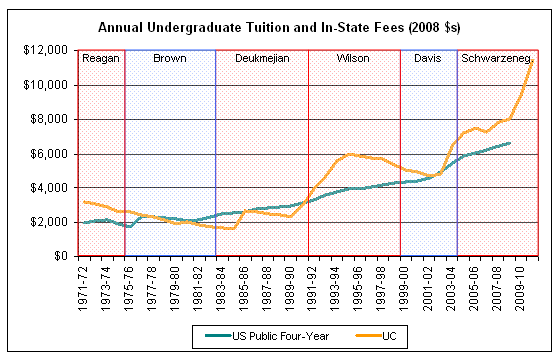
The University of California recently stated that should the November ballot initiative not pass, tuition is likely to increase an additional 20 percent:

uc tuition and fees

Source: Keep California Promise

"(Contra Costa Times) California voters know their K-12 schools will see dramatic cuts and perhaps the nation's shortest school year if they reject a November tax increase. Now, the University of California has revealed its stake in the election: a 20-percent tuition hike for its nearly 182,000 undergraduates.

UC's annual cost could bump to $14,670 a year -- one more threat among many if Gov. Jerry Brown's sales tax and tax on the wealthy fails. California State University students would see their tuitions leap 5 percent to $6,120 a year."

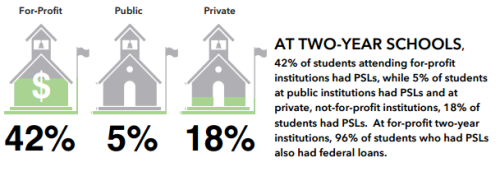
This is a significant increase. As recently as 2005 the annual tuition to attend a UC was roughly $6,000. It is now double that and should the tax measures fail, it is likely to jump to close to $15,000 per year. You also have many students enrolling in for-profit institutions and going into deep debt:

2 year schools private loans

Source: CFPB

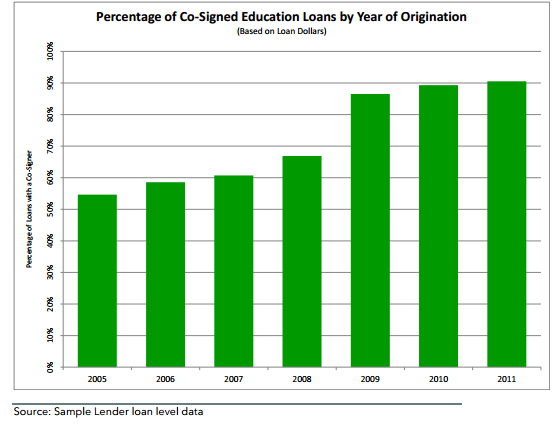
Most of the private student loan debt at two year institutions is flowing into the for-profit sector that is facing default rates similar to what was experienced in the subprime mortgage sector. This is important to note since the return on many of these institutions is minimal. It is hard to imagine but student loan debt is much worse than housing debt. Why? With a mortgage, if you have not noticed, you can stop paying and it will take some time before you lose your home. After losing your home in most states your liability on the property ends and your only penalty is a dinged credit score for a few years. Student debt does not go away. It will follow you around similar to unpaid taxes. This is why I found this part in the report interesting:

cosigned loans

In California, many of those buying these $500,000 homes with low interest rates think they got a major deal. It is likely they are middle class so they are unlikely to qualify for many grants and aid. So many of these home buyers with kids are "school obsessed" so they are likely aiming for elite public universities or top private schools that cost upwards of $50,000 per year. As you can see from the above chart, many parents are co-signing the loans for their children. A student going to a private school might end up having $100,000 or more in debt when they are done and many are moving back home. That co-signer is on the hook as well. The data shows growing default rates:

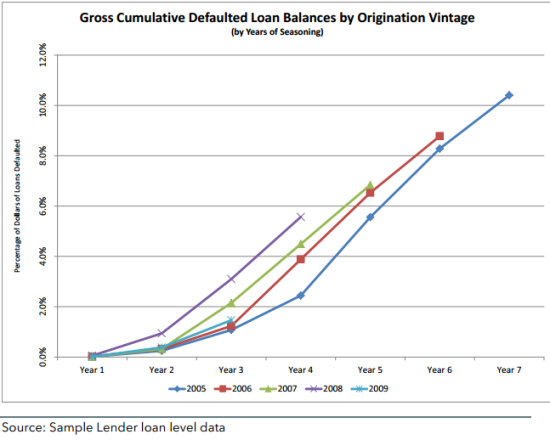
gross defaults

There is no guarantee of a good paying job in this market even with a college degree. The unemployment rate of those with private student loans is 16 percent (twice the nationwide headline figure). Of those with a bachelor degree the unemployment rate was 11 percent. As previously noted, more private student loan debt is going to for-profit institutions so this is likely to push the unemployment rate even higher than the headline unemployment rate. So you have to wonder how eager will these young graduates be to purchase that first home and take on more debt?

Homeownership rates have fallen significantly for those 34 and younger:

HomeownershipRateAge

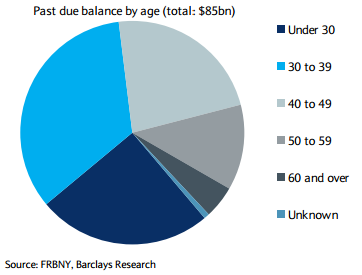
It is important to note most of the student debt problems are hitting the younger generation:

Past-due-balance-by-age

Over two-thirds of past due debt is hitting with those 39 and younger. A good amount is hitting the under 30 crowd. Remember those co-signed loans? There is little doubt why the housing recovery has been so tepid nationwide. In California, home prices are still out of sync in many locations but just think about a more realistic nationwide scenario. A young graduate comes out with $50,000 in student debt and the starter homes they are looking at cost $150,000. This is very typical. How easily can they shoulder that new debt amount? Are they even willing to take this new loan on? Virtually every other debt segment has pulled back since the recession hit outside of student debt. Home ownership rates for younger Americans have fallen dramatically in the last decade and this burden of "other" debt is becoming a big issue. It is also impacting baby boomers as kids boomerang back home. Another trillion dollar debt market with major issues. You don't need a Ph.D. to know this is a big problem.


Original Page: http://feedproxy.google.com/~r/zerohedge/feed/~3/fvSZ4lxEwro/mortgaging-your-way-college-education

26 July 2012

One does not simply End the Fed

When Jamie Dimon says that we have no need to worry, as JP Morgan lost
$2 billion yet will still run a profit. Banks can only grow when the
economy first grows. Banks are supposed to grow as they help the
economy grow. When banking profits grow and economic activity
contracts, we have a problem.

JP Morgan came through the last financial crisis unscathed and ahead.
I wonder if it has anything to do with Dimon's position with the
Federal Reserve? Conflict of interest? I think so!

Ah, the failure of Keynesianism.
It's starting to smell like fascism.

New Debt Target: 2 August 2012

The deadline for raising the US debt ceiling or risk a default remains August 2, the US Treasury said Friday, after speculation that there might be more leeway for politicians to carve a deal.

"The Treasury Department continues to project that the United States will exhaust its borrowing authority under the debt limit on August 2, 2011," the Treasury said in a statement.

This means that the US Treasury runs out of money on 2 August. We hit the new debt ceiling sooner each time than we did the last. No actual spending cuts occur, but the debt target gets set higher and higher. Spending cuts are now automated, since politicians can't stomach what needs to be done.
"Secretary (Timothy) Geithner urges Congress to avoid the catastrophic economic and market consequences of a default crisis by raising the statutory debt limit in a timely manner."


The US ran into the $14.29 trillion statutory legal limit on borrowing on May 16, but has since used spending and accounting adjustments, and higher-than-expected tax receipts, to continue operating without impact on government obligations.


But by August 2, the government will have to begin withholding payments -- to bond holders, to civil servants, retirees or government contractors -- if the ceiling is not raised by Congress.
If we are unable to service the national debt (or simply pay the interest, not even touching the principle), setting our lending limit higher only encourages more irresponsible actions by the state.
Some economists had estimated that higher tax receipts might add a week or two to the deadline.

Republicans are refusing to raise the ceiling unless the White House agrees to sharp spending cuts while forgoing any tax increases to begin closing the government's huge budget deficit.

Geithner has warned that defaulting on bond payments would have a devastating effect, ironically forcing up government costs.

Activist Post: US debt ceiling deadline still August 2: Treasury

25 July 2012

Bitch on a Donut Run

This goes out to Christopher Titus. Keep helping to wake up the sheeple. 


Let me start out by saying that Left and Right are both wrong. 

Now, on to the news. 
Another increasingly-rare, yet ever-increasingly-reported instance of violence against innocent fellow sheeple in a gun free zone led to the loss of twelve lives in Colorado last week. If anyone doubts that gun laws are effective, they only have to discount reality, heavily. Like buy-one-get-ten-free discounted. 


Does anyone believe that just because statistical data shows gun ownership is increasing, while violent crime is decreasing, could actually correlate? Does anyone believe making something illegal makes it go away, or that someone else enjoyed that something without hurting anyone else? Wow, crimes with no victims? Sounds like fascism in full swing...
There are always generally more laws, it's what keeps politicians in business. Despite increasing volumes of convoluted and unconstitutional laws impeding natural, human rights, somehow people are still violent against each other, on occasion. It's in the genes. 

We died before we were born and we waste the time we have been spared to live. No wonder so many collapsitarians believe we won't survive. 

The definition of a criminal is one who commits an act of crime. I thought it was a simple premise as well, I fear few can muster that level of cognitive disention. It's like winning by default; I'm still a loser. 


Fight for your fucking lives people. Lest it no longer be yours when you wish to exercise the free will upon which you allowed encroachment, albeit rather slowly. We the People hold the final power to nullify bad law and despotic regimes. ...then they came for me and there was no one left...

And if some evil fucktard zombie jumps out and starts doing harm to others? Get some live tactical experience. And take responsibility for the safety of you and those near you. Law enforcement is not responsible for public safety, they react to criminal breaches of the peace. And remember kids, when seconds and lives matter, police are only minutes away...

It's a hell of a lot better than being someone's BITCH ON A DONUT RUN.