Showing posts with label depression. Show all posts

22 December 2011

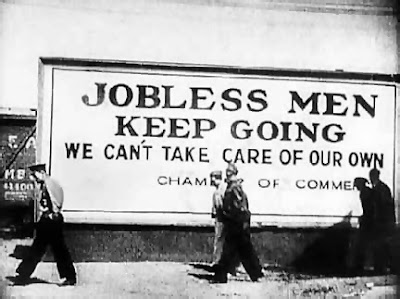
Decade from Hell will Get Worse in 2012

https://blogger.googleusercontent.com/img/b/R29vZ2xl/AVvXsEhLs-oWxQe9VNUTEr3WjPg9zQOeDJYPfLHCz-l0CCNmj8pKGknUCu9anI1vdDqwABAwbLYZAIQkcB7HJDynAaGBSWCfgSPz5U3b9C7-vIn4MS8QQMRVc3Z3QPypnLSwUdsI0UsCaOzaaw4/s1600/great_depression%2525202.jpg

    Fasten your seat belts: 2011 was far worse than expected. Our earlier predictions for America's Worst Decade just got worse.

    As financial historian Niall Ferguson writes in Newsweek: "Double-Dip Depression … We forget that the Great Depression was like a soccer match, there were two halves." The 1929 crash kicked off the first half. But what "made the depression truly 'great' …began with the European banking crisis of 1931." Sound familiar?

    Yes, huge warnings: But America's deaf. In denial. When we predicted the 2011-2020 "decade from hell" we didn't see the big macro events dead ahead: Arab Spring virus that's now Occupy Wall Street, promising to explode into an even more powerful force in 2012 … war on the middle class … widening inequality gap. … Washington gridlock … the Super Rich's blind resistance to all new taxes.

    As Ferguson puts it: "To understand what has been happening in our own borderline depression, you need to know this history. But hardly anyone does." Get it? America's already in a "borderline depression," and virtually nobody gets it. American leaders are dummies about history. Worse, nobody may be able to stop our depression from turning "great."

    Investors beware: Please, protect your assets: "Those who don't remember history are doomed to repeat it." We've already forgotten the lessons of the 2008 disaster. No wonder we're doomed to repeat the mistakes of the 1930's triggering the Second Great Depression. Soccer anyone?

Few seem capable of accepting that our situation is one on dire straits. 


03 October 2011

Is the Whole World Going Into a Recession at the Same Time?

As the third quarter comes to an end, strategists and investors are beginning to prep their clients and portfolios for the chance that the whole globe slides into a recession at the same time. The worse news is that with uncertainty in Europe, the U.S. and China as high as when the quarter began, they can’t find much to do about it.
 
Yes... and then some. The word "recession" is inadequate. -- MCR

Click here to read more at cnbc.com
Source

05 September 2011

California Employment at Record Low

The percentage of working-age Californians with jobs has fallen to a record low, and employment may not return to pre-recession levels until the second half of the decade, according to a research group.


Just 55.4 percent of working-age Californians, defined as those 16 or older, had a job in July, down from 56.2 percent a year earlier and the lowest level since 1976, the Sacramento- based California Budget Project said in a report released late yesterday.


California's 12 percent unemployment rate in July, the nation's second-highest after Nevada, compared with 9.1 percent nationwide. The most-populous state lost 1.4 million jobs during the recession that began three years ago, and has gained back only 226,800, or about 17 percent, according to the report.


Alissa Anderson, deputy director of the research group, which concentrates on issues facing low- and middle-class Californians, said women have disproportionately trailed men in regaining jobs.


"Women represent nearly half of the workforce," Anderson said in a telephone interview. "They gained just one of the 10 jobs added." more

http://thecomingcrisis.blogspot.com/2011/09/california-employment-at-record-low.html

US Postal Service Is Nearing Default as Losses Mount: Mail Service Could Stop by this Winter

Okay, I see a major issue with one branch of government with a narrow scope of interest (and even less authority) contemplates bailing out another.


The United States Postal Service has long lived on the financial edge, but it has never been as close to the precipice as it is today: the agency is so low on cash that it will not be able to make a $5.5 billion payment due this month and may have to shut down entirely this winter unless Congress takes emergency action to stabilize its finances.


"Our situation is extremely serious," the postmaster general, Patrick R. Donahoe, said in an interview. "If Congress doesn't act, we will default."


In recent weeks, Mr. Donahoe has been pushing a series of painful cost-cutting measures to erase the agency's deficit, which will reach $9.2 billion this fiscal year. They include eliminating Saturday mail delivery, closing up to 3,700 postal locations and laying off 120,000 workers — nearly one-fifth of the agency's work force — despite a no-layoffs clause in the unions' contracts.


The post office's problems stem from one hard reality: it is being squeezed on both revenue and costs.


As any computer user knows, the Internet revolution has led to people and businesses sending far less conventional mail. more


31 August 2011

14 Of The Biggest Mass Layoffs In 2011


http://si.wsj.net/public/resources/images/NA-BM486_Layoff_G_20110720211803.jpg

Need more evidence that the US economy is not in recovery mode, but slipping further into a recession, one that will likely lead to another great depression? Just look at the miserable job growth numbers, then factor in massive layoffs.
The looming standstill in the U.S. economy has intimidated private sectors into cutting operating costs by handing out pink slips -- thousands of them.

In July, the number of job cuts increased by 60.3% -- approximately 66,414 jobs -- compared to the previous month, according to a report from consultants Challenger, Gray & Christmas, Inc.

Many of the massive workforce downsizing came from sectors who endured fairly well in the past.

Gannett Co: 700
Sears: 700
Goldman Sachs: 1,000
Boston Scientific: 1,400
Delta: 2,000
Credit Suisse: 2,000
Research in Motion: 2,000
Barclays: 3,000
Pfizer: 5,530
Lockheed Martin: 6,500
Cisco: 6,500
Borders: 10,700
Merck & Co: 13,000
HSBC: 25,000

More

29 August 2011

What to Do in the Event of an Out of Control Money System

As fiat currency dies a slow death, and takes the efforts of the majority of the working class to the grave with it, we can take a step back and look at the reason for fiat currency's existence. Control.

http://derekmyoung.com/wp-content/uploads/2011/08/6a00d8341bfa1853ef010535d2dc55970b-800wi.jpg
Who is this man, Ben Bernanke, and what kind of shoulders does he have? Is he a great deep thinker…a renown philosopher in whom the world's people could have confidence? Is he a captain of industry…a man who has proven that he can lead men and run a profitable business? Is he an investment wizard, like Warren Buffett, with billions of dollars as testament to his understanding of the world of money? Is he even a powerful politician or an acclaimed statesmen, who can at least pretend to solve the world's problems by threats and force?
"It's either control or money," says our friend John Henry. John made a fortune out of a simple insight. If corporations would give up control of their legal problems, they could save themselves a lot of money. John takes on their legal challenges and handles them as commercial matters; he doesn't particularly care whether they win or lose the case, as long as the net cost is lower. He shares the savings.
"But a lot of companies don't really care about saving money. They don't want to give up control. Or, more precisely, their legal team doesn't want to give up control. So, they end up spending more money."

Control or money. That is the choice. An economy functions best with no one in control. Central planning doesn't work. A little bit of it is a drag. A lot is fatal.

But people don't like it when things are "out of control." And that's the problem with capitalism. It is always out of control. At least, it should be.

Yesterday we got word that housing went down in the last quarter — making 17 straight quarters of losses. Homeowners are down about $7 trillion…and still sinking. New building permits are down to a 15-year low. Sales have not been this low in a generation.

As for unemployment, the numbers are shifty. Most of the improvement in the unemployment rate comes from the feds' taking people who can't find jobs off the list of those looking for work. But layoffs are increasing…and it is now obvious that most of these jobs will NEVER come back.
As the control is lost, a real existence will fill it's void.

23 August 2011

Risk of Recession Masking Risk of Depression

http://modernsurvivalblog.com/wp-content/uploads/2010/07/great-depression.jpg 


With more than 2.5 million additional workers joining the unemployed, I'd says we never got out of the last recession, and are headed full-speed toward a depression more devastating than the Great one. 
FLORENCE, Alabama (Reuters) - The risk of a new U.S. recession has risen over the last couple of months, but an outright contraction will most likely be avoided, Atlanta Federal Reserve Bank President Dennis Lockhart said on Monday.

17 August 2011

An American Collapse in Russia's Shadow


Is an American collapse inevitable? Can we avoid a complete failure of the nation? Should we begin to localize our lives and let go of government reliance? Dmitry Orlov has insight into how to apply the survival of the people of Russia to a post-collapse America?
America is still in deep denial which is still the first stage of the Awakening. This denial will be wiped away when the dollar collapses. For now the economy is still functioning with food and fuel available. Americans still have the illusion of wealth and normalcy. They still are stuck in the false left right paradigm and think some other sock puppet will turn things around.
America is following in the footsteps of the Soviet rise and collapse.

When the dollar collapses, all American illusions will collapse with it. Deep denial will turn into deep anger. The violence I expect in the other 3 areas on the list and all urban areas in the US, will make all other global riots pale in comparison. America is deeply infused with arrogance, denial, narcissism, drugs and violence. There is no other society that I know of that has the degree of intensity and combination of these factors.

This American arrogance will be turned on to other Americans as the dollar collapses. We will no longer be able to maintain the global empire of force without a functioning currency. All of our troops will be forced to come home and we will no longer be able to import 25% of the world’s oil. This sudden shift will turn arrogant Americans on each other as they seek to enforce their inflated sense of self worth on to others. They will think that somehow the world somehow owes them something and they believe that lesser people should make that sacrifice for them. After all, the American way of life is not negotiable… at least that’s what Dick Cheney said.

The dollar collapse will end the ability of the average American to deny their active or passive participation in the dominance of the world by spreading debt and death. When people’s entire life’s savings are wiped away, they will wonder what their life has been all about. All of the missed times with their family and connections with others has been stained by the pursuit of material gains. Only when everything is taken from them, will they start to see the real importance of life. Many will not be able to come to terms with this coming reality. Those that are aware and prepared stand a great chance of making it through this paradigm shift and thrive. (Join the Sons of Liberty Academy.)

We are surrounded by violence and have been desensitized anti social behavior. Our movies and video games show the killing of others but rarely the consequences of those actions. Even other anti social behavior has been normalized. I even realized my favorite show of all time Seinfeld was all about normalizing anti social behavior. The series finale was based on a man getting mugged and all 4 main characters not only not helping the man, but actually making fun of the man as he is violently robbed. This lack of empathy is at the root of our problems. So here we now have a society that not only cares only about themselves and their materialistic needs, we also have a society that no longer cares about other’s feelings.

The American riots will be the worst the word has seen because of the amount of will be of arrogance, denial, narcissism, drugs and violence in our society. These factors are systemic and infect every level of society. I do fear that our nation is sick enough to unleash a series of false flag events to spread our violence even further. This violent Anger phase in the 5 Stages of the Awakening will not last long and not happen in every part of America. There will be a few months of violence that will shake the faith in mankind. Those that live by the sword, will die by the sword. After the most violent are either killed, brought to justice or burnt out, we will enter in a societal depression as we try to come to terms with what has happened. This period could last for years as we struggle with the loss of wealth and life.

I am hopeful that this collapse will actually be the beginning of something really great for mankind. A new paradigm not based on debt and death is a very real outcome of this collapse. With the collapse of the dollar, those that were lured into a senseless narcissistic consumer lifestyle will be forced to come to the understanding that instant gratification is not why we are put on this earth. Those that were ill prepared for the collapse will start to ask questions, then they will seek answers, then they will want blood. The Elite that created, perpetuated and profited off of this paradigm will be running for cover as the world wakes up to what they have done. It will be nice to have consumerism, militarism and narcissism flushed away. (Read Resonate IV)

This collapse will not result in a One World Order. The Elite that are trying desperately make this happen will no longer be able to operate in secrecy. Their minions will lack any legitimacy with the people they rule. After all who is going to trust a President who says he did not see this coming when you and I can see it coming from miles away. The result after a very violent Anger phase is going to be massive decentralization of power not more centralization of power. Local communities, cities counties and states will assert more power over the daily activities of our lives. Some will will slip into tyranny to make order out of chaos. Others will attract the best and brightest by embracing freedom and honest money. The end result is a life where we can reach our highest and best self. How we get there is a rough road, but one I feel is easily traveled if you are aware and prepared.
https://blogger.googleusercontent.com/img/b/R29vZ2xl/AVvXsEiDhk8r38I6dJR-yjcc9-HzrZFZyBJTe4ec_n0PVw9mBis_Sf0eB4LnlKIEsRoS8ueXLReIzCNzV9poYmh3WwPZun1GksN1wB-vFIldMCtoe0lJ2fF4js9-p7Y4oNK8LRMYGAx5hNqubpRW/s1600/Russia+and+America+%25281%2529.jpg

All this has happened before. All this will happen again

More

09 August 2011

Fed vows low rates for two more years

http://maxinewspress.com/wp-content/uploads/debt-ceiling.jpg

For a new recession to start, doesn't that mean that there would have To have been some sort of recovery first? The idea that the government is admitting that a second recession is a possibility only points to the fact that another Great Depression is much more likely. 


The Federal Reserve pledged Tuesday to hold interest rates near zero for two more years and said it was mulling the tools it has to boost a slowing economy. Meeting as worries grew of a new recession, the Fed's policy board said growth so far this year had been "considerably slower" than expected....

08 August 2011

The first post-downgrade business day

The yield on the 10-year note has dropped to 2.44%, down from 2.57% at Friday's close. I'm thinking this is telling us the economy's on the way into the toilet, as the standard reaction for a credit downgrade is rising interest rates, to cover the extra risk. The Dow's long slide, which began on 22 July–and continues with a 250 point loss so far today–is probably telling us the same thing, as earning expectations slide. Since the downgrade was one agency only, and the downgrade only to AA+, economic factors are clearly weighing more on the bonds than the downgrade.  On the other hand, if you're a gold investor, you're probably a little happier today, as Gold hit $1,715/oz.
The key takeaway so far today is the continuing decline in yields, which isn't good news. Thank goodness there's no economic releases today. I'd hate to see what more bad news would bring.
So, back into recession, it looks like.
One of the more interesting things I'm wondering about, in a horrified kind of way, is what effect the downgrade has on corporate paper.  A number of institutions have investment rules that require they concentrate their investments in AAA-rated securities.  But, one of the general rating rules is that subsidiary corporate and government instruments cannot have a higher rating than their sovereign instruments. So if the US Government doesn't have a AAA rating, no subsidiary US corporate or government paper should have a AAA rating either.
So, what does this mean for the handful of corporate and government instruments that were rated AAA prior to the downgrade? Do they get downgraded, too?  If so, where do the institutions with a AAA rating requirement go with their money?
I'm not at all sure how this works. As we've been saying a lot in the last week or so, we're in uncharted territory.


29 July 2011

Debt Ceiling's Impact is Overrated

http://cloud.frontpagemag.com/wp-content/uploads/2011/06/Raising-Debt-Ceiling2.jpg
The government's debt ceiling has been the focus of heated debate in Washington, as many economists, politicians, and pundits buy into the notion that the debt ceiling must be raised to avoid economic disaster. The reality is that many potential catastrophes have been threatening the U.S. for years now, as a consequence of our growing debt. Treating our unhealthy fiscal state with more debt may stave off withdrawal symptoms for a while, but the underlying addiction to spending remains, and grows worse by the day.
I only wish that the national (bought and paid for) media would focus on the default issue, rather than the angle of increasing our debt limit. What good is increasing, or even doubling, our debt limit when we are so close to defaulting on paying the minimum payments on the nation's credit card? We are borrowing from our children to make interest payments at this point, so I have little faith that our "representatives" with stop playing games long enough to present a practical solution that includes massive spending cuts, which are what the country needs to control it's debt, as well as drastically reducing taxes to restart the failing economy. Wow. It really appears simple when you take a step back to look at the situation from a realistic perspective. 
Despite the fact that a debt ceiling increase only provides temporary, superficial respite, many of those who favor such a move give too much weight to the impact of the debt ceiling. In a recent op-ed in the Washington Post, Virginia Senator Mark Warner argues, "Failing to raise the debt ceiling will increase interest rates, gut consumer confidence, and drag down business investment and job creation." The notion that changing an artificial construct like the debt ceiling will have such a massive impact on real economic conditions comes from viewing the economy in the abstract. Rather, the economy is comprised of people who engage in millions of exchanges every day. Because the economy is not an abstraction but is very real, it is unlikely that an arbitrary debt limit would dramatically affect real economic conditions. Some parts of the doomsday scenario posed by officials like Senator Warner, Treasury Secretary Tim Geithner, and the president may well come to pass: rising interest rates, consumer confidence falling, job creation declining. However, it is not likely to be the sole result of a failure to raise the debt ceiling, as we already see many of these symptoms occurring.


http://ladylibertytoday.files.wordpress.com/2011/04/debt_ceiling-19034935.jpg


28 July 2011

Michael Nairne: There is a pattern to all this drama

Just like "global warming," financial cycles that lead to a significant crash need to be put into perspective to truly understand their impact and causes. 


Jobless men swarm boxcars for the "On to Ottawa" protest shortly after the stock market crash of 1929 and the beginning of the Great Depression. Economic downturns are cyclical, so investors must be patient to wait for things to recover.
Photograph by: Archive, Archive


It takes a brave soul to read a newspaper today with a steady hand. The world seems to lurch from crisis to crisis. One day it's the possibility of a financial contagion sweeping through Europe. The next, it's the spectacle of political gridlock in the United States that could lead to a debt default. Story after story recounts languishing growth in most of the developed world along with sputtering employment gains.


This torrent of bad news should be no surprise. Leading economists Carmen Reinhart and Ken Rogoff foretold the state of the developed world's economies back in 2008. Their sweeping research into the financial crises of the past few centuries found that, instead of being an extraordinary occurrence, crises are a recurring event.


They also follow a pattern. The stage is set by a debt cycle when borrowing, often real estate-related, skyrockets. The onset of the crisis is marked by collapsing asset values as real estate prices plunge and bankruptcies soar. As asset writedowns proliferate, a banking crisis ensues. Lending and liquidity dry up, investment and consumption collapse, and a deep recession ensues.


27 July 2011

Do Americans care about the debt ceiling?

I doubt it. 

I also doubt most Americans even understand it, let alone care. Let someone else fix it. Why should I care? It's not my job.


http://www.uncoverage.net/wp-content/uploads/2011/07/AFB-Debt-default-speech.jpg


Politicians and financial experts warn of economic collapse if there's no deal to raise the ceiling by next week. The vast majority of Americans don't share that concern, according to a survey.
As congressional leaders continue to duel ahead of the Aug. 2 deadline for raising the U.S. debt ceiling without signs of a deal, a large contingent of respondents to a recent MSN Money poll make clear what they think of the matter: They're sick of hearing about the whole thing.
From July 19-22, just more than 9,100 readers voted in the informal online poll, which asked, "Are you concerned about the debt ceiling?"
Forty-three percent answered that they were sick of hearing about it, while 39% reported feeling a little concern. Only 15% said they were concerned enough that the issue keeps them up at night, and a small minority, 3%, said they didn't know anything about the issue....
Most people are more concerned about who is on Dancing with the Stars this week, or whatever distraction they can find so they don't have tho think about the dark reality looming on the horizon.


19 July 2011

What's the Next Chapter in the Economic Saga?


The past several years in the economy and investment markets have been extraordinary. We have had the deepest recession since the Great Depression of the 1930s. Banks, brokerage firms and AIG went bust, or almost failed before the great bailout. The venerable firm of Lehman Bros. actually failed, while others were merged and/or propped up by massive politician-backed infusions of cash. The predictions were dire, and the politicians flinched and bailed out the financial industry, not to mention General Motors and Chrysler.

The Federal Reserve moved to make money widely available at a nearly 0 percent interest rate. When that was not enough, they bought hundreds of billions of dollars of Treasury debt as the federal government ballooned its expenditures in the face of falling tax receipts. The sharp expansion of credit fired up the stock and commodity markets, but it did little to spur everyday economic activity
Now we are debating the debt ceiling at the federal level. State and local governments are raising taxes, cutting expenditures and employees. Even venerable Penn State is feeling the cutbacks. In the private sector, new hiring is agonizingly slow.
We are in a worse economical position today than in the late 20's through the early 30's. The news media won't hardly report on the existence of a recession, but we are closer to a major depression.

We have a presidential election coming up in 15 months. Historically, the party in power pulls out all the stops to make the markets and the economy look great just in time for voters to make their selections. Ours is not a perfect system. Yet what stops are left to pull out to make the economy improve in the next 15 months? Indeed, what is next?

The financial world may read like a Russian novel (that is, long-suffering), but we hope to avoid it becoming a Greek tragedy.

More: http://www.statecollege.com/news/columns/whats-the-next-chapter-in-the-economic-saga-809506/

18 July 2011

What would it be like if the United States goes into default?

In case you haven't kept up with the latest news, there's been a lot of talk about such a possibility these last few weeks.
It's almost as if they are testing the waters, seeing the people's reaction, but most of all making sure they are completely terrified of such a possibility so as to make sure the mass goes along with them in their decision.
Investors protect against U.S. default
Why Wall Street doesn't seem worried about default
Bernanke: U.S. default would cause 'major crisis'


What would it be like if US Defaults?


For one second lets suppose the mad debt race is halted in August 02. What really happens?
From our own experience we know that defaulting on your countries debt is indeed catastrophic as Wall Street and the politicians that work for them predict. What happens is that the US would fall into the feared 3rd world economy status Americans never want to experience. Worst of all, credibility is lost in a way people just don't comprehend. When that sort of trust shatters, it's like trying to put together a crystal cup: You can glue it back together but it will never be the same, the illusion is lost. Make no mistake, defaulting would cause poverty and a significant decrease in the American lifestyle for decades to come.


But on the other hand you can't avoid asking yourself, why do the creators of the greatest economic crisis known to man kind want to continue rising the debt level? What's in it for them? Well my dear friends, it's the mechanism they have been using to grow rich beyond their wildest dreams and doing so on by sending that debt to the American's middle class through inflation and higher taxes, while the bailout money goes straight into their pockets.


You may think billionaires are done for,t hey don't care about money, and you'd be wrong. Few billionaires retire and spend the rest of their lives with their families in some far away beach paradise. The nature that made them rich in the first place makes them keep going for more and more money in spite of not needing it.


Continue doing what has caused the economic crisis in the first place could hardly be called a solution. Would you fix your own debt situation by getting yet another credit card to burn and go further into debt? Of course not, we all know the hard choice that must be made. Cut down your expenses, save money and get out of debt. We all know thats the solution on an individual case and it's the same thing here.


If America puts an end to its ever growing debt not everything would be bad.
First of all, on an elemental level it would stop the vicious debt cycle, both on an economic and political level. The greedy criminals that have caused this would have to find other ways of getting richer. The political cost would likely end the current administration in the next elections. That is if social unrest can be controlled and they don't take the easy way out by resigning, forcing anticipated elections like it happened here.


Second, a cheaper dollar would mean that America is at another level compared to foreign economies. A more competitive dollar would mean that "Made in USA" is viable on a broader spectrum, small and medium companies could be started and strive.
The horizon looks bad either way. The decisions to be made aren't easy and none offers a good, let alone ideal solution, but you still have to ask yourself if going further into debt is the right choice.
I never knew anyone that got out of a hole by digging down even more or stopped a fire by throwing gasoline at it.

06 July 2011

Will Fiscal Austerity Lead to a Depression?

In the video at the end of this post I speak to RT Television about fiscal austerity in the UK and the likelihood of fiscal austerity in the US.

A few thoughts here:

Barack Obama says:

Government has to start living within its means, just like families do. We have to cut the spending we can't afford so we can put the economy on sounder footing, and give our businesses the confidence they need to grow and create jobs.

Wrong on every single count. This is why the US is probably headed for a repeat of 1938. The President knows better, but he's saying this stuff anyway. If you have the President spouting this nonsense, you know the Republicans will use it to force cuts that will weaken the economy.


More Here..


19 May 2011

Keynes and Hayek - The Boom and the Bust

Here are a couple of tasty treats explaining economics in a more palatable manner. John Maynard Keynes was a British economist who worked toward minimizing the negative impacts of recessions and depressions. Friedrich August von Hayek was an economist who thought that markets should be free, rather than to sustain the state. Hayek felt that application of Keynes's policies would give too much power to the state and would lead to socialism. Gee, ya think?