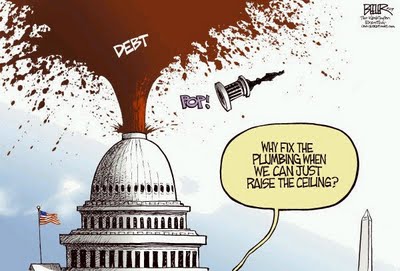
Showing posts with label Debt Target. Show all posts

30 January 2012

Arlo Sings Bailouts

The 2008 version is sung here by Arlo and here by Paxton. Besides the name of the company, they had to make a few other changes in the lyrics, like "When they hand a trillion grand out, I'll be standing with my hand out."
But that was October 2008. By the end of December, I was noting that it was a Merry Christmas for GMAC, which learned on Christmas Eve that the Federal Reserve had approved its application to become a bank holding company. That gave GMAC "access to new sources of funding, including a potential infusion of taxpayer dollars from the Treasury Department and loans from the Fed itself," as the Washington Post explained. GMAC wasn't the only company that suddenly became a "bank holding company" in order to cash in on the $700 billion financial bailout. Late one night in November, American Express was granted the same privilege, along with Morgan Stanley, Goldman Sachs, and CIT. Which was why I suggested then that Tom and Arlo needed a new version: "I'm Changing My Name to Bank Holding Company."


Original Page: http://www.cato-at-liberty.org/arlo-sings-bailouts/#utm_source=feedburner&utm_medium=feed&utm_campaign=Feed%3A+Cato-at-liberty+%28Cato+at+Liberty%29

07 January 2012

US Debt Nearly Surpassing Economy

The soaring national debt has reached a symbolic tipping point: It's now as big as the entire U.S. economy.

The amount of money the federal government owes to its creditors, combined with IOUs to government retirement and other programs, now tops $15.23 trillion.
Those creditors include the US taxpayers and those collecting retirement, social security and other entitlements.
That's roughly equal to the value of all goods and services the U.S. economy produces in one year: $15.17 trillion as of September, the latest estimate. Private projections show the economy likely grew to about $15.3 trillion by December — a level the debt is likely to surpass this month.
"The 100% mark means that your entire debt is as big as everything you're producing in your country," says Steve Bell of the Bipartisan Policy Center, which has proposed cutting nearly $6 trillion in red ink over 10 years. "Clearly, that can't continue."
That's a very Libertarian direction, well worth considering, since nations that apply Austrian economics tend to maintain economic stability, something we fail to do in the US.
Long-term projections suggest the debt will continue to grow faster than the economy, which would have to expand by at least 6% a year to keep pace.

President Obama's 2012 budget shows the debt soaring past $26 trillion a decade from now. Last summer's deficit reduction deal could reduce that to $24 trillion.
Gee, who else saw this coming during last year's debt ceiling debates?
Many economists, such as the Brookings Institution's William Gale, say a better measure of the nation's debt is how much the government owes creditors, not counting $4.7 trillion owed to future Social Security recipients and other government beneficiaries. By that measure, the debt is roughly a third less: $10.5 trillion, or nearly 70% the size of the economy.

That is still high by historic standards. The total national debt topped the size of the economy for three years during and after World War II. It dropped to 32.5% of the economy by 1981, then began a steady climb under President Reagan, doubling over the next 12 years. The combination of recession and stimulus spending caused it to soar again under Obama.
During WWI, the economy didn't collapse to this point because government spending was at a significantly lower level, and individual liberty was much higher. Also consider that there was no income tax during that time. As government increases it's scope and appetite, taxation increases.
Among advanced economies, only Greece, Iceland, Ireland, Italy, Japan and Portugal have debts larger than their economies. Greece, Ireland, Portugal and Italy are at the root of the European debt crisis. The first three needed bailouts from European central banks; Italy's books are monitored by the International Monetary Fund.

The White House and Congress agreed in August to cut about $1 trillion from federal agencies over 10 years. An additional $1.2 trillion in automatic spending cuts looms beginning next year if lawmakers can't agree on a better way to do it.

Economist Mark Zandi of Moody's Analytics says reaching the 100% mark shows "the grave need to address our long-term fiscal problems."

US Debt Is Now Equal to Economy

Trillions of dollars are difficult for many to wrap their heads around. To put it into perspective, just hack off the extra zeroes;

Income; $15,170
Debt; $15,230

Now think of it as household income and debt. What are the chances that our nation can get out from under that debt without cutting unnecessary spending, like military and entitlements? Would a household be able to sustain that level of debt indefinitely? Can we realistically believe our nation can?

I don't expect to see any significant growth in our economy as long as the bloated government siphons off an ever-increasing amount...

28 December 2011

Obama to Ask for Debt Target Hike

WASHINGTON (Reuters) - The White House plans to ask Congress by the end of the week for an increase in the government's debt ceiling target to allow the United States to pay its bills on time, according to a senior Treasury Department official on Tuesday.
The approval is expected to go through without a challenge, given that Congress is in recess until later in January and the request is in line with an agreement to keep the U.S. government funded into 2013.
The debt is projected to fall within $100 billion of the current cap by December 30, when the United States has $82 billion in interest on its debt and payments such as Social Security coming due. President Barack Obama is expected to ask for authority to increase the borrowing limit by $1.2 trillion, part of the spending authority that was negotiated between Congress and the White House this summer.
Under the agreement struck in August during the showdown over the government's debt limit, the cap is automatically raised unless Congress votes to block the debt-ceiling extension. Lawmakers have 15 days within receiving the request to vote, which is largely symbolic because the president can veto it and Congress would be unlikely to muster the two-thirds majority to override it. Moreover, the U.S. House of Representatives also is in recess until January 17.
The deal called for raising the debt ceiling by $2.1 trillion to serve the nation's borrowing needs into 2013 and also included mandatory cuts to the federal budget deficit. Since then, the extension has been increased twice by a total of $900 billion.


And we wonder why the national debt is so high. Scary to think of that kind of money being tossed around and I have a hard time paying the federal taxes as they already are. When we keep raising these limits, we have to pay it back sometime, and it's your federal tax dollars and mine that will be paying this debt. It means our federal taxes are going to increase even more. I already know they are going up. Let's quit with borrowing more and do with what we have. There is so much waste that could be cut away within the federal government itself WITHOUT cutting social programs!
Unfortunately, with the voting record of most politicians, I imagine they will give Obama more than 1.2 trillion. We the People must end the madness within our government by throwing out most of the scummy politicians in D.C. and State capitols. Ron Paul will cut one trillion dollars, end five federal departments, and bring sanity back to this nation.
http://news.yahoo.com/obama-ask-debt-limit-hike-treasury-official-152416457.html

Don't forget that our currency is inflating and devaluating in the meantime...

13 September 2011

Economic Collapse: Bank Runs, China, Peter Schiff, Gerald Celente, Max Keiser

As national debt increases and economy produces less, we came closer to an economic collapse.


The US dollar is not going to be the world reserve currency any longer. Foreign countries and lenders want US funds in other currencies now. They don't want any more US dollars. That should give everyone something to think about. Fiat currency in the US is crashing.

$13 trillion national debt probably equates to more like $30 trillion in bad debts. Debt-to-equity is much greater than the simple national debt number. More recently, our debt was increased as government spending ramped up to give a false feeling of security.

Banks are crashing around the country, but all of the big banks are going to crash hard soon enough. Looking back, stories like these were spot-on and give us a good perspective looking forward. Bank of America is on the verge, looking to kill 40,000 jobs. This is too regular of an occurrence, but is definitely a sign of the times.

The world is going to break down as nations decouple from each other to buffer the collapses of other nations.

08 September 2011

The Coming Chaos

America is about to be destroyed by debt. And we're acting like it's business as usual.
In the push to resolve America's impending debt crisis, much has been done to ensure politically favorable positions for those engaged in the debt talks, and the possibility of a default has been addressed in largely academic terms, with complete disregard for the gruesome realities a default implies. Our leaders are living in a fantasy world, indulging in partisan gamesmanship, concerned only about their reelections. The time has come for our leaders to be Americans first, and do what needs to be done to save us from collapse.


America lives on borrowed time because its politicians are more concerned about reelection than saving the nation that guarantees their public offices. There was a time when the safety of America wasn't a Republican or Democrat "viewpoint," but a transcendent value that united all blessed to live in this land, no matter the race, religion, or political point of view. But there is still hope. We are brothers and sisters, part of the same legacy of freedom. Do we really want it to end this way? One thing is certain: default must be stopped at all costs. The time for political posturing is past. Let's be Americans.

05 September 2011

We Have Merely Made the Fuse On Our National Debt Bomb One Inch Longer


China, sitting on the world’s biggest foreign exchange reserves of around $3.20 trillion as of the end of June, is the largest holder of US Treasuries. — Photo by AP

BEIJING: China warned Wednesday that tortured efforts to raise the US debt ceiling had failed to defuse Washington’s “debt bomb”, and that it would further diversify its currency holdings away from the dollar.

US President Barack Obama finally signed an emergency austerity bill on Tuesday that averted what would have been a catastrophic debt default for the world’s biggest economy.

But a failure to rein in US borrowing could “jeopardise the well-being of hundreds of millions of families within and beyond the US borders”, the official Xinhua news agency said in a blistering commentary on the deal.

“The months-long tug of war between Democrats and Republicans…failed to defuse Washington’s debt bomb for good, only delaying an immediate detonation by making the fuse an inch longer,” the commentary said.

“Meanwhile, the madcap farce of brinkmanship has disclosed yet another ticking bomb in the heartland of the sole superpower in the world — the crippling tendency to politicise the economics while trivialising the politics.”

China, sitting on the world’s biggest foreign exchange reserves of around $3.20 trillion as of the end of June, is the largest holder of US Treasuries.


More

11 August 2011

Obama's Degrade led to the Credit Downgrade

Undermining our Legacy of Liberty

"No pecuniary consideration is more urgent, than the regular redemption and discharge of the public debt: on none can delay be more injurious, or an economy of time more valuable. ... Cherish public credit. One method of preserving it is to use it as sparingly as possible: avoiding occasions of expence [and] avoiding likewise the accumulation of debt ... not ungenerously throwing upon posterity the burthen which we ourselves ought to bear." --George Washington, December 3, 1793

Despite all the political rhetoric about the historic downgrade of our nation's credit rating last week, that devaluation was a mere shadow of the colossal degradation Barack Hussein Obama and his socialist cadres have inflicted upon our country since 20 January 2009. Of much greater significance than our nation's credit, our nation's credibility as a constitutional republic has suffered relentless and ruthless offense.
Obama is succeeding in his endeavor to break the back of free enterprise, a keystone of Essential Liberty, by implementing failed "New Deal" policies and rejecting sound free market principles. His endeavor to lay the groundwork for the transformation to "Democratic Socialism" has been so successful that the debate about the future of American Liberty now includes the once-radical question of whether it will be restored by way of the "ballot or bullet box."
To understand Obama's degradation of our national credibility in an economic context, consider that the U.S. credit rating is, in effect, a barometer of the world's confidence in our national leadership and the direction of the U.S. economy. Thus, its downgrade is a dire indication of worldview regarding the systemic economic risk of the debt bomb Obama has dropped on our nation.
 More

09 August 2011

Fed vows low rates for two more years

http://maxinewspress.com/wp-content/uploads/debt-ceiling.jpg

For a new recession to start, doesn't that mean that there would have To have been some sort of recovery first? The idea that the government is admitting that a second recession is a possibility only points to the fact that another Great Depression is much more likely. 


The Federal Reserve pledged Tuesday to hold interest rates near zero for two more years and said it was mulling the tools it has to boost a slowing economy. Meeting as worries grew of a new recession, the Fed's policy board said growth so far this year had been "considerably slower" than expected....

08 August 2011

Back to Big Government-Spending as Usual

http://www.indiacause.com/blog/wp-content/uploads/2010/12/USA_we_are_broke.png

When our country is on a downhill slide toward financial collapse, rather than freeze spending and focus on our country's real needs, our false representatives in big .gov are pushing ahead and looking for ways to increase their control and spend us into oblivion. They are no more concerned with job growth than they are with our debt crisis. Another downgrade may come, but not before our situation gets much worse. The only solution is to insulate yourself from the government, because it's going to hit hard when the bottom comes up to meet it.


The American Age of Austerity lasted approximately three minutes, give or take a nanosecond. Immediately after the Senate approved the bipartisan "Budget Control Act of 2011" on Tuesday afternoon, President Obama hustled over to the Rose Garden -- to crow about the renewed opportunity to make "key investments."

Yes, the pitched battle to force government to live within its means has preserved the failed stimulator-in-chief's ability to keep spending like there's no tomorrow. As the curtains closed on D.C.'s debt-ceiling theater, Obama wasted no time putting his new "investment" priorities on the table: higher taxes, more funding for endless unemployment benefits and a "national infrastructure bank."


Balancing the Budget, Holding Us Hostage

 https://blogger.googleusercontent.com/img/b/R29vZ2xl/AVvXsEjk23nWEDAYu-gYbmfFIRV4kHveSO_7vL0uU5DNwKhN4HQvSkfXB1AjiFjOqqr3GgSRs2hJf6YDg8-ZxHwdfH2B287p1IdrGVgHNbRYtUVKaOB7iFnQb5ovoaXjQ9k4TMXzdSPd8sn4a9M/s1600/debt-ceiling.jpg
The political class predicted "disaster" if Congress didn't raise its debt limit.

I think that was a scam to get more money. See, the poor politicians don't have enough, and they need to borrow more. We taxpayers are cheap. This year we'll give them only $2.2 trillion. They want to spend $3.8 trillion.

The president said if he didn't get more money, Social Security checks wouldn't go out. Why not?

Where Are These Government-Slashing Republicans I Keep Hearing About?

Two heads of the same monster that continues to devour the People and growing ever greater in size and power. Someone needs to slay that monster, but a champion is hard to find these days. 
Two weeks ago, The New York Times reported that Republicans "want a vastly smaller government." Last week, the Times called the dispute about raising the federal debt ceiling "an epic clash over the parties' divergent views on the size and role of the federal government." This week, it said President Obama faces "a conservative movement seeking a wholesale redefinition of the proper role of government."

The recent debt deal, widely portrayed as a victory for Republicans, suggests their goals are decidedly less ambitious. As always in Washington, the "epic clash" perceived by the Times is in fact a squabble between two parties that both favor big government.

07 August 2011

Debt issuers brace for impact from downgrade

NEW YORK (Reuters) - A downgrade of United States' top-tier credit rating has Wall Street scrambling to figure out the knock-on effects for the financial system, from mortgages to banks to markets that rely on U.S. Treasuries for collateral.


05 August 2011

Increased Debt Ceiling Fails to Abate Continued Decline, Eventual Collapse

The latest Patriot Post Digest reports:
Congress passed and the president signed the increase in the debt ceiling Tuesday, and that, as Leftmedia outlets rejoiced, ended the "crisis" just hours before the default deadline. On the other hand, the Left is grousing that the Tea Party got everything it wanted. But did the deal really end the crisis? Hardly. World markets plummeted in its wake -- the Dow fell 512 points Thursday, erasing all gains from 2011, evoking this response from the White House: "Markets go up and down." Furthermore, credit rating agencies continued to warn of a looming downgrade of the nation's AAA rating. And did the Tea Party come out with everything it wanted? Not a chance. On the contrary, the ship is still sinking. The Tea Party and the markets know that, despite all the back-patting in Washington.
Those responsible for our continued (and hastened) financial decline are still slinging muck at each other instead of working on practical solutions. Our debt, rather than our economy, has been given a significant increase, having a massive negative result on the Dow. Has anyone else's 401k taken another dive yet?
The $2.4 trillion debt ceiling increase is the biggest ever. In fact, total U.S. debt didn't reach $2.4 trillion until 1987. Immediately on Tuesday, the Treasury borrowed another $239 billion -- the largest one-day debt binge in history -- bringing total federal debt to $14.532 trillion, or just over 100 percent of our gross domestic product. Debt has not exceeded GDP since 1947 -- immediately after World War II -- and 30 years ago it was just 32.5 percent of GDP. Could there be a connection between the market collapse and this debt "milestone"?

Democrats foisted upon the nation the biggest Keynesian spending bonanza in history, and the result has been almost no GDP growth, headline unemployment exceeding 9 percent (despite 117,000 new jobs in July), decreased consumer spending, inflation, debt as far as our great-grandchildren can see and a possible national credit rating downgrade.

On Aug. 3, 2010, Treasury Secretary Timothy F. Geithner penned an op-ed for The New York Times titled "Welcome to the Recovery." That rings awfully hollow now. In fact, many think that we're headed for a double-dip recession.
Welcome to the beginning of the end is more appropriate.
As for debt "deal" specifics, the House passed the increase 269-161, despite opposition from many Democrats and Tea Party Republicans. The Senate followed suit 74-26. Congress then quickly left for August recess. Barack Obama also signed the increase Tuesday saying the deal was "an important first step for ensuring that, as a nation, we live within our means." He even said it with a straight face.

On the contrary, "living within our means" doesn't actually seem to be part of the plan. The debt ceiling was immediately increased by $400 billion. By the end of September, another $500 billion increase is subject to a congressional vote of "disapproval," and Obama can veto that measure. After that, a "blue ribbon" joint committee of Congress (six members from each chamber, divided equally between Democrats and Republicans) will meet to recommend another $1.5 trillion in deficit reduction by Nov. 23, which Congress must take up by Dec. 23, in exchange for that much more in debt. If the committee or Congress fails, which is possible, if not probable, the debt ceiling will increase by $1.2 trillion anyway, with across-the-board cuts -- including to ObamaCare -- equal to that amount kicking in automatically.

Adding insult to injury, every spending cut is over 10 years, while every debt increase is immediate. So even with the deal, the forecast for the next decade is still trillions more in debt. As Sen. Tom Coburn (R-OK), who voted against the bill, put it, "It eliminates no program, consolidates no duplicative programs, cuts no tax earmarks and reforms no entitlement program. The specter of default or a credit downgrade will still hang over our economy after this deal becomes law." Is that what the Tea Party wanted?


"The White House doesn't create jobs." --White House Press Secretary Jay Carney

This Keen-Sense-of-the-Obvious moment is quite a change from all the administration's claims of millions of jobs "saved or created" via the "stimulus."
Obama takes credit when the administration helps to spur the economy, but fails to accept responsibility when it's actions do more damage than good when we can't afford to have any more massive mistakes in government action.

In perhaps the only heart-warming aspect of the debt-ceiling debacle, Rep. Gabrielle Giffords (D-AZ) returned to Congress to cast her vote for the first time since being shot in the head in Tucson in January. Her recovery has been incredible, and we wish her well.

Her return, however, provided a striking picture of the hypocrisy of the Left. When she was shot, leftists couldn't say enough to blame so called "right-wing hate speech" for the shooting. Now, it's leftists who are employing "destroy," "hostage," "terrorist" and even "gun-to-the-head" metaphors to describe the Republican approach to the debt ceiling.

House Minority Leader Nancy Pelosi (D-CA) said that, for Republicans, "It isn't about reducing the deficit, it is about destroying the public space. It is about destroying ... federal involvement in education. It's about clean air, clean water, food safety, public safety. You name it, they're there to diminish it. Destroy it." (New Democrat bumper sticker: "Republicans Hate Clean Water -- Vote Democrat".)

Giffords, we should mention, voted "yes" on the debt increase.
I guess being shot in the head didn't give her a new found sense of perspective.


More

03 August 2011

Patriot Post Chronicle on the Deceptive and Dastardly Debt Deal Debacle

http://image.patriotpost.us/2011-08-03-chronicle.jpg

"After months of talk about the nation's runaway debt, lawmakers managed to agree on a plan that, at most, will cut spending by a mere 5%. Is it any wonder federal spending is out of control? ... According to IBD's analysis of available budget numbers, the deal's $2.4 trillion in 10-year cuts amounts to a mere 5% trim off total projected federal spending during that time. It's like a 400-pound man boasting that he plans to drop 20 pounds over a decade, while his doctors warn about the risks of losing weight so fast. Even calling these 'cuts' is a bit of a stretch, since spending will continue to increase, just at a slightly slower pace. ... By 2021, federal spending would still equal 22% of the nation's economy, above the post-World War II average of 20%. Not really a cut, is it? Plus, in the short term, these 'deep,' 'sharp,' 'slashing' cuts would still leave the federal government spending roughly 4% more in 2012 than it did in 2010, and 20% more than it did in 2008. Shorn of all the hyperbole, what this agreement really demonstrates is why it's so hard to get federal spending under control. Both sides routinely use budget gimmicks to exaggerate spending cuts, while armies of special interests swarm Washington to make sure their pet programs don't get touched. All the while, spending marches upward. And reporters too dumb, lazy or biased to understand how budgets work keep falling for this nonsense." --Investor's Business Daily


He should take his own advice: "[This debt-ceiling deal is] an important first step for ensuring that as a nation we live within our means. ... [But the economy] didn't need Washington to come along with a manufactured crisis. It's pretty likely that the uncertainty surrounding the raising of the debt ceiling -- for both businesses and consumers -- has been unsettling, and just one more impediment to the full recovery that we need. And it was something that we could have avoided entirely. Voters may have chosen divided government, but they sure didn't vote for dysfunctional government." --Barack Obama

Pity party: "If I were a Republican, I would be dancing in the streets. I don't have any idea what the Republicans wanted that they didn't get." --Rep. Emanuel Cleaver (D-MO)
Government is great: "[Some] of us ... believe that government has a role for positive achievement in society along with the private sector doing things only government can do. ... I don't like this deal. But I think it would have been worse. ... Tax cuts are fun, but I never saw a tax cut put out a fire. I never saw a tax cut make a bridge. We need to have to make the case for positive government." --Rep. Barney Frank (D-MA)

Hating the Tea Party: "[A]s result of the Tea Party direction of this Congress these last few months has been very, very disconcerting and very unfair to the American people." --Senate Majority Leader Harry Reid (D-NV)

"The Tea Party acted like terrorists in threatening to blow up the economy." --Rep. Mike Doyle (D-PA)

"They have acted like terrorists." --Joe Biden, repeating and approving the line
Gun grabbers: "The easy availability of high-capacity ammo magazines in the U.S. has once again helped enable a large-scale massacre. ... This is another tragic example of our lack of common-sense gun laws failing us with deadly consequences, allowing a cold-blooded killer to easily acquire the tools of mass murder even from another country. How many more innocent people need to die before we realize that some simple, common-sense gun safety laws in the United States could actually save lives?" --Rep. Carolyn McCarthy (D-NY) on the Norway massacre, while her pals call conservatives "terrorists"


"They used to say that Richard Nixon had a 'secret plan' in the 1968 presidential campaign to end the Vietnam War. President Barack Obama outdid Nixon with a secret plan to control the deficit. He kept telling us of all the virtues of his plan. It was balanced, responsible, courageous and fair. It was just very, very secret." --columnist Rich Lowry

"President Obama admitted in a Kansas City radio interview the next election will be a referendum on him and his presidency. The White House quickly clarified his statement. What the president meant to say is that Bush has screwed up left field so badly that nobody can play it." --comedian Argus Hamilton

"Someone said President Obama was wrong for telling the American people to call their representatives about the debt ceiling. If there's one thing that congressmen hate, it's being told what to do by the people that put them there." --comedian Jay Leno

More: http://patriotpost.us/edition/2011/08/03/chronicle/

31 July 2011

Gold & Silver Beyond the Limit by Peter Schiff


http://thebubbaeffect.files.wordpress.com/2011/07/nosebleed_debt.jpg
Perhaps the debt ceiling should be renamed the "national debt target," for it seems Washington is always trying to reach it. One could say it's their only reliable, time-tested achievement. And without fail, upon reaching their national debt target, they promptly extend it further in order to discover how quickly it can once again be attained!

While I have little doubt that the ceiling will be raised, my readers have been curious as to the implications for gold in each of the debt and "default" scenarios possible after August 2nd. This month, I'll outline how each outcome could affect the price of gold and silver.

If the debt ceiling is raised in order to avert imminent default, but the spare time is used to truly bring the federal budget into balance, the US economy might still be saved. But when I say "balanced," I mean it. This would mean not only eliminating the entire $1.5 trillion deficit, but also leaving enough of a surplus to cover all outstanding debt and unfunded liabilities. For perspective, Senator Rand Paul's proposal to but $500 billion a year, widely considered more radical than landing a man on Mars, would only address 1/3 of the annual deficit – it would take cuts many times that for the US to return to solvency.

This is the scenario that President Obama and Secretary Geithner are threatening. They claim that if the debt ceiling is not raised, they will have to immediately begin defaulting on Treasury interest payments. This is rather unlikely, as interest payments make up only 10% of spending, but let's say they stop paying anyway.
If they do this, market interest rates for US debt would skyrocket, meaning the only buyer left at rates the Treasury could afford would be the Fed. In other words, if they default on August 2nd, QE3 will start on August 3rd. Of course, a default would be absolutely devastating to the dollar and a boon for gold and silver. Global confidence in the invincibility of the United States would be shattered, and the underlying problem of excessive spending would still remain to be addressed.

Another interesting scenario would be if Congress didn't raise the debt ceiling and the Treasury just kept borrowing anyway. It's not like the Executive Branch follows laws scrupulously nowadays. What if they just ignored it? Someone could challenge the act in federal courts, but the odds are often in the President's favor. In this case, gold and silver might experience less of an initial spike, but their long-term prospects would be elevated as the world recognized that we were one step closer to becoming a banana republic.

The plans on the table suggest cutting a couple trillion in cumulative spending over the next decade. In other words, they propose cuts that only reduce deficits by about 10-20%; they do nothing to reduce actual debt levels. So if these talks are successful, then instead of a $1.5 trillion deficit each year, perhaps we only suffer a $1.2 trillion deficit. Meanwhile, the debt continues growing. This is "success" in Washington.

Clearly, this is bullish for precious metals. It means more of the same – more spending, more debt, and necessarily more money-printing.

Over the past 50 years, the US debt ceiling has been raised over 70 times. In other words, there is no ceiling at all – it is as fictitious as the idea that central planning works, or that the US has anything resembling a "free market."

So, I guess it stands to reason that regardless of the debt ceiling increase, it is likely that the US will be downgraded by one or more ratings agencies. The effect will be massive because the world's largest pension, mutual, and sovereign wealth funds typically mandate investment only in AAA-rated securities. A downgrade of US debt means those funds must immediately sell off their primary reserve asset. The effect of this cannot be overstated, and gold would be the first and best refuge for an onslaught of orphaned capital.

Despite gold once again hitting new highs, I can only recommend my readers continue to keep a healthy portion of their portfolio in precious metals. Given the sad realities of the US fiscal and monetary situation, it's prudent to assume that nothing will be solved by August 2nd.

US Debt Crisis: Capitol Hill Ready To Strike Deal - But At What Cost?

http://smacktalkradio.files.wordpress.com/2011/04/debt-ceiling.jpg?w=490&h=371

America could soon lose its much-coveted triple-A credit rating, possibly by the end of this week, as politicians in Washington race to clinch a deal to solve the debt crisis in what is likely to be a volatile week for global financial markets.

On Monday morning the dollar rose against the yen and Swiss franc as hopes grew that a deal could be reached to raise the $14.3tn ceiling on borrowing to enable US public workers to be paid, and the country to keep functioning. In early trading the New Zealand dollar was just shy of a 30-year high, while the Australian dollar also edged up.

But while there was some relief that an outright US default on debt payments might now be avoided, there was lingering concern that congressmen might not fall behind the $3tn of cuts needed in return for a $3tn rise in the debt ceiling before Tuesday's deadline – when the White House has warned the money runs out.

Anxiety was apparent on both sides of the Atlantic about the implications of the crisis in the US, where data on Friday showing the US economy has stagnated further heightened tensions in the market.

If a deal is done, market experts predict a rally on Wall Street (which lost almost 4% of its value last week), and for the dollar to rise against the Swiss franc.

But any relief is likely to be short-lived if the ratings agencies move quickly to downgrade the debt rating, although some economists believe that a downgraded rating may not have the same impact as it has on some eurozone countries where the cost of borrowing has reached punitive levels.

As the world's biggest bond market, the US is supported by China, which owns up to one third of foreign-held treasuries, although economists at Capital Economics believe China would keep buying treasury bonds even if they were downgraded.

http://www.mockpaperscissors.com/blog/wp-content/uploads/2011/04/leadership_lemmings.jpg

President Obama, Congress Reach Private Backroom Debt Deal

https://blogger.googleusercontent.com/img/b/R29vZ2xl/AVvXsEiDIkNVuba3Kqm2dgq9GGi4XS0wJSwvbtuwRKAWf29XtMlUOzzvad-Afc-lFB_o3AL3R_dFEzuvfIC7y5NTZIMgPfcI7nf2zA1Pu5GwC8oUc-TiWCpNUBdMBW4gI_ChkE7NdccOvGxklrI/s1600/debt-ceiling-obama-cartoons.jpg 

So much for transparency, accountability, or even public input.
The top Senate leaders expressed optimism today that a deal will be reached to raise the nation's debt limit and avoid a default that could wreak calamity on the global economy.

After taking a procedural vote, the Senate is in recess. Furious negotiations are going on between the White House and Senate Minority Leader Mitch McConnell, R-Ky., to reach a deal before Tuesday's deadline.

The outlines of the proposal on the table would raise the nation's $14.3 trillion debt ceiling in two stages . . . . .

Ending a perilous stalemate, President Barack Obama announced agreement tonight with Republican congressional leaders on a compromise to avoid the nation's first-ever financial default. The deal would cut more than $2 trillion from federal spending over a decade.
Spending that (by the way) was on a massive increase already, so they're reducing the rate of increase more than they are reducing spending on existing programs and rates.

Default "would have had a devastating effect on our economy," Obama said at the White House, relaying the news to the American people and financial markets around the world. He thanked the leaders of both parties.

House Speaker John Boehner telephoned Obama at mid-evening to say the agreement had been struck, officials said.


US Economy Needs To Rid Itself Of Debt Addiction

https://blogger.googleusercontent.com/img/b/R29vZ2xl/AVvXsEg7T-QhKmVx_Qz-a2UZj0Ds7_03LdfO84Q4Ua7zUSdqv0gDM2WgZ2nnMQUw1d1ICVYJ8EPCzuaw866nd6BcV7NlFUhPgXOvkKQnYnSOZx7v_sp5O-V8ee9D40n0ntiqpgfpAfYYrkjPtTo/s1600/debt_ceiling_word_cloud.jpg


The US can solve its debt crisis but sustainable prosperity lies in improved productivity and real wage growth not asset bubbles

A country where a plutocracy is firmly in control. A country that has racked up whopping trade and budget deficits over the past quarter century. A country where the tax system is biased towards the rich and spending is lavished on the military rather than the poor. This country – where the politics are dysfunctional and the economy a train wreck – is not some tinpot Latin American dictatorship circa 1980 but the United States in 2011.

If the US were any other country it would be seeking help from the International Monetary Fund (IMF). It is considered a blessing that the dollar's role as the global reserve currency of choice means that Washington does not have to suffer this indignity, but in reality the blessing has turned out to be a curse. The security blanket provided by the dollar has allowed Americans to believe that if they close their eyes all their problems will go away.

Policymakers have fostered this belief. They have assumed that the normal rules of economics do not apply to the US and have always looked for the easy way out of any problem. Under Alan Greenspan, an excess of private-sector debt and speculation created the dotcom boom of the late 1990s. When the bubble burst, Greenspan's response was to create an even bigger bubble, this time in the housing market.

At the same time, George W Bush took what had been a solid fiscal position inherited from Bill Clinton and trashed it. Two expensive wars and tax cuts for the well off meant that by the time the subprime mortgage crisis broke the US was saturated in private-sector debt and the public sector balance sheet was in poor shape.

Both Democrats and Republicans are partly right in their analysis of the crisis. The Democrats are right when they say that Bush's tax cuts and military spending were the fundamental reason for the deterioration in the public finances. By the time Obama arrived at the White House in early 2009, he was faced with a budget deficit projected to climb to $1.2tn based on the cost of the recession and of Bush's policies continuing. Obama's stimulus measures have added to the deficit, although the assumption has been that the effect would be temporary rather than permanent.

27 July 2011

Do Americans care about the debt ceiling?

I doubt it. 

I also doubt most Americans even understand it, let alone care. Let someone else fix it. Why should I care? It's not my job.


http://www.uncoverage.net/wp-content/uploads/2011/07/AFB-Debt-default-speech.jpg


Politicians and financial experts warn of economic collapse if there's no deal to raise the ceiling by next week. The vast majority of Americans don't share that concern, according to a survey.
As congressional leaders continue to duel ahead of the Aug. 2 deadline for raising the U.S. debt ceiling without signs of a deal, a large contingent of respondents to a recent MSN Money poll make clear what they think of the matter: They're sick of hearing about the whole thing.
From July 19-22, just more than 9,100 readers voted in the informal online poll, which asked, "Are you concerned about the debt ceiling?"
Forty-three percent answered that they were sick of hearing about it, while 39% reported feeling a little concern. Only 15% said they were concerned enough that the issue keeps them up at night, and a small minority, 3%, said they didn't know anything about the issue....
Most people are more concerned about who is on Dancing with the Stars this week, or whatever distraction they can find so they don't have tho think about the dark reality looming on the horizon.


Consequences Of No US Debt Deal Spelt Out

http://profile.ak.fbcdn.net/hprofile-ak-snc4/23315_132841750082265_8276_n.jpg 

Going Flat Black

When I look at all of the potential ways our economy is headed down the crapper, I can only think about being prepared for the worst. Here are my suggestions, take them at face value. You get what you pay for, as they say. Think simple. Do you have food for now and a way to grow more for the future? Do you have water for now and a way to collect or purify in the future? Do you have the means to protect what you have from those willing to take it from you?


The United States remains on course to default on its debt for the first time in history in six days time, as politicians continue to squabble over the answer. There are signs the American public is growing increasingly frustrated that the White House and Congress cannot strike a deal.

And stock markets around the world are watching closely, with credit ratings agencies threatening to downgrade America's AAA-rating unless a significant solution to the debt and deficit crisis is found.

Officials from two of those agencies, Moody's and Standard and Poor's, are due to address a congressional hearing later today.

So far, all attempts at compromise among the Republican-controlled House, the Democratic-run Senate and President Barack Obama have failed.

The President and Speaker of the House John Boehner have repeatedly clashed, with Mr Obama refusing to accept a plan that would effectively put off the debate for six months, saying that would fail to provide stability to the US economy . . . . . . .