Released: 5th of November, 2011. Muad'Dib's latest hard-hitting documentary about the innumerable crimes of the Ashke-Nazi Banksters.
From their historical origins down to their planned genocidal future, Muad'Dib tracks who THEY* are, how THEY operate, and most importantly, how to get rid of them once and for all.
It is time for millions of us, to take full responsibility for our actions & circumstances, unite and peacefully gather at the Houses of Parliament in London, England -- on the 5th of November 2012 -- to support Muad'Dib in declaring a Year of Jubilee, to cancel all debts and end the corruption and treason, making this a day that present and future generations will never forget.
After being wrongfully arrested and falsely and maliciously imprisoned for making His "7/7 Ripple Effect" film and defending innocent people, Muad'Dib is back with no mercy for those who've shown none to others.
Cutting to the root of the problem, with the only solution. Come and be part of it.
Showing posts with label collapse. Show all posts
Showing posts with label collapse. Show all posts
19 March 2012
Nazi Banksters' Crimes Ripple Effect


24 January 2012
How to Fix the Housing Crisis

The foreclosure crisis has crawled on for going on four years now with no end in sight. The S&P/Case-Shiller index for August fell 3.8 percent from a year ago. The index includes home prices for 20 US cities.
"Continued house price declines could lead to even more defaults, foreclosures and distress sales, undermining wealth, confidence and spending," William Dudley, president of the Federal Reserve Bank of New York said. "Breaking this vicious cycle is one of the most pressing issues facing policy makers."
Every one of the Republican presidential candidates is being asked how they would handle the slow-motion housing wreck. Long shot Newt Gingrich says he would rewrite the rules to make it profitable for banks to renegotiate loan principal amounts.
"He disagrees with his Republican colleagues that the free market will find a fair way to let the banks and homeowners work things out," writes Karoun Demirjian for the Las Vegas Sun.
President Obama has jumped in to adjust Fannie Mae and Freddie Mac rules to allow refinances for loans exceeding 125 percent loan to value(!).
The president says this will save underwater homeowners thousands of dollars a year.
Princeton professor Alan Blinder penned an op-ed for the Wall Street Journal proposing forced principal reductions with the cost to be shared by banks and taxpayers — with the proviso that government be given an equity kicker when housing prices go back up.
Blinder also thinks the Federal Reserve and Treasury should provide cheap financing to developers who will use the money to buy up properties with the intention of renting the properties out.[...]
More: How to Fix the Housing Crisis - Doug French - Mises Daily
18 January 2012
More on the Higher Education Bubble and Coming Collapse

Source: Great Higher Education Bubble Infographic
Parents of children born today should be prepared to pay a hefty price for college tuition, if current trends in tuition costs don’t change. According to new analysis by The Daily, the class of 2034 will pay an average of $288,000 in 2011 dollars at a four-year private school and $123,000 at an average public school.Read more: Skyrocketing Tuition: College Costs Could Reach $422K For Children Born Today
That’s an increase of 111 percent and 167 percent, respectively, from the average class of 2012 tuition:
New moms and dads with visions of Ivy League degrees dancing in their heads should be prepared to face a bill of $422,320 in today’s dollars if Junior heads off to one the country’s priciest colleges as a member of the class of 2034.
If college costs keep rising as they have for the last three decades, the inflation-adjusted price of four years of tuition alone will more than double at private colleges and nearly triple at public universities by the time a baby born this year is ready to enroll, an analysis by The Daily shows.
With the Iowa caucus under our belt, the 2012 election year is in full swing and one issue being raised across the country is student debt. So far, it seems that a number of candidates propose to address this issue through their plans to "improve the economy." They don't seem to understand the educational debt crisis very well.Read more: Student Debt Crisis Isn’t Just About Economy
We certainly recognize the dire need for more jobs, but we think the issue of educational debt demands a more direct solution. We're taking this opportunity to raise some issues that warrant candidates' attention and to clarify the magnitude of what students and graduates are facing.
Student debt is already greater than credit card debt (that happened in 2010) and will soon pass $1 trillion. According to expert Mark Kantrowitz, total student loan debt is increasing at a rate of about $2,853.88 per second. Two thirds of the undergraduate class of 2010 graduated with student debt, at an average of more than $25,000 per student.
Persistent unemployment, shrinking job prospects, home foreclosures and gas prices predicted at $5 a gallon by summer, have the middle class hope ‘n changers of ’08 vexed.Read more: Biden bypasses the college bubble
Here’s an alarming factoid. In 1993 fewer than half of those who received bachelor’s degrees in the U.S. left school carrying student loan debt, according to The New York Times. Today, two-thirds leave college deep in debt, carrying student loans averaging $24,000. College loans stand at $1 trillion, nationally.
Unemployment, about 9 percent nationwide, is only 4.5 percent among college graduates.
07 January 2012
US Debt Nearly Surpassing Economy
The soaring national debt has reached a symbolic tipping point: It's now as big as the entire U.S. economy.
The amount of money the federal government owes to its creditors, combined with IOUs to government retirement and other programs, now tops $15.23 trillion.
Those creditors include the US taxpayers and those collecting retirement, social security and other entitlements.
That's a very Libertarian direction, well worth considering, since nations that apply Austrian economics tend to maintain economic stability, something we fail to do in the US.That's roughly equal to the value of all goods and services the U.S. economy produces in one year: $15.17 trillion as of September, the latest estimate. Private projections show the economy likely grew to about $15.3 trillion by December — a level the debt is likely to surpass this month."The 100% mark means that your entire debt is as big as everything you're producing in your country," says Steve Bell of the Bipartisan Policy Center, which has proposed cutting nearly $6 trillion in red ink over 10 years. "Clearly, that can't continue."
Gee, who else saw this coming during last year's debt ceiling debates?Long-term projections suggest the debt will continue to grow faster than the economy, which would have to expand by at least 6% a year to keep pace.
President Obama's 2012 budget shows the debt soaring past $26 trillion a decade from now. Last summer's deficit reduction deal could reduce that to $24 trillion.
During WWI, the economy didn't collapse to this point because government spending was at a significantly lower level, and individual liberty was much higher. Also consider that there was no income tax during that time. As government increases it's scope and appetite, taxation increases.Many economists, such as the Brookings Institution's William Gale, say a better measure of the nation's debt is how much the government owes creditors, not counting $4.7 trillion owed to future Social Security recipients and other government beneficiaries. By that measure, the debt is roughly a third less: $10.5 trillion, or nearly 70% the size of the economy.
That is still high by historic standards. The total national debt topped the size of the economy for three years during and after World War II. It dropped to 32.5% of the economy by 1981, then began a steady climb under President Reagan, doubling over the next 12 years. The combination of recession and stimulus spending caused it to soar again under Obama.
Among advanced economies, only Greece, Iceland, Ireland, Italy, Japan and Portugal have debts larger than their economies. Greece, Ireland, Portugal and Italy are at the root of the European debt crisis. The first three needed bailouts from European central banks; Italy's books are monitored by the International Monetary Fund.
The White House and Congress agreed in August to cut about $1 trillion from federal agencies over 10 years. An additional $1.2 trillion in automatic spending cuts looms beginning next year if lawmakers can't agree on a better way to do it.
Economist Mark Zandi of Moody's Analytics says reaching the 100% mark shows "the grave need to address our long-term fiscal problems."
US Debt Is Now Equal to Economy
Trillions of dollars are difficult for many to wrap their heads around. To put it into perspective, just hack off the extra zeroes;
Income; $15,170
Debt; $15,230
Now think of it as household income and debt. What are the chances that our nation can get out from under that debt without cutting unnecessary spending, like military and entitlements? Would a household be able to sustain that level of debt indefinitely? Can we realistically believe our nation can?
I don't expect to see any significant growth in our economy as long as the bloated government siphons off an ever-increasing amount...
22 December 2011
Decade from Hell will Get Worse in 2012
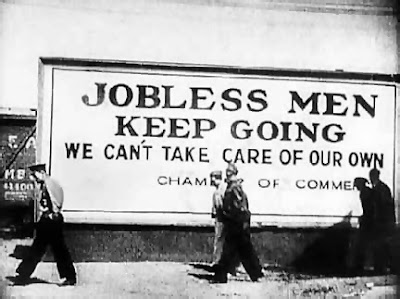
Fasten your seat belts: 2011 was far worse than expected. Our earlier predictions for America's Worst Decade just got worse.
As financial historian Niall Ferguson writes in Newsweek: "Double-Dip Depression … We forget that the Great Depression was like a soccer match, there were two halves." The 1929 crash kicked off the first half. But what "made the depression truly 'great' …began with the European banking crisis of 1931." Sound familiar?
Yes, huge warnings: But America's deaf. In denial. When we predicted the 2011-2020 "decade from hell" we didn't see the big macro events dead ahead: Arab Spring virus that's now Occupy Wall Street, promising to explode into an even more powerful force in 2012 … war on the middle class … widening inequality gap. … Washington gridlock … the Super Rich's blind resistance to all new taxes.
As Ferguson puts it: "To understand what has been happening in our own borderline depression, you need to know this history. But hardly anyone does." Get it? America's already in a "borderline depression," and virtually nobody gets it. American leaders are dummies about history. Worse, nobody may be able to stop our depression from turning "great."
Investors beware: Please, protect your assets: "Those who don't remember history are doomed to repeat it." We've already forgotten the lessons of the 2008 disaster. No wonder we're doomed to repeat the mistakes of the 1930's triggering the Second Great Depression. Soccer anyone?
Few seem capable of accepting that our situation is one on dire straits.
15 December 2011
Eurozone Defaults On Their Way

For some time I have taken the view that rescuing eurozone governments from their financial crises was too big a job for the European Central Bank, which should stick to keeping the banking system going. The only hope was that individual governments would be forced to face up to the reality of cutting government spending hard and quickly. They have failed to even begin to address this fundamental problem. As a consequence, it is now impossible for them to roll over their maturing debt, let alone raise new money. Instead there is now a scramble into cash as banks and hedge funds prepare themselves for sovereign defaults.
Posturing over geared stability funds, financial transaction taxes, installing unelected governments, putative treaty changes and finally enhanced fiscal supervision proposals have finally convinced markets that the only outcome is widespread government defaults. There is now no alternative and the fallout will have to be managed.
The inept handling of this crisis has weakened the eurozone’s banks to the point that they are unable to subscribe for more debt. Furthermore, the ECB cannot afford to see the liquidity it provides to European banks disappear into new government bonds that will default anyway. Therefore, it is now in the ECB’s interest to see sovereign defaults occur as soon as possible, unless the International Monetary Fund can come to the rescue, which is looking less likely by the day.
There is growing evidence that there is insufficient support for an IMF bailout from its member governments. The IMF’s charter is as an intergovernmental lender of last resort, not a supporter of government profligacy. Following the failure of the G20 meeting in mid-October there has been no substantive attempt to rescue the eurozone. The telephones might be buzzing, but there is no urgent meeting, suggesting that events must take their course.
[...]
Eurozone Defaults On Their Way | Before It's News
14 December 2011
When will America Collapse?
Double dip recessions, falling home prices, mortgage foreclosures, high unemployment, tight oil supply and rising sovereign debt are today's news. What does tomorrow hold for us? By examining today's news we can look at one possible scenario and the future isn't pretty.

07 December 2011
American Eugenics Applied in Nazi Germany
Remember that the Nazi's didn't create eugenics, they used the practice from the United States and applied it to dividing along racial lines in Germany, seeking to exclude those they saw as inferior and promote their own race. That ethnic cleansing began in American and spread to Europe, though most people only realize and condemn the German Nazi's for the practice. When the state legislates segregation and sterilization along ethnic lines, what results is suffering, not improvement. Eugenics is promotion of a small minority at the cost of diversity. The difference in Germany was that it was applied without reservation, inflicting the most damage possible on it's victims. The responsibility for that can still be traced back to America, for without the Eugenics programs in the States, the Nazi's would have been much less focused. Their efforts were even funded by Americans through the Rockefeller Foundation Not only did America ignore the plight of those affected by the genocide for years, many Americans were willing accomplices.
War Against the Weak is the gripping chronicle documenting how American corporate philanthropies launched a national campaign of ethnic cleansing in the United States, helped found and fund the Nazi eugenics of Hitler and Mengele — and then created the modern movement of "human genetics."In the first three decades of the 20th Century, American corporate philanthropy combined with prestigious academic fraud to create the pseudoscience eugenics that institutionalized race politics as national policy. The goal: create a superior, white, Nordic race and obliterate the viability of everyone else. How? By identifying so-called "defective" family trees and subjecting them to legislated segregation and sterilization programs. The victims: poor people, brown-haired white people, African Americans, immigrants, Indians, Eastern European Jews, the infirm and really anyone classified outside the superior genetic lines drawn up by American raceologists. The main culprits were the Carnegie Institution, the Rockefeller Foundation and the Harriman railroad fortune, in league with America's most respected scientists hailing from such prestigious universities as Harvard, Yale and Princeton, operating out of a complex at Cold Spring Harbor on Long Island. The eugenic network worked in tandem with the U.S. Department of Agriculture, the State Department and numerous state governmental bodies and legislatures throughout the country, and even the U.S. Supreme Court. They were all bent on breeding a eugenically superior race, just as agronomists would breed better strains of corn. The plan was to wipe away the reproductive capability of the weak and inferior. Ultimately, 60,000 Americans were coercively sterilized — legally and extra-legally. Many never discovered the truth until decades later. Those who actively supported eugenics include America's most progressive figures: Woodrow Wilson, Margaret Sanger, and Oliver Wendell Holmes who ruled on the infamous Carrie Buck trial and declared "three generations of imbeciles is enough."American eugenic crusades proliferated into a worldwide campaign, and in the 1920s came to the attention of Adolf Hitler. Under the Nazis, American eugenic principles were applied without restraint, careening out of control into the Reich's infamous genocide. During the pre-War years, American eugenicists openly supported Germany's program. The Rockefeller Foundation financed the Kaiser Wilhelm Institute and the work of its central racial scientists. Once WWII began, Nazi eugenics turned from mass sterilization and euthanasia to genocidal murder. One of the Kaiser Wilhelm Institute doctors in the program financed by the Rockefeller Foundation was Josef Mengele who continued his research in Auschwitz, making daily eugenic reports on twins. After the world recoiled from Nazi atrocities, the American eugenics movement — its institutions and leading scientists — renamed and regrouped under the banner of an enlightened science called human genetics.
06 December 2011
Fukushima Daiichi Nuclear Power Plant: Highly Radioactive Water Leaks From Crippled Japanese Facility
Japan's crippled nuclear power plant leaked about 45 tons of highly radioactive water from a purification device over the weekend, its operator said, and some may have drained into the ocean.
The leak is a reminder of the difficulties facing Tokyo Electric Power Co. as it tries to meet its goal of bringing the tsunami-damaged Fukushima Dai-ichi nuclear power plant to a cold shutdown by year's end.
A pool of radioactive water was discovered midday Sunday around a decontamination device, TEPCO said in a statement on its website. After the equipment was turned off, the leak appeared to stop. Later, workers found a crack in a concrete barrier leaking the contaminated water into a gutter that leads to the ocean.
TEPCO estimated about 300 liters leaked out before the crack was blocked with sandbags.
Officials were checking whether any water had reached the nearby ocean.
The leakage of radioactive water from the Fukushima plant into the Pacific Ocean in the weeks after the March 11 accident caused widespread concern that seafood in the coastal waters would be contaminated.
The pooled water around the purification device was measured Sunday at 16,000 bequerels per liter of cesium-134, and 29,000 bequerels per liter of cesium-137, TEPCO said. That's 270 times and 322 times higher, respectively, than government safety limits, according to the Citizens' Nuclear Information Center in Tokyo.
Cesium-137 is dangerous because it can last for decades in the environment, releasing cancer-causing radiation. The half-life of cesium-134 is about two years, while the half-life of cesium-137 is about 30 years.
TEPCO is using the purification devices to decontaminate water that has been cooling the reactors. Three of the plant's reactor cores mostly melted down when the March 11 tsunami knocked out the plant's cooling system.
Fukushima Daiichi Nuclear Power Plant: Highly Radioactive Water Leaks From Crippled Japanese FacilityFurther reading:
Fukushima Diary
Fukushima Update | Tracking Japan's nuclear crisis
Fukushima news and articles
Helen Caldicott, MD | PHYSICIAN – AUTHOR – SPEAKER
Updates on Fukushima: | Fairewinds Associates, Inc, Arnie Gunderson
21 November 2011
Mises: The Higher Education Bubble
Read by Steven Ng. B.T. Donleavy is a foreign-exchange specialist in New York City. He has worked at several Fortune 500 companies and he advised Michael Moore on the effects of loose monetary policy for the film "Capitalism: A Love Story".
From: Audio Mises Daily , Wednesday, May 12, 2010 by B. T. Donleavy
The Education BubbleIn the advent of the worst financial crisis seen in decades, there is much to be learned. Many economists agree that creating false demand will eventually create a bubble and crush a market much faster than the natural economic cycle. Take for instance the student loan market. Student loans, subsidized and unsubsidized, allow an 18-year-old to finance some or all of the next four years of his or her life, including living expenses. Morally, is it right to allow our children to start their lives immersed in debt?
In 1992, Congress increased the amount of money a student can borrow from the federal loan program with the reauthorization of the Higher Education Act. The act also enabled students defined as "in need" easier access to funding. Now we see student loans dominating the higher-education industry and accounting for 50% of all financial-aid packages.
According to FinAid.org, the average range of tuition inflation is normally 8% annually, and prices have not fallen or stabilized once since 1977, regardless of economic climate. In 2004, the Census Bureau released a report saying private university and college tuition are "up 93 percent from 1990." This symptom may be attributed to cheap and accessible money, and it is becoming an issue now because tuition is still rising but wages have been flat for a decade.
The Department of Education reports having a $63.7 billion budget in appropriations for 2010. It has also received $96.8 billion from the American Recovery and Reinvestment Act of 2009. The department's website states that "department programs also provide grant, loan, and work-study assistance to more than 14 million post-secondary students." That is roughly 4 million short of every college student in the country. Does this mean that only 22% of students in the United States have adequate means to pay for college? Based on America's economic model, this statistic should theoretically be impossible. This means that over 3/4 of Americans attending higher-education institutions are "in need."
There are benefits to the industry being able to increase prices. Colleges and universities need to be competitive. New revenue means that a college or university can afford better professors and improve infrastructure. It can create new dorms for incoming students and build new facilities to allow better access to labs and campus centers. The overall quality of a school and the educational services it offers will increase.
Loans and grants are not necessarily a bad thing, but when the amount of money flooding the industry drives up the demand to the point of the former becoming a market essential, there is an influx of risk. Similarly, healthcare has also enjoyed the fruits of easy money because of the insurance industry. The added funding for research and development has aided advances in medication and technology. But third-party funding usually drives prices up because consumer decision is weakened in the economic equation. Now healthcare is often unaffordable to the independent purchaser.
In most cases, student aid is an immeasurable liability. The individual's risk at 18-years-old cannot be accurately quantified even with a cosigner. Realistically, no private institution would lend this kind of capital to such a young demographic without credit history. It also should be noted that reports have shown average college students to carry 4 credit cards and an average balance of $3,000 that they cannot pay off in full. This is a small sum compared to the amount they will inherit after a four-year tenure, but it shows that credit is being handed out indiscriminately. A massive amount of speculation is being placed on the payees with no indication of them being able to afford repayment.
"The risk associated with loan obligations are shifted to the taxpayer. Consequently, the act removes obligation and creates a moral hazard with the creation of a virtual backstop."
A boost in educational funding for financing may come at a price. If the current trend continues, students will increase the amount financed and they will be paying for the majority of their education in loans. As the January 14 edition of the Economist notes, "only about 400,000 more Americans were employed in December 2009 than in December 1999, while the population grew by nearly 30m." With an unemployment rate of 10% (real figures are closer to 17%), matters look only more ominous.
Millions of students will graduate with the same popular majors and compete for fewer jobs because a significant amount of manufacturing and industry has left the United States. The supply of students entering the job market will be endless, and businesses will lower the base pay of new employees because of their abundance.
The other scenario is that businesses will not hire them at all because they are fully staffed, thus creating a bottleneck in the job market. Unemployment, Social Security, and Medicare will all suffer from the supply and demand effects of this type of crisis.
State and city universities will not be able to handle every student but they may remain the most inexpensive way of obtaining a diploma. City University of New York has reported a 77.5% increase in transfer students in the last year. This is a sign of education becoming unaffordable. Without major state funding or tuition increases CUNY's infrastructure will not be able to handle the capacity of incoming students.
It is difficult to come to a reasonable assessment on how to address an impending student-loan crisis. Candidates running on a platform of limiting financial aid or reducing the Department of Education will be writing a political death sentence for themselves. The recent Health Care and Education Reconciliation Act of 2010 will end subsidies for student aid to private lenders. This will make it easier for students to shop for a loan by going directly to the source but will only address who controls the market and has no effect on the economics of tuition cost.
Payments will have a threshold of 10% of a graduate's disposable income and will be forgiven after 20 years while a public servant will be forgiven after ten. The risk associated with loan obligations are shifted to the taxpayer. Consequently, the act removes obligation and creates a moral hazard with the creation of a virtual backstop. With the combination of this backstop and decreasing wages because of an oversupply of workers, the result can only perpetuate default. This bursting bubble will be massive and will affect other major industries such as housing, auto, and credit.
Because of the ease of obtaining these types of loans and leniency in repayment terms, the postsecondary education industry may possibly raise tuition at a faster rate. There lies no risk for a college or university. As long as prices are met, schools can charge whatever the market is willing to pay. Keeping up with the rising costs will be difficult to do because public funding will have to increase exponentially relative to tuition.
In conclusion, we see that the theory of scholastic financial assistance through government intervention does not perform as advertised. The program will actually only hurt the people it is trying to help.
Parents are no longer able to save for their child's college years because postsecondary education price inflation is exponentially higher than the savings rate. This forces more and more students to go into debt before they earn their first professional dollar. It will eventually be disruptive to the economy and will have a massive impact on other industries. Furthermore, debt forgiveness is a moral hazard that means that the debtor has no real obligation and the taxpayer is now responsible.
Whether the student-loan industry is run by the American government or by subsidized lending institutions, the business model is flawed and will continue to force prices upward regardless of whether it makes economic sense.
The Education BubbleWould you like your college education to be free? Sure, who wouldn't? Well, the people of Tunisia and Egypt are learning that whenever the government supplies something, it is never really "free."
In Tunisia, "free" university education is guaranteed to anyone who passes the government's exams at the end of high school. Largely as a result of this, the number of Tunisians who graduated college more than tripled in the last ten years. This may sound like a good thing, but it has produced a glut of graduates.
Fifty-Seven percent of young Tunisians entering the labor market are college educated. This is while only 30 percent of Americans earn a college degree by the time they are 27. Recent Tunisian college grads have an unemployment rate approximately three times higher than the national average of 15 percent. This is up ninefold from 1994.
The reason for this is not necessarily because having a college education hinders people in getting a job, but because so many college grads are entering the labor market at a time when there are few jobs.
Additionally, government domination of the educational system discourages economic growth. The Tunisian Ministry of Education decides what major students will have. Students are not allowed to change fields during their course of study. This control reduces the type of expertise necessary to create successful businesses.
The Tunisian educational system is also enormously expensive. Of Tunisia's GDP, 7.2 percent is spent on education, more than any European or North American country beside Denmark and Iceland, which also spends 7.2 percent of its GDP on education. Tunisia's educational results, however, appear to be horrible. A 2002 UNESCO report puts its graduation rate at about 30 percent.
Having such a large number of unemployed youths can be dangerous. As George Mason University sociologist Jack A. Goldstone notes, "Educated youth have been in the vanguard of rebellions against authority certainly since the French Revolution and in some cases even earlier."
In fact, the Tunisian protests began after a recent graduate killed himself because government authorities confiscated his fruit stand when they discovered he did not have an "official" permit. The BBC reported that most of the early protesters were unemployed recent graduates.
Like Tunisia, Egypt also has a massive youth-unemployment problem. Unsurprisingly, it also has a system of "free" college education.
In Egypt, enrollment in tertiary education increased from 14 percent in 1990 to approximately 35 percent in 2005. Yet this has not helped the unemployment rate among recent grads. The national Egyptian unemployment rate is 9.4 percent, comparable to the United States, but the unemployment rate for people between the ages of 15 and 29 is 87.2 percent. College graduates, largely because of their age, have a ten times higher unemployment rate than for those who did not attend college.
The Egyptian government also rigidly controls the educational system, just like in Tunisia. A centralized government committee controls decisions regarding curriculum, program development, and deployment of faculty and staff for institutions of higher learning across the entire country. Private universities were only legalized in 1992, and enrollment is very small.
In Egypt, educational expenditures were 3.7 percent of GDP in 2007. By most accounts the Egyptian education system is underfunded. Its educational standards were called "abysmal" by the Economist. Fewer than half of all students graduate, and many universities are viewed as diploma mills.
Although the Egyptian government may have avoided some of the economic costs of "free" higher education that the Tunisian government has incurred, it has not avoided the social costs.
We, in America, might not be as far away from the problems of Tunisia and Egypt as some may be inclined to think.
From 1997 to 2007, full-time enrollment in US tertiary education increased 34 percent. The average college student graduates with $24,000 in debt, a 40 percent real increase from 1997. In 2008, only 57 percent of students enrolled in a four year college graduated within six years. The unemployment rate for 16 to 24-year-olds is 52 percent. The underemployed as a group may be as large as the unemployed in America. For example, in 1970 only 3 percent of mail carriers had a bachelor's degree, while today the number is 12 percent.
Although our case may not be as extreme as that of Tunisia or Egypt, we are headed in the same direction. And just like in Tunisia and Egypt, our education bubble is fueled by governmental policy.
Government accreditation laws keep potential institutions of higher education out of the market, which allows the institutions already in the market to raise their prices. Accreditation institutions can also force institutions of higher education to make changes that increase costs. For instance, the American Bar Association forced the University of Colorado Law School to increase the number of electrical outlets in the library and to construct an instructional court room, which the university claimed caused them to increase tuition.
Government aid also helps institutions of higher education inflate prices. For instance, although the cost of higher education in real dollars increased by 68 percent between 1986 and 2006, when increased government aid is accounted for the real cost to the student increased by only 29 percent. The ceiling of how much students are able to pay is artificially raised, allowing the colleges to charge more.
Also, if a student defaults on a loan backed by the government, which is by far the most common kind of loan, the lender does not bear the loss, the government does. This obviously encourages the lenders to lend more freely than they otherwise would. Enormous losses have been socialized. There is currently $730 billion of outstanding student-loan debt, and the overwhelming majority of losses will be borne by the government if it is not repaid. Only 40 percent of all student debt is being actively repaid.
There are more causes to the revolutions in Tunisia and Egypt than just the higher-education bubble, but the effect it has had cannot be ignored. We could be bringing ourselves dangerously close to the point when all the people of our country have to learn, one way or another, that nothing the government provides is ever free.
The Education Bubble Is Fuel for RevoltA college degree once looked to be the path to prosperity. In an article for TechCrunch, Sarah Lacy writes, "Like the housing bubble, the education bubble is about security and insurance against the future. Both whisper a seductive promise into the ears of worried Americans: Do this and you will be safe."
But the jobs that made higher education pay off during the inflationary boom, kicked into high gear by Nixon waving goodbye to the last shreds of a gold standard, came primarily from government and finance.
In 1990, 6.4 million people worked for federal, state, and local governments. By 2010, that number had grown almost 6 times — to 38.3 million — with many of these jobs being white-collar.
In 1990, the financial sector was less than 7.5 percent of the S&P 500. By 2006, this sector had grown to 22.3 percent of the S&P, and that year the financial sector constituted 45 percent of the index's earnings.
"Prices and wage rates boom," writes Mises.
Everybody feels happy and is convinced that now finally mankind has overcome forever the gloomy state of scarcity and reached everlasting prosperity.
In fact, all this amazing wealth is fragile, a castle built on sands of illusion. It cannot last. There is no means to substitute banknotes and deposits for nonexistent capital goods.
Times have changed.
Last week, HSBC Holding Plc announced plans to eliminate 30,000 jobs worldwide by the end of 2013. The job cuts will affect "support staff where we believe we have created an unnecessary bureaucracy in this firm over a number of years," HSBC chief executive officer Stuart Gulliver said.
Goldman Sachs plans to cut 1,000 positions. Bank of America is laying off 1,500 employees and closing 600 retail branches.
At the same time that banks are trimming their fat, according to a Labor Department report released earlier this month, from May 2010 to May 2011 local governments shed 267,000 jobs and state governments 24,000. Local government employment in May, at 14.165 million jobs, was the lowest since July 2006.
An increase in the amount of real savings, which induces a fall in the interest rate and a lengthening of the production schedule, increases an economy's productive capacity, creating genuine growth brought about by the investment in higher-order goods such as factories and other production assets.
"Like all booms, higher education has been fueled by credit."
Conversely, easy, cheap credit fools entrepreneurs into believing that society's collective time preference has fallen, enticing them into investing in higher-order goods, such as land, factories, and the like — when in fact the collective time preference hasn't changed, and the demand for higher-order goods is merely a mirage. The result is booms and busts rather than genuine growth.
College degrees are similar to what the Austrians call higher-order goods. It's thought that a student will gain knowledge and seasoning in college that will make him or her more productive and a candidate for a high-paying career. The investment of time and money in knowledge pays through higher productivity and is translated into higher income. Higher education is the higher-order means to a successful career.
PayPal founder and early Facebook investor Peter Thiel, questioning the value of higher education, tells TechCrunch,
A true bubble is when something is overvalued and intensely believed. Education may be the only thing people still believe in in the United States. To question education is really dangerous. It is the absolute taboo. It's like telling the world there's no Santa Claus.
The excesses of both college and homeownership were always excused by a core national belief that, no matter what happens in the world, these were the best investments you could make. Housing prices would always go up, and you will always make more money if you are college educated.
The New York Times' David Leonhardt even claims,
Construction workers, police officers, plumbers, retail salespeople and secretaries, among others, make significantly more with a degree than without one. Why? Education helps people do higher-skilled work, get jobs with better-paying companies or open their own businesses.
Using data from the Center on Education and the Workforce at Georgetown University, Leonhardt asserts that dishwashers with college degrees make $34,000 a year while those without make $19,000.
No employer in their right mind would pay nearly double for a dishwasher with a college degree. However, there are plenty of fresh college graduates cobbling together multiple low-level jobs just to make ends meet.
"More college graduates are working in second jobs that don't require college degrees," writes Hannah Seligson in the New York Times, "part of a phenomenon called 'mal-employment.' In short, many baby-sitters, sales clerks, telemarketers and bartenders are overqualified for their jobs."
Nearly 2 million college graduates were mal-employed last year, up 17 percent from 2007. Nearly half of all college graduates are working at a job not requiring a degree.
In the United States, 80,000 bartenders as well as 317,000 waiters and waitresses have college degrees. Nearly a quarter of all retail salespersons have a college degree. In all, 17 million Americans with college degrees are working at jobs that do not require a bachelor's degree.
"Young college graduates working multiple jobs is a natural consequence of a bad labor market and having, on average, $20,000 worth of student loans to pay off," said Carl E. Van Horn, director of the John J. Heldrich Center for Workforce Development at Rutgers.
"The median starting salary for those who graduated from four-year degree programs in 2009 and 2010 was $27,000, down from $30,000 for those who graduated in 2006 to 2008, before the recession," Seligson writes, adding, "Try living on $27,000 a year — before taxes — in a city like New York, Washington or Chicago."
Like all booms, higher education has been fueled by credit. In June of last year, total student-loan debt exceeded total credit-card debt outstanding for the first time, totaling more than $900 billion.
"Not only are the returns poor, but the quality of the product is poor."
All of this credit has pushed the average cost of tuition up 440 percent in the last 25 years, more than four times the rate of inflation. But while the factors of production on campus have been bid up, just as they are in any other asset boom, the return on investment is a bust. In 1992, there were 5.1 million mal-employed college graduates. By 2008, the number was 17 million.
Not only are the returns poor, but the quality of the product is poor (as in the case of new-construction quality in the housing boom). According to the authors of Academically Adrift: Limited Learning on College Campuses, 45 percent of students make no gains in their critical reasoning and thinking skills, as well as writing ability, after two years in college. More than one out of three college seniors were no better at writing and thinking than they were when they first arrived at their campuses.
Many projects contemplated and started during the real-estate boom are never completed, as prices are bid up, and owners run out of capital. Such is the case for many attending college, as over 45 percent of those who enroll as freshmen ultimately give up, realizing they lack the disciplinary and mental capital, and do not graduate.
Similar to the government push for increased homeownership, government is foursquare behind having more young people attend universities. One of President Obama's top goals is to increase the number of Americans attending college.
But why? "Among the members of the class of 2010, just 56 percent had held at least one job by this spring, when the survey was conducted," reported the Times recently. "That compares with 90 percent of graduates from the classes of 2006 and 2007."
And because they can't find jobs, 85 percent of college grads move back in with their parents after they graduate. According to a poll by Twentysomething Inc., a marketing and research firm based in Philadelphia, that rate has steadily risen from 67 percent in 2006.
Perversely, while the market tries to clear away malinvestments in finance and real estate, plus the jobs that supported them, colleges continue to turn out more business majors than any other discipline. In 2007 and 2008 there were more than 335,000 business degrees granted — 100,000 more than a decade before, according to the National Center for Education Statistics.
At the same time as law schools have a building boom underway, many new law grads can't find work or are working temporary jobs at $15 an hour.
David Segal reports for The New York Times,
As other industries close offices and downsize plants, the manufacturing base behind the doctor of jurisprudence keeps growing. Fordham Law School in New York recently broke ground on a $250 million, 22-story building. The University of Baltimore School of Law and the University of Michigan Law School are both working on buildings that cost more than $100 million. Marquette University Law School in Wisconsin has just finished its own $85 million project. A bunch of other schools have built multimillion dollar additions.
And while law grads can't find work, law schools are enrolling more students than ever before at tuition rates of $40,000+ a year. Segal explains that law-school tuition has increased at 4 times the rate of undergraduate education, which itself has increased 4 times the CPI. "From 1989 to 2009, when college tuition rose by 71 percent, law school tuition shot up 317 percent."
Students and their parents are investing in the higher-order good of a college degree, in the mistaken belief that plenty of jobs await college graduates at the end of four or six or seven years. However, time preferences haven't changed. The demand for consumer goods remains, and that's where the jobs are. The boom in demand for bankers, barristers, and bureaucrats is over.
The Higher-Education Bubble Has Popped
12 November 2011
On Liberty, Economics
To change the world for the better, to really change the world, we can not believe that one candidate for public office will save our society. True salvation lies in the people, changing their hearts and minds. If we start from the ground and work our way up, we can realize a future that functions for the greater good; not for the benefit of those who govern, but for the governed. I see Anarcho-capitalism as one of the most likely solutions, abandoning our failed system of crony government that benefits those in support of ever-increasing government, but working to free the individual people to live life as we are meant to. Libertarian politics are a step in the right direction for the government, but a small step at best for that governed majority. Economics will always be tied at the hip to politics as long as those who govern believe that we must control private exchanges between individuals and organizations for the benefit of those in government.
11 November 2011
Philipp Bagus: Currency and Economic Collapse
Jeffrey Tucker interviews Philipp Bagus, Assistant Professor of Economics at the University Rey Juan Carlos in Madrid, and discusses Philipp's academic life and his two recent books: 'Deep Freeze: Iceland´s Economic Collapse' (co-authored with David Howden) and 'The Tragedy of the Euro'. Recorded at the Ludwig von Mises Institute in Auburn, Alabama, on 10 March 2011 [16:05]
Currency and Economic Collapse | Philipp Bagus - YouTube
Currency and Economic Collapse - Mises Media
01 November 2011
Greece Moving Away From EU, Collapsing Consciously
Athens, Greece (CNN) -- Stock markets in the United States and Europe dropped dramatically Tuesday after Greek Prime Minister George Papandreou stunned the world by calling a national referendum on international aid for his country.It seems to be getting harder and harder to prop up this false wealth global economy, and the people at the bottom keeping it afloat are less likely to continue to support it.
A "No" vote could theoretically force Greece to crash out of the euro and send shock waves through the global financial system.
Papandreou is seeking public backing for the bail-out deal, which took months to hammer out.
But French President Nicolas Sarkozy and German Chancellor Angela Merkel issued a terse statement Tuesday saying they were "determined to ensure the full implementation, without delay, of decisions adopted by the summit, which are necessary now more than ever."
The agreement would see the country's sky-high debts cut in half, but it comes with strings attached which have led to angry demonstrations in the streets of Greece.
International lenders are demanding that Athens raise taxes, sell off state-owned companies, and slash government spending -- which means firing tens of thousands of state workers.
German and French markets were down about 5% in afternoon trading Tuesday, and the Dow Jones index plunged more than 250 points at the opening before recovering slightly, then falling further.
The announcement of the referendum rattled Papandreou's hold on power Tuesday, as a lawmaker defected from his party, leaving him with a majority of only two in Parliament.The root of the problem is that taxpayers around the world are being manipulated to support the big banks through false bailouts that do not support the actual nations, but those financial companies that knowingly buy insolvent debt, expecting to receive bailouts when those markets and investments fail.
The European debt crisis claimed its first American victim shortly before Papandreou announced the referendum on Monday, as MF Global filed for bankruptcy protection, leaving top Wall Street creditors holding more than $2 billion in debt.
The commodities and derivatives broker was run by ex-Sen. Jon Corzine, a former head of Goldman Sachs.
"The prime minister will be hoping for a vote in favor to strengthen his mandate, but if the Greek population votes against, it will leave the IMF and Greece's European partners in a very difficult situation," said Gary Jenkins of Evolution Securities.
The planned referendum casts a shadow on a hard-fought deal that would allow Greece to write off much as 50% of its debts to banks.
The agreement for private lenders to scrap half of Greece's debt is worth 100 billion euros to Athens, and comes along with a promise of 30 billion euros from the public sector to help pay off some of the remaining debts, making the whole deal worth 130 billion euros ($178 billion).
A weekend survey in Greece found nearly 60% opposed the debt deal reached in Brussels last week.
"If approved, a vote of confidence in government's handling of the situation ... if calmer heads prevail and it can rationally be explained to the public, I wouldn't discount the measure being approved.
Greek surprise sends shock waves through markets

Euro Declines Amid Renewed Greek Default Concerns; Dollar, Yen Strengthen
The euro weakened for a third day against the dollar, touching the lowest in almost three weeks, as concern the currency region’s rescue plan will crumble and the European Central Bank will cut interest rates damped demand.
The 17-nation currency fell the most in two weeks versus the yen after Greek Prime Minister George Papandreou pledged to put the European Union’s latest accord to a referendum, risking pushing the country into default if rejected by voters. The dollar and yen strengthened as stocks slid around the world and data showed Chinese manufacturing slowed. Australia’s dollar dropped after the nation’s central bank lowered interest rates.
27 October 2011
Euro deal leaves much to do on rescue fund, Greek debt
Euro zone leaders struck a last-minute deal to limit the damage from the currency bloc's debt crisis early on Thursday but are still far from finalizing plans to slash Greece's debt burden and strengthen their rescue fund.


US stocks higher ahead of EU talks


This is most likely due to some companies set up to make a profit from the failures of foreign banks, which bought insolvent debt from EU governments knowing they could seek bailouts from the IMF. There can't be much of any support left by those actually paying taxes and dealing with inflation down here at the bottom, where the energy and false money for these bailouts comes from.
Max Keiser: Whether Debt Slash or Hike, Collapse is Guaranteed!
With the euphoria over the deals reached at Brussels dying down, the numbers are now being pored over by economists and experts to see if they add up. One of them is RT's Max Keiser who believes nothing's changed - the EU's still fighting debt with debt.
RT on Twitter http://twitter.com/RT_com
RT on Facebook http://www.facebook.com/RTnews
18 October 2011
Michael Rupperts' Latest Lifeboat Hour Radio Program
MCR's guest is Charles Eisenstein, brilliant author of the book Sacred Economics. They discuss the rapidly growing global Occupy Movement, the ongoing collapse of infinite growth economics, and designing the next economic paradigm.
The Lifeboat Hour - 10/16/11
Ruppert addresses a variety of issues in this week's show, including supporting the Occupy movement. His guest Eisenstein is well-versed in economics.
07 October 2011
06 October 2011
JFK vs The Zombie Federal Reserve

On June 4, 1963, a virtually unknown Presidential decree, Executive Order 11110, was signed with the authority to basically strip the Federal Reserve Bank of its power to loan money to the United States Federal Government at interest. With the stroke of a pen, President Kennedy declared that the privately owned Federal Reserve Bank would soon be out of business. The Christian Law Fellowship has exhaustively researched this matter through the Federal Register and Library of Congress. We can now safely conclude that this Executive Order has never been repealed, amended, or superceded by any subsequent Executive Order. In simple terms, it is still valid.
JFK Vs The Federal Reserve
So, the Fed has no validity, yet persists. This is likely what resulted in the death of JFK as well. The protests and actions to "End the Fed" seem to be against an organization that has already been declared invalid, but we continue to allow it to exist. Is the Fed a zombie? Why won't it die?
Economic Collapse Considerations
* This is mostly taken from an online conversation I had.
I wonder when we'll realize that being polarized by the two halves of the political machine doesn't bring any real change. Going from one extreme to another, back and forth, doesn't seem to do anything to better the lives of any of us, it only seems that liberty decreases year after year.
There are two candidates from Texas running for president, but only one that doesn't support extremism in politics. Guess which one I'm supporting, still.
Why political polarization has gone wild in America (and what to do about it)

And some background on why our government was initially restrained from having a heavy hand in economics. Congress has given away the responsibility to coin currency to the Federal Reserve, which is headed by major players from the banking industries, but is not actually a federal agency and has no federal oversight. Anyone who still doesn't see the problem?
History of Fiat Money
And with investments in the US government, devaluation of the dollar results in many of these investments returning near zero profits for investors, but keeps the government floating along, but only just. These systems do little to nothing for those of us at the bottom. It's all just a twisted way to control a population.
I wonder when we'll realize that being polarized by the two halves of the political machine doesn't bring any real change. Going from one extreme to another, back and forth, doesn't seem to do anything to better the lives of any of us, it only seems that liberty decreases year after year.
There are two candidates from Texas running for president, but only one that doesn't support extremism in politics. Guess which one I'm supporting, still.
Why political polarization has gone wild in America (and what to do about it)
The problem goes way way deeper than whoever the president is or which political party controls congress. 30 years of bad economic policy and allowing wall street to create the internet & housing bubbles that burst and ended up dragging the entire world economy into the crapper is the long & the short of it. There was an enormous systemic failure both of the govt, and the financial system....to think that one president or another is entirely to blame is short-sighted and foolish. Every president since reagan had a hand in this mess and both political parties are just as responsible as the other. No president gets elected without wall street money, and no president in the future is going to do anything other than wall streets bidding. 4 more years of Obama is going to be exactly the same as 4 years with some other dipshit. If you think otherwise, you're not being completely honest with yourself. This mess will take decades to crawl out from under.
1. Incase you haven't noticed we are in large part still operating this country under W's policies, W's wars, W's tax cuts, W's subscription drug plan, etc. A large majority of our current spending is a result of the Bush administration. And lets no forget the two completely failed stimulus bills that added over 1 trillion dollars to the national debt. All of the above—unpaid for, but I digress
2. There is no comparison to W vs. Obama on spending. Even with projected analysis of Obamas current policy costs by the CBO, W out spends him by a 1: 4 margin. That's not debatable, it's a fact.
3. In 2001, President George W. Bush inherited a modest surplus, with projections by the CBO for increased surpluses with continuations of Bill Clinton’s policies. But every year starting in 2002 and the adoption of the Bush tax cuts, the budget fell into deficit at a rapid pace. In 2009, Obama inherited a $1.2 trillion deficit and more deficits in years to come, based on continuing W's policies and the effects of the recession that W created.
Some see Obama as less of a problem than Bush, but Obama is just getting started. Wait until he has four years behind him (or God forbid, eight). Projections are just fairy tails. I'll wait and see what the actuals look like once he's done his damage.
Want to get to the root of the problems? Fiat currency. Which I guess we can pin on Nixon and Co. Everything after that has been downhill, sometimes polished nice and shiny so we keep buying into it...
Want to fix the financial problems of the world? Crash the banks. Go back to a currency with real value. Invest in gold and silver. Get out and stay out of debt. Dump the 401k. Stay out of the stock market. All of these things support the system of control and wealth redistribution that the government and banks have created to manimpulate our economy.
Want to fix the financial problems of the world? Crash the banks. Go back to a currency with real value. Invest in gold and silver. Get out and stay out of debt. Dump the 401k. Stay out of the stock market. All of these things support the system of control and wealth redistribution that the government and banks have created to manimpulate our economy.
And some background on why our government was initially restrained from having a heavy hand in economics. Congress has given away the responsibility to coin currency to the Federal Reserve, which is headed by major players from the banking industries, but is not actually a federal agency and has no federal oversight. Anyone who still doesn't see the problem?
History of Fiat Money
And with investments in the US government, devaluation of the dollar results in many of these investments returning near zero profits for investors, but keeps the government floating along, but only just. These systems do little to nothing for those of us at the bottom. It's all just a twisted way to control a population.
The main issue is that the public seems to be in a lull, not really wanting to accept that this is one of the biggest problems we have. This false wealth and market manipulation is not sustainable, but the public seems to want to ignore it as long as they can charge their purchases and get loans for whatever.
We have moved away from an economy based on wealth and production to one based on debt. The only way out of this pit is to kill the Fed, go back to a currency system that can not be controlled, and forgive debt. If we don't work toward changing the way our economy works, it will cease to work.
We have moved away from an economy based on wealth and production to one based on debt. The only way out of this pit is to kill the Fed, go back to a currency system that can not be controlled, and forgive debt. If we don't work toward changing the way our economy works, it will cease to work.
Take a moment and listen to Andrew Gause talk about the real world of money. It will give you a new perspective, or at least reassure you if you already believe anything of what I posted already.
Lewis also wrote the Blind Side and Moneyball, but haven't read any of his work yet.
For a more bleak perspective, look into Dmitry Orlov. He observed the Russian collapse, then moved to the US and started making correlations...
For a more bleak perspective, look into Dmitry Orlov. He observed the Russian collapse, then moved to the US and started making correlations...
Here are a few other resources I follow regularly, more along the lines of collapse. With these groups and movements, the goal is sustainability and localization, the practical opposite of the failure that is globalism.
http://www.thezeitgeistmovement.com/
http://www.transitionnetwo
http://www.collapsenet.com
http://www.thezeitgeistmovement.com/
http://www.transitionnetwo
http://www.collapsenet.com
Back to financial systems, I believe the first steps toward collapse have been met already. The guys over at Half Past Human predicted that the dollar would cease to be the global reserve currency. The Fed keeps printing dollars, China is unloading deflating dollars, so we are past this point already.
http://halfpasthuman.com/
The next stages would be a collapse of the derivatives markets, something that is probably good for anyone who is not a millionaire.
http://www.derivativescoll
Backdoor bailouts of banks are attempts at keeping the fractional reserve banking system afloat, but it has been on the downhill slide since the umbilical to real wealth (gold standard) was cut in Nixon's reign.
http://lewrockwell.com/rot
I know I don't paint a pretty picture, but I am just being realistic, and hope to simply help others learn more so that we can gain more support for recognizing what is wrong with US (and global) economics and work toward a replacement system that doesn't defraud the vast majority of people supporting it under threat of violence (taxation = violence).
http://halfpasthuman.com/
The next stages would be a collapse of the derivatives markets, something that is probably good for anyone who is not a millionaire.
http://www.derivativescoll
Backdoor bailouts of banks are attempts at keeping the fractional reserve banking system afloat, but it has been on the downhill slide since the umbilical to real wealth (gold standard) was cut in Nixon's reign.
http://lewrockwell.com/rot
I know I don't paint a pretty picture, but I am just being realistic, and hope to simply help others learn more so that we can gain more support for recognizing what is wrong with US (and global) economics and work toward a replacement system that doesn't defraud the vast majority of people supporting it under threat of violence (taxation = violence).
Subscribe to:
Posts (Atom)