Showing posts with label peak oil. Show all posts

16 January 2012

Peak People: The Interrelationship between Population Growth and Energy Resources

This is just the section regarding the human population effect of energy sources. Population growth has increased along with the industrialization that oil and other natural resources brought, but they are finite. As we crest the peaks of various resources, will we see population decline as well?
Figure 12 shows the sum-of-energies model of population growth versus actual population growth, projected to 2050.
Figure 12: World Population vs. Sum-of-Energies Population 800-2050

What Next? - Future Scenarios


There are three general scenarios that the world’s energy future may take. Their effects on population will be radically different. They are:
1. Continued fossil fuel growth
2. Fossil fuel decline and no sufficient substitute
3. Fossil fuel decline and a new source of energy

Scenario 1: Continued Fossil Fuel Consumption Growth

In this scenario, fossil fuel consumption continues to grow at similar rates to the recent past and population grows as projected by the United Nations to 9 billion people by 2050.
Based on the above sum-of-energies model, if Oil Population is close to reaching its peak, a much larger share of the world’s population growth will have to be driven by Coal Population, requiring much higher consumption of coal. Unless carbon sequestration technologies quickly become viable, this will have detrimental effects on climate change.
The increased importance of natural gas in the 21st century may also contribute to population growth, as the introduction of new energy sources has done in the past. But based on current trends natural gas will play a much smaller part than coal.
Or population may already be slowing more quickly than most analysts realise.[14] If so, the world’s population in 2050 may be substantially lower, closer to 7.5 billion people (1 billion for Biomass Population, 2.5 billion for Coal Population, 2.7 for Oil Population and 1.1 for Natural Gas Population equals 7.3 billion).

Scenario 2: Fossil Fuel Decline and no Sufficient Substitute

Figure 13 - Population/Energy Dependency - After Peak Energy Production
A decline in oil and gas production would mean a decline in energy inputs into society, a decline in productivity and, hypothetically, a decline in population. If population growth were related to oil production and oil production is beginning to decline, Oil Population will also decline – in other words, its growth curve may change from a slowing logistic curve, to a declining parabolic curve - and therefore a large component of global population will decline more quickly than most people anticipate.
Mortality rates may increase, as a population grown large through dependence on high quality energy sources now must allocate scarcer resources per person. This is evident in agriculture’s dependence on fossil fuel based fertilisers[15]. Without them, agricultural productivity decreases and less people can be fed. Human carrying capacity decreases.
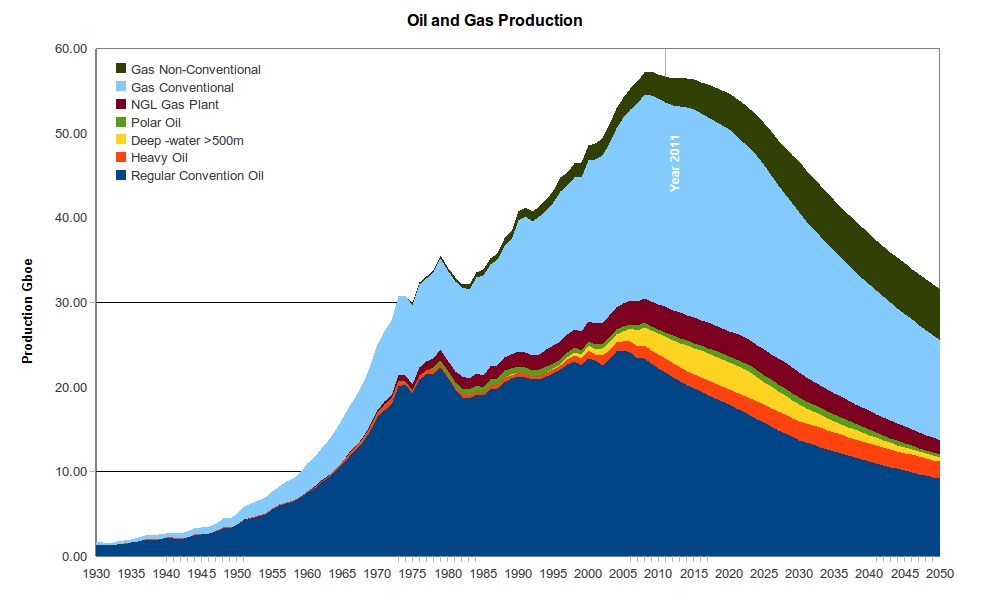
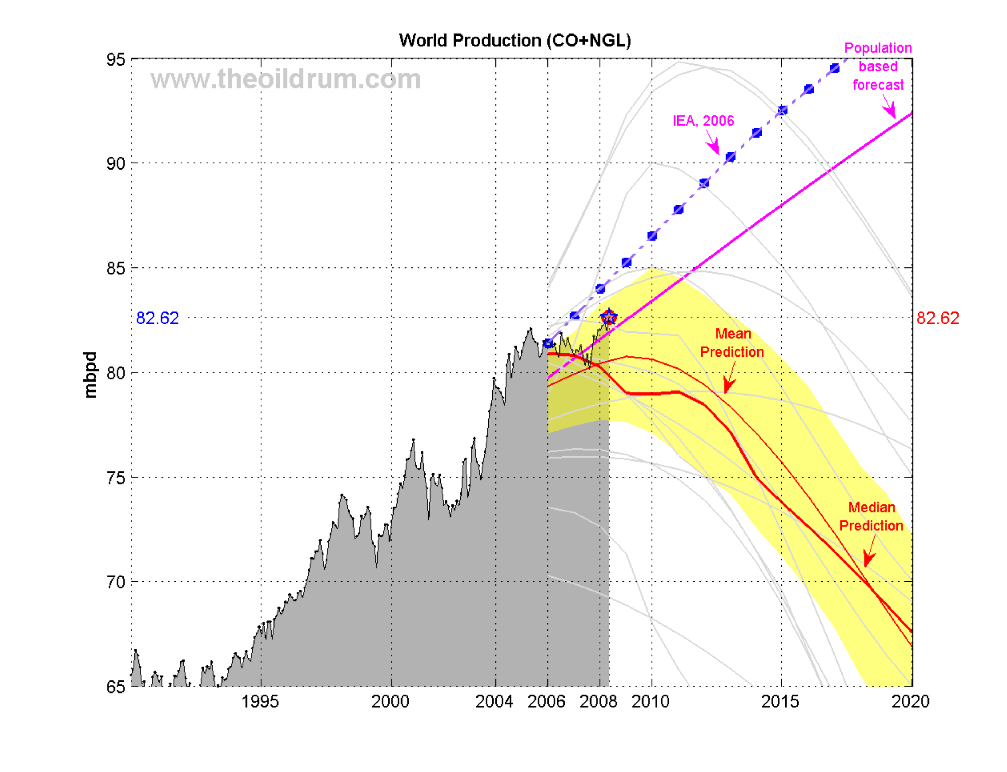
Figure 14 depicts projected world oil production to 2020. These figures are based on conventional crude oil resources and natural gas liquids (CO + NGL). They do not include unconventional oil resources such as shale oil, oil from tar sands, ultra-deep water oil or polar oil. These oil sources are not included because they are much more expensive to extract, in monetary terms but also in energy terms. In other words, a large amount of energy inputs are required to extract energy outputs from say, tar sands in north western Canada. Hence the net energy gain is lower, and these energy sources may not be as important in raising productivity and population ceilings.
Based on these projections, the 3.2 billion people that are dependent on oil in the sum-of-energies population model are in serious jeopardy in the next fifty years as the world’s remaining oil resources are consumed, and world population could suffer a precipitous decline.
Figure 14: Projected World Oil Production

Scenario 3: Fossil Fuel Decline and a New Energy Source

This scenario follows from Ester Boserup’s observations that many of humankind’s technological innovations have resulted from population pressures, or increased population densities. According to Boserup, demand-induced innovation led to the shift from hunter-gatherer societies to agricultural societies and from the use of wood to coal. One could speculate that a shortage of fossil fuels caused by population pressures would lead to yet more innovation and the discovery of newer and better sources of energy. From our vantage point though, it is not clear what these innovations might be or what new sources of energy would be capable of replacing fossil fuels.
A higher quality energy source, say fission, could lead to further productivity improvements, reducing the pressure on existing resources and further raising the ceiling on population size. But fission still lies closer to the realms of science fiction than science.
A lower quality energy source, like solar or wind power, is less efficient. It has less ability to perform work and to raise productivity. Another problem with low quality energy sources is that their net energy is low - they require a large proportion of energy in, to get some energy out - in contradistinction to oil and gas, which have high net energy values. A switch to a lower quality energy source from fossil fuels will put further pressure on other remaining energy sources, such as wood and coal. This could lead to further pressures on land and other resources and hence lower the population ceiling. Low quality energy resources do not support large populations.
Nuclear power is not the answer. To replace diminishing oil and gas (which currently provides the world with 60% of its energy resources) with nuclear power (which currently provides 5.6%) would not only require vast amounts of capital but would require vast amounts of high quality energy. In a period of declining oil and gas resources, existing energy sources would be getting scarcer.
Perhaps a new high quality source of energy will be found. This would then add a new energy component to population growth. This may lead to a raised population ceiling and an initial burst of population growth as population grows to occupy the space between the previous ceiling and the new ceiling. Then growth may slow again as a new equilibrium is reached.

Peak People: The Interrelationship between Population Growth and Energy Resources | Energy Bulletin

10 January 2012

The Geopolitical Implications Of “Peak Everything” By Richard Heinberg


Reprinted from POST CARBON INSTITUTE

From competition among hunter-gatherers for wild game to imperialist wars over precious minerals, resource wars have been fought throughout history; today, however, the competition appears set to enter a new—and perhaps unprecedented—phase. As natural resources deplete, and as the Earth's climate becomes less stable, the world's nations will likely compete ever more desperately for access to fossil fuels, minerals, agricultural land, and water.

Nations need increasing amounts of energy and raw materials to produce economic growth, but the costs of supplying new increments of energy and materials are burgeoning. In many cases, lower-quality resources with high extraction costs are all that remain. Securing access to these resources often requires military expenditures as well. Meanwhile the struggle for the control of resources is re-aligning political power balances throughout the world.

This game of resource "musical chairs" could well bring about conflict and privation on a scale never seen before in world history. Only a decisive policy shift toward resource conservation, climate change mitigation, and economic cooperation seems likely to produce a different outcome.

America's best shot at expanding its oil interests lie in the deep oceans and the Arctic.[7] However, both military maneuvering and engineering-mining efforts will see diminishing returns as costs rise and payoffs diminish. 

Arctic borders map 

Climate change is likely to exacerbate geopolitical rivalry with China, although it's important to recognize that climate risks will not be evenly apportioned. Unstable states will become more unstable, poor nations poorer. Many of the areas of greatest geopolitical risk are also most at risk for impacts from climate change. Equatorial regions are most likely to suffer from extreme drought and occasional catastrophic flooding, while some northern temperate regions may see some transitory benefit from warming—though unpredictable weather will plague nearly every region. With the melting of Arctic ice, new mineral and energy resources in the northernmost portions of the planet will become accessible, as will new trade routes; this may lead to a "Cold Rush" of economic and military exploitation and open a new theater for international conflict.[8]


Jintao and Obama at APEC

The world's governments engage continually in both cooperative and competitive behavior, though sometimes extremes of these tendencies come to the fore—with all-out conflict exemplifying unbridled competition. Geopolitics typically involves both cooperative and competitive strategies, with its long-term goal centering on the furtherance of national interest (including increased control of territory and access to resources). Recent decades have generally seen increasing international cooperation, showing up in the expansion of trade, the proliferation of treaties and conventions, and the development of international institutions for justice and conflict resolution. The UN, WTO, World Bank, International Criminal Court, as well as regional economic (e.g., Shanghai Cooperation Organization, or SCO) and military (e.g., NATO) cooperation groups exemplify this trend. While some of these efforts appear to be geopolitically motivated, others seem to be genuine attempts to reduce both international tensions and global environmental problems while advancing human rights.

This trend toward increasing international cooperation could see a reversal in coming years and decades. As noted above, history is replete with instances of resource scarcity fomenting conflict.[9] In such cases, competitive advantage typically resides either with nations that have domestic resources and the ability to defend them; or with nations that develop a vigorous, flexible, and motivated military force able to take advantage of other nations' weaknesses in order to seize control of their resources.

[...]

30 November 2011

Renewable vs Nonrenewable Resources

Renewable resources consist of energy sources like, wind, solar, geothermal, and tidal. These sources are not reduced significantly by their usage. Those energy resources are readily accessible, though reliance upon nonrenewables keeps us from transitioning to those more practical energy sources. As we pass the peak energy realities of nonrenewable energy sources like oil and coal, we see more and more of a need to make that transition to avoid a collapse. The peak of finite resources is the top production or discovery level of those resources, where they enter a decline, but consumption sadly continues on, often continuing it's increase.

In contrast, nonrenewable resources like oil, coal, and natural gas take such a significant amount of time to produce that there is no practical replenishment without our lifetime. Even obvious limitations on clean water for consumption can make that resource's limitations nearly nonrenewable. If we use all that there is available, that resources can be considered depleted. Those resources take significant time to replenish, so our reliance and usage must be responsible.

Peak Oil

Life After the Oil Crash


We consume four times as much oil as we discover today. At that rate, we will most certainly run out of oil eventually, most likely in a few generations at most.

18 September 2011

Oil Rigs and Energy Sustainability

Off-shore oil drilling is a massive system that few people truly can wrap their heads around. We can go down to the coast and look out and see an occasional oil rig in the distance, thinking that there are a few out there. The reality is that oil companies are in high gear, working to extract every last drop they can from the Earth to feed consumer wants (not needs). Deepwater Horizon was a horrible tragedy, but the odds that something like it was going to happen were in it's favor.
http://cache.gawkerassets.com/assets/images/12/2010/05/gulf_of_mexico_oil_spill.jpg

There were around 3,700 oil rigs in the Gulf of Mexico alone in the early part of last year. The volume of oil being extracted is as far from sustainable as you can imagine. One of the things that the majority of people do not understand is how energy from natural resources is interconnected to population growth and global economies. Without cheap energy, our way of life is not sustainable. Being able to recognize the stark reality of this situation is what is driving so many people and companies to find alternative solutions for energy that are sustainable as well as reduce the negative impact on our environment. If our collective energy needs can be reduced and those sources replaced with more practical solutions for future efficiencies, our survival and way of life can be assured.
Farron Cousins | The Ticking Time Bombs In The Gulf of Mexico

01 September 2011

Heinberg and Kaku Talk About Energy and Collapse

Dr. Michio Kaku talks with Dr. Richard Heinberg on his new book and the collapse of society due to decline in energy sources. Alternative energies are not necessarily practical based on the source of the incoming energy creating the alternative energy source.


Guests Dr. Richard Heinberg on Society in Collapse, and Eris Assadorian on the State of the World

Exploration, with Dr. Michio Kaku, on the Progressive Radio Network podcast

Man has relied upon fossil fuels to create a complex and expanding society. As those sources decline, so will industrial civilization and the growing human population. 6.5 billion people are only sustainable if energy is available and affordable to support that population. We already see conflicts across the earth over natural resources. To survive a collapse, the world needs to work together to reduce dependency, rather than fight the addiction to cheap energy.

26 August 2011

Hydraulic Fracturing Potentially Causing East Coast Quakes

http://thehudsonvalleygreen.com/wp-content/uploads/2011/02/gasdrilling.jpg 

Experts are looking for a reason behind Tuesday afternoon’s unlikely 5.8 magnitude earthquake that shook people up and down the East Coast, and some are saying that a recent rise in fracking could be the culprit.

Hydraulic fracturing, or “fracking,” is the man-made splintering of underground rocks to expedite the exploiting of natural resources. It’s become a widespread phenomenon since its introduction in 2004, and though the practice can help increase supplies of oil and gas without reaching out internationally for imports, the result it can have on the geological make-up of the Earth can be ravaging. Now some experts say the rise in fracking could be to blame for yesterday’s quake.

The odds of a quake exceeding a magnitude of 5.5 occurring in central Virginia are so slim that Dominion Power determined only around six quakes of that size would occur in the area over the next 10,000 years. Dominion was looking at building a third nuclear reactor at their power plant in North Anna, VA, where facilities had to be taken offline yesterday as a result of the quake. Despite predicting that the site would be scarcely affected ever by a tremor, the quake’s epicenter was only mere miles from the nuclear facility.

Multi-stage fracking, which can drill several miles deep in the Earth, has only become prevalent in recent years. Once introduced, however, Arkansas, West Virginia and Texas all saw an unexpected increase in quakes across the region.  The correlation has caused concern in other parts of the country, including West Virginia, where residents are asking lawmakers to reconsider the legality of fracking, which can not only cause earthquakes but is overall detrimental to the local ecosystem. One incident in central Virginia occurred in 2008 when fracking caused an explosion of a natural gas pipeline that created a fireball that stretched up to half a mile long and tall and injured five people.

Mineral, VA, the site of Tuesday’s quake’s epicenter, is only 90 miles from the West Virginia border, where activists are rallying to change the lax state legislation which has caused companies to conduct fracking operations more and more and recent years. 
More from RT

http://www.naturalgaswatch.org/wp-content/uploads/2011/05/flaming_water.jpg


31 July 2011

Tech Talk - Gulf of Mexico production and hurricanes

The summer brings back hurricane season, with the threat that such storms bring to the oil and gas well operations in the Gulf of Mexico. And the National Oceanic and Atmospheric Administration (NOAA) has noted that
The Atlantic basin is expected to see an above-normal hurricane season this year, according to the seasonal outlook issued by NOAA's Climate Prediction Center . . . 3 to 6 major hurricanes (Category 3, 4 or 5; winds of 111 mph or higher)
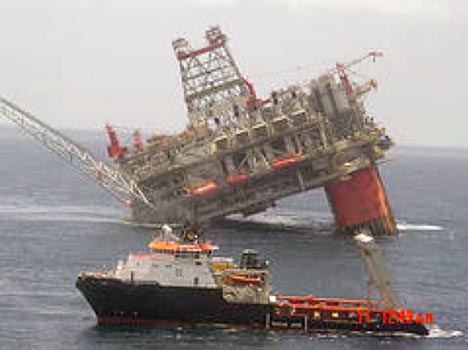
The lessons of this vulnerability were, perhaps, more than most years, evident in 2005. The first sign of problems came with the arrival of Hurricane Dennis in July. It was a storm which severely damaged the BP deep water Thunder Horse drilling platform. 


Thunder Horse after Hurricane Dennis


As that season wore on, the vulnerability of the platforms in the Gulf and the refineries that border it, were exposed in more intensity with the passage of Hurricanes Katrina and Rita. These threats and their analysis were one of the factors that helped, in that formative year, to bring an audience to the pages of The Oil Drum. The Gulf is now home to thousands of wells which, as the evidence from the Deepwater Horizon disaster last year reminded us, has moved further and further away from shore. That vulnerability is perhaps illustrated by a map showing the path of Hurricane Rita through the oil platforms off the Texas and Louisiana coasts.

More: http://feedproxy.google.com/~r/theoildrum/~3/XKeCSNGLX-I/8201

05 July 2011

Chrysler, GM, Toyota criticize EPA's ethanol-blend fuel proposal

Ah, ethanol. Big investment, small return. Thanks god for government subsidized ignorance. Good for big business, but that's about it. 
Automakers including Chrysler, GM and Toyota criticized an Environmental Protection Agency plan to allow gasoline containing up to 15 percent ethanol to be used in cars and trucks in the U.S., saying it may void warranties.

More: http://www.autonews.com/article/20110705/OEM05/307059860/1186

Oil Supply: Peak Oil and the Role of Enhanced Oil Recovery

"Peak Oil" is a reality that will continue to play a critical role in the lives of billions of people who live in the 195 countries of the world who depend on oil. Matthew Simmons, one of the leading and most knowledgeable advocates of Peak Oil before his untimely death in 2010, wrote a highly acclaimed book, Twilight in the Desert that discussed the oil industry in depth and also provided substantial proof of dangerously shrinking oil reserves in Saudi Arabia. Mr. Simmons' bottom line was simply, Peak Oil is real and we must take definitive action.
Most of the economies of the world have been built on the availability of "cheap oil", but unfortunately cheap oil no longer exists. In the late 1990's, oil sold for around $10 a barrel, but today oil is selling for around $100 a barrel and is expected to trend much higher in the years ahead.
The world currently consumes approximately 85 million barrels of oil per day or over 31 billion barrels of oil per year – or as author Peter Tertzakian states in his wonderful book on the oil industry, "One Thousand Barrels of Oil Per Second". The world actually uses about 1,000 barrels of oil per second—a staggering reality. The figures for the United States are about 22.5 million barrels of oil per day, or 7.5 billion barrels of oil per year. By the year 2025, the International Energy Agency (IEA) forecasts that the world demand for oil will grow by 50% – from 31 billion barrels of oil per year to over 47 billion barrels.. The big question is whether this is even possible? However, if this increase is possible where will this additional oil (energy) come from? The answers to those two questions are not exactly clear today—but they may be matters of life and death for millions of people—a sobering thought.
When Peak Oil arrives it doesn't mean that there is no more oil available. It simply means that there will be less oil available, demand cannot continue to be continuously satisfied, and only the most prosperous and wealthiest countries of the world will be able to afford the high cost of oil. However, someday (perhaps as early as the end of the 21st Century) there will be no more oil to be recovered because we all agree the supply of global oil is finite.

Oil Edge

More: http://peakoil.com/production/oil-supply-peak-oil-and-the-role-of-enhanced-oil-recovery/

Oil Prices Climb Back to Pre-Reserve Release Levels

Let's burn up all of our reserve oil just to keep from having to pay a little bit more right now. Yeah, that makes lots of sense. Let's artificially drive costs down, who cares what it will do down the road!
Crude raced higher Tuesday as energy bulls pushed Nymex oil back toward the $100-a-barrel mark, prices last seen before world governments said they would release crude from their reserves last month.
West Texas Intermediate jumped 2.1 percent to $96.89 a barrel on the New York Mercantile Exchange, decidedly above the $94.45 close of June 22, the day before the announcement on the release of 60 million barrels from reserves.
Brent crude on the ICE futures exchange finished $2.25 higher at $113.63 a barrel, and just below the June 22 high of $114.21. Brent touched $114.44 Tuesday.
"I think we could probably test that $100 mark again. I also think for it to be sustained up there, you'd have to have something a little more going on, like geopolitical problems or some demand pickup," said Anthony Grisanti, president of GRZ Energy.
Some traders said the price gains Tuesday came from speculation that demand could tighten if the world economy improves, but others pointed to momentum and technical factors.
The WTI August futures contract broke above its 200-day moving average of $96.18.
On June 22, the day before the announcement by the International Energy Agency that crude would be released from strategic reserves, it was at $95.41. It hit a low close of $90.84 on June 27.
"The volume is very light. The market is very quiet," said Addison Armstrong of Tradition Energy. "After repeated attempts to break through the 200-day moving average on August WTI, it broke through there this morning. A settlement above that would be constructive for further price gains for the remainder of the week. That's what's going on today, particularly with the dollar higher and equities staying unchanged."
Armstrong said Brent has already experienced a similar move. Brent, which more reflects international oil markets, hit a low of $102.28 on June 27.
"Brent's 200-day moving average was $101.96. The sell-off halted just above the 200-day and since then, we've been off to the races," said Armstrong.
Another bullish technical message was also at work for WTI. "There was an inverse head and shoulders on the charts, with the neckline at $96 (WTI)," said Michael Fitzpatrick, editor of the Energy Overview newsletter.
"We tested there several times...It formed a head around $88 to $90."
"It means that we've come a long way since those big sell offs in early May, and the bears are starting to lose some of their power, and the momentum is shifting back toward the bulls," said Fitzpatrick.
He said the market reacted positively to the Greek debt deal, and WTI could head to the $102 range. "That pushed it back toward technical levels and momentum just took over," he said.
But the market faces other near term hurdles, including Friday's June jobs report, widely expected to be weak.
Armstrong believes the IEA and U.S. Department of Energy could dip back into reserves to try to control rising prices. The IEA said the initial release was to make up for lost Libyan production. But Fitzpatrick said the criticism against the move was significant enough to crimp further actions.
"It would be like intervention in he currency markets in the 1980s. The intended purpose was to psychologically drive down prices and every time they intervened it almost expressed their desperation...it would be like putting gasoline on a burning fire," said Fitzpatrick.


01 July 2011

China’s Oil Demand Up 8% YOY

China’s apparent oil demand in May reached 39.4 million metric tons (mt) or an average of 9.31 million barrels per day (b/d), which was 8% higher year on year, as state-owned enterprises continued to increase output to meet local market supply needs, according to a Platts analysis based on recent statistics released by the Chinese government.

Still, May’s apparent oil demand was lower than April’s oil demand at 9.37 million b/d. It was also the second consecutive month of single-digit demand growth following the October 2010 to March 2011 period of monthly demand growth in excess of 10%.

“China’s crude oil imports and refinery throughput continued to grow last month, albeit at a slower pace,” said Calvin Lee, Platts senior writer, China. “More importantly, demand appears to have dropped another notch last month, contributing to rising inventories.”

Chinese refiners processed a combined 38.47 million mt of crude oil in May, or an average of 9.1 million b/d, equating to a 7.5% increase year over year.

Tasked by the central government to maintain adequate supplies of refined products in the local markets, domestic refineries continued to run at a rapid pace last month in a bid to prevent any oil shortages in the country. Yet, May’s throughput was only marginally higher than April’s crude runs at 9.09 million b/d.

With China refineries experiencing very low or negative margins, the Chinese companies are not well motivated to process more crude to meet the potential diesel demand surge, industry consultancy FACTS Global Energy said in a brief earlier this month.

In the meantime, net product imports last month were only 930,000 mt, or an average of 0.21 million b/d. Thus, net imports in May were the lowest this year, reflecting the fact that Chinese companies’ appetite for imports has ebbed due to high prices in the global markets.

According to an estimate released earlier this month by the National Development and Reform Commission (NDRC), China’s consumption of refined products in May grew 5.2% year on year to 20.19 million mt. But consumption was down 28,000 mt from April.

Coupled with increased production, the May drop in consumption helped to boost inventories and oil product stocks at month’s close were one million mt greater than a year ago, the country’s top economic planning agency said in its monthly industry report.

A month ago, NDRC reported that consumption of oil products in April grew at a faster pace of 8.3% year over year to 20.4 million mt. Oil product inventories at the end of April were 450,000 mt more than a year earlier.

In a separate report earlier this month, the NDRC said China’s state-owned oil majors Sinopec and PetroChina held in storage by late May more than 13 million mt of refined products, a level which the NDRC termed as a “reasonable level.”

“A recent supply crunch appears to have dissipated for now. But it could be a different story if power shortages worsen, forcing industrial users to fall back on diesel power generators, and peak summer demand for transportation fuels cause another tightening in supply,” Lee said.

RigZone

22 June 2011

A Review of Peak Oil Dangers

How can (the myth of) infinite growth continue when our energy sources that drive growth are either leveling off or in decline? The cost of most goods and services are directly related to energy costs, so a decline in oil production translates to an increase in the costs of those goods and services. If oil production decreases dramatically, then many of those goods and services may become too inefficient to maintain availability. Here are excerpts from an article at peakoil.com that gives some insight into the situation:

Global oil production (crude oil plus condensate) has been on a plateau / in decline for 7 years resulting in high energy prices that are feeding inflation, eroding family budgets and crippling the World economy. It is time for the international political community to awaken to the risks posed by Peak Oil. A British Government report published last week under a Freedom of Information Act (FOIA) request makes clear that civil servants working at the UK department of Energy and Climate Change (DECC) seem very aware of the risks posed by peak oil, and yet the British Government seems happy to continue to ignore warnings.

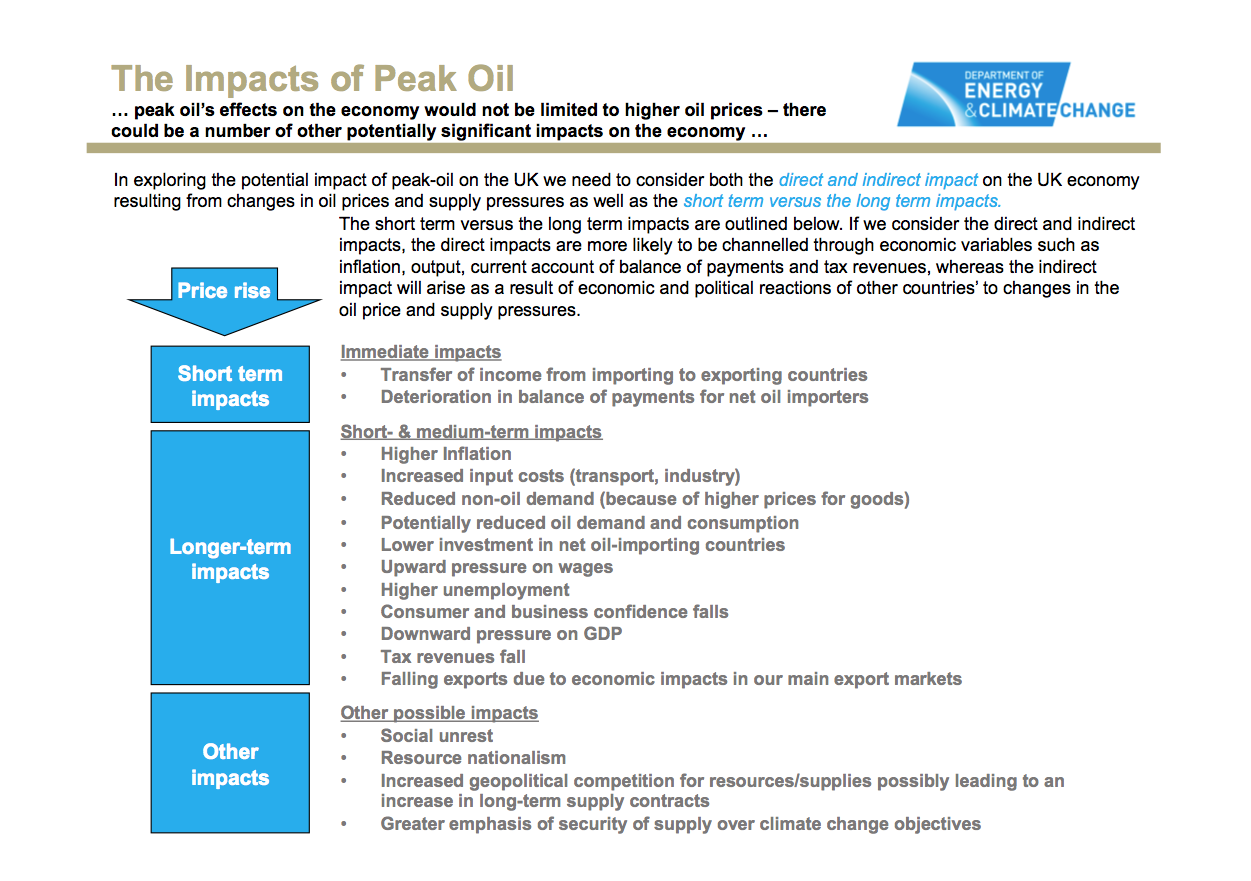
Last week The UK Guardian "newspaper" carried a story about an internal UK government report on peak oil that the government failed to make public and was eventually released under a Freedom of Information Act (FOIA) request made by French student Lionel Badal. The report, in form of a data and text rich Power Point presentation landed in my inbox (hat tip to Jerome) and I was quite amazed by the content. Slide 16 in particular caught my attention:

Of the 17 bullet points on the slide 16 have come to pass in the UK and in the neighbouring countries of Europe (click on slide to enlarge and open in separate window). Given that the research was conducted in 2007 and the report compiled in 2009 this conveys amazing insight by the DECC civil servants. Many may argue for different causes for the peak oil symptoms listed by DECC. But given the length of the list, near perfect correlation between forecast and events and the fact that global oil production has not increased for seven years, is it not safe to now draw the conclusion that peak oil lies at the heart of the UK and global economic woes?
Two important items are missing from the list and when these are taken on board the story is complete.

Methodology and observations

There are four main agencies reporting on global oil production:
1. The Energy Information Agency (EIA) in Washington that is a US Government agency.
2. The International Energy Agency (IEA) in Paris that is an OECD agency.
3. The BP statistical review of world energy, produced by BP, the UK based international oil company
4. The Joint Oil Data Initiative (JODI) that is a voluntary form of NGO.
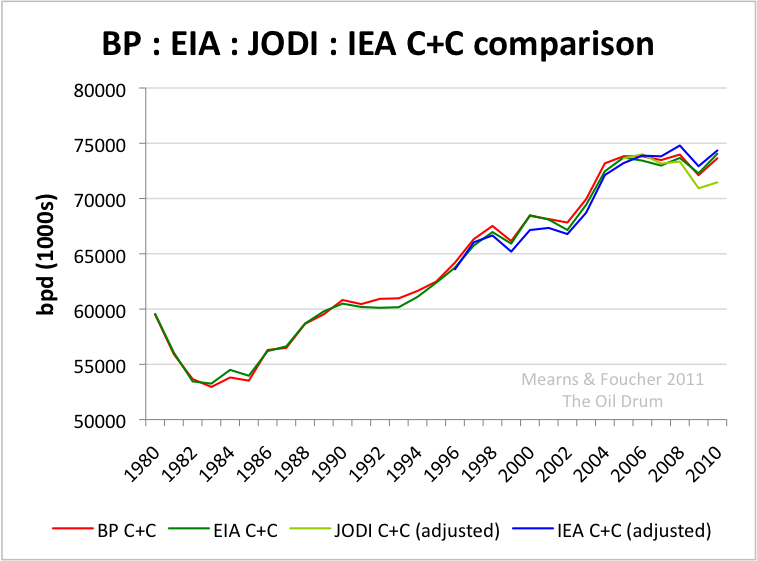
These agencies may gather information in different ways and they also report data in different ways using different categories and definitions of oil. The EIA reports monthly production data for crude oil + condensate (C+C) that includes synthetic crude oil produced from tar sands in Canada and Venezuela for all countries and giving a world total. JODI also reports C+C but only for 90 countries accounting for around 90% of global production. In the first post in this mini series, Dr Sam Foucher filled in the missing countries from the JODI data using EIA data giving an adjusted JODI proxy for global production that may then be compared with the EIA global total. BP report annualised average daily production data for C+C+NGL (natural gas liquids) and these data are not directly comparable to C+C reported by EIA and JODI. TOD commenter KLR deducted NGL data reported by the EIA from the BP data to get a BP proxy for C+C that is plotted in the chart up top.

Key Observations

The two previous posts in this series here and here examined the divergence between the EIA and JODI data since 2009 (see chart). Introducing BP and IEA data to the mix shows good agreement with the EIA and may tend to argue that these three sources provide the most reliable data. However, it may be the case that the EIA, BP and IEA are obtaining their data from the same source which remains unknown but rumored to be IHS. The source of JODI data is known to be direct reporting by national governments to JODI and it remains intriguing that the JODI data, which are based on government statistics, are diverging from the rest. The latest JODI production data reported for March 2011 shows production below 70 mmbpd. That is 6 mmbpd below the equivalent IEA data.
A production plateau was reached in 2004. The JODI data suggest that production may now be in decline whilst the EIA, BP and IEA data suggest that production remains on the range bound plateau. The difference here is really immaterial since high energy prices post 2007 caused by a failure to raise production to meet demand are traumatising the global economy.
The Oil Drum
Dinosaurs never believe you when you tell them that their extinction is imminent.

More at: http://peakoil.com/production/peak-oil-the-clear-and-present-danger/