Showing posts with label Natural Resources. Show all posts

19 October 2012

Al Gore and EROI

http://www.troll.me/images/al-gore-meme/iceage-100k-years-ago-human-made-climate-change.jpg

A recent Al Gore reference in a forum caught my attention because of the recent news of the arrest of Jill Stein at the recent presidential debate (Green Party candidate arrested outside debate site), so I am still not convinced that government is the best champion of environmental issues. Al Gore probably gained most of his attention during his crusade for green efforts simply due to his position in the Clinton presidency, and he rode that wave to champion a cause he was dedicated to, though likely more than a bit of corporate favoritism and government special interest have been the driving force behind Gore's successes.

I agree with some "green" initiatives, but I am also a supporter of free market economics which do not require the use of force through the state to promote (so I guess I'm a bit of a Green Libertarian in that regard), and rely on people's tendency to do what is in their best interest (which in voluntary exchanges is in the interest of both parties). I look critically at most issues, and on those in the realm of energy or environment I often consider how efficient solutions are to environmental issues.

I often find myself thinking of the idea of efficiency through EROI (Energy Returned on Energy Invested), or basically that if more energy is put into a process than is generated at the end of the process, it produces a net energy loss and is inefficient. In regards to many traditional fossil fuel energy sources, there has been a shift in the EROI of those resources toward a much less efficient return on energy inputs (the concept is pretty well described in There's No Tomorrow). Despite a ratio of barely over 5:1, sources like oil shale are significantly less efficient than crude oil from maybe a hundred years ago. Yet the trend continues toward decreased returns on investment, and I wonder if alternative energies will be efficient enough to displace declining energy sources.

24 January 2012

Conflict over Finite Resources

One big weakness in the public's ability to properly manage resources is knowledge. A couple of centuries ago, most people lived in rural environments rather than urban, and relied on availability of resources like water, wood for construction and heat, the ability to grow crops for food, to maintain their existence. They were focused on the ability to obtain their own resources, rather than have those resources provided for them through central planning by government. With that part of the process taken out of the hands of the consumer, there is little motivation to understand how the avilibity of resources can effect the end user, or the greater society.

As demand for water hits the limits of finite supply, potential conflicts are brewing between nations that share transboundary freshwater reserves. More than 50 countries on five continents might soon be caught up in water disputes unless they move quickly to establish agreements on how to share reservoirs, rivers, and underground water acquifers. The articles and analysis below examine international water disputes, civil disturbances caused by water shortages, and potential regulatory solutions to diffuse water conflict.

Water in Conflict - global policy

Strength comes from individuals and groups learning how to manage their own resources independent of governments. Consider the zenith resource; water. The one we can not live without. As governments and private corporations move to secure water rights and charge consumers increasingly greater amounts, we see conflict rising in many countries around the world. We also see conflict rising over privitization of food supplies around the world, with increases in costs to consumers leading to eruptions.

18 January 2012

Water: Blue Gold

Water is a resource that is so unknown to most people that they simply are ignorant to the reality of the scarcity of clean water. Water covers 70% of the surface of the planet, but only 2.5% of that is freshwater, with 70% of that in the frozen ice caps and most of the remainder in aquifers. That leaves 0.007% of the Earth's freshwater that is available to drink. Clean water is a finite resource. As such, it is subject to the same economic efforts to control and profit from it as oil, coal, natural gas, and other resources are. There is a great documentary called Blue Gold : World Water Wars, which gives insight to the scarcity of clean water and the results of that lack of availability.


Award-winning featured documentary narrated by Malcolm McDowell. Global Warming is an issue of 'how' we live, the water crisis is an issue of 'if' we live. DVD at www.bluegold-worldwaterwars.com

It may sound like paranoia, but that is why I set up a rainwater collection system. It was mostly to reduce municipal usage to water gardens and lawn, but in an emergency like a natural disaster where water supplies are cut off or contaminated (like Hurricane Katrina), 2,000 gallons of clean water can provide survival for a family of four for up to 800 days.

Human Appropriation of the World's Fresh Water Supply

16 January 2012

Peak People: The Interrelationship between Population Growth and Energy Resources

This is just the section regarding the human population effect of energy sources. Population growth has increased along with the industrialization that oil and other natural resources brought, but they are finite. As we crest the peaks of various resources, will we see population decline as well?
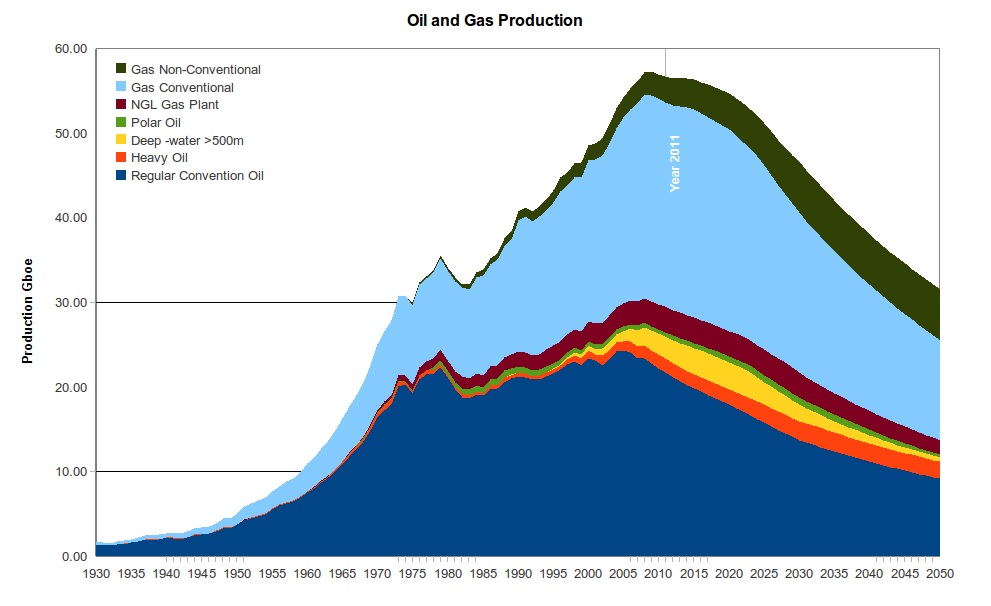
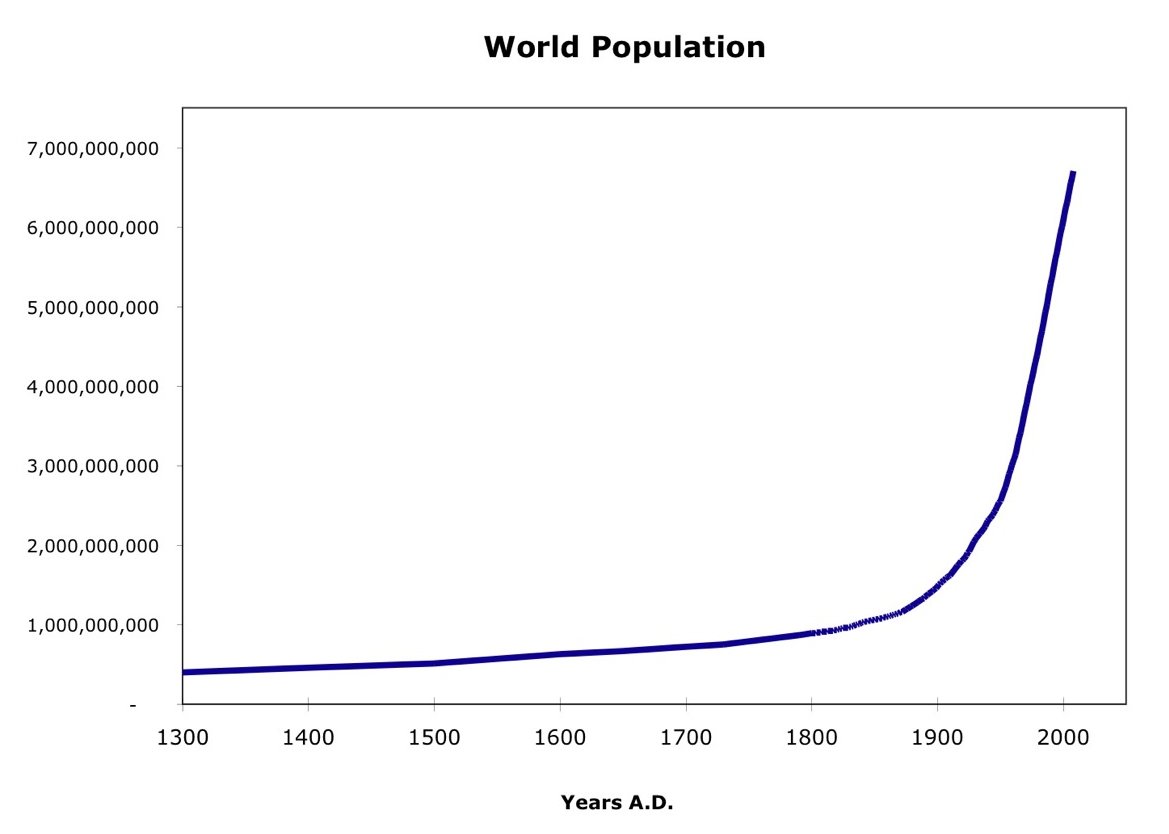
Figure 12 shows the sum-of-energies model of population growth versus actual population growth, projected to 2050.
Figure 12: World Population vs. Sum-of-Energies Population 800-2050

What Next? - Future Scenarios


There are three general scenarios that the world’s energy future may take. Their effects on population will be radically different. They are:
1. Continued fossil fuel growth
2. Fossil fuel decline and no sufficient substitute
3. Fossil fuel decline and a new source of energy

Scenario 1: Continued Fossil Fuel Consumption Growth

In this scenario, fossil fuel consumption continues to grow at similar rates to the recent past and population grows as projected by the United Nations to 9 billion people by 2050.
Based on the above sum-of-energies model, if Oil Population is close to reaching its peak, a much larger share of the world’s population growth will have to be driven by Coal Population, requiring much higher consumption of coal. Unless carbon sequestration technologies quickly become viable, this will have detrimental effects on climate change.
The increased importance of natural gas in the 21st century may also contribute to population growth, as the introduction of new energy sources has done in the past. But based on current trends natural gas will play a much smaller part than coal.
Or population may already be slowing more quickly than most analysts realise.[14] If so, the world’s population in 2050 may be substantially lower, closer to 7.5 billion people (1 billion for Biomass Population, 2.5 billion for Coal Population, 2.7 for Oil Population and 1.1 for Natural Gas Population equals 7.3 billion).

Scenario 2: Fossil Fuel Decline and no Sufficient Substitute

Figure 13 - Population/Energy Dependency - After Peak Energy Production
A decline in oil and gas production would mean a decline in energy inputs into society, a decline in productivity and, hypothetically, a decline in population. If population growth were related to oil production and oil production is beginning to decline, Oil Population will also decline – in other words, its growth curve may change from a slowing logistic curve, to a declining parabolic curve - and therefore a large component of global population will decline more quickly than most people anticipate.
Mortality rates may increase, as a population grown large through dependence on high quality energy sources now must allocate scarcer resources per person. This is evident in agriculture’s dependence on fossil fuel based fertilisers[15]. Without them, agricultural productivity decreases and less people can be fed. Human carrying capacity decreases.
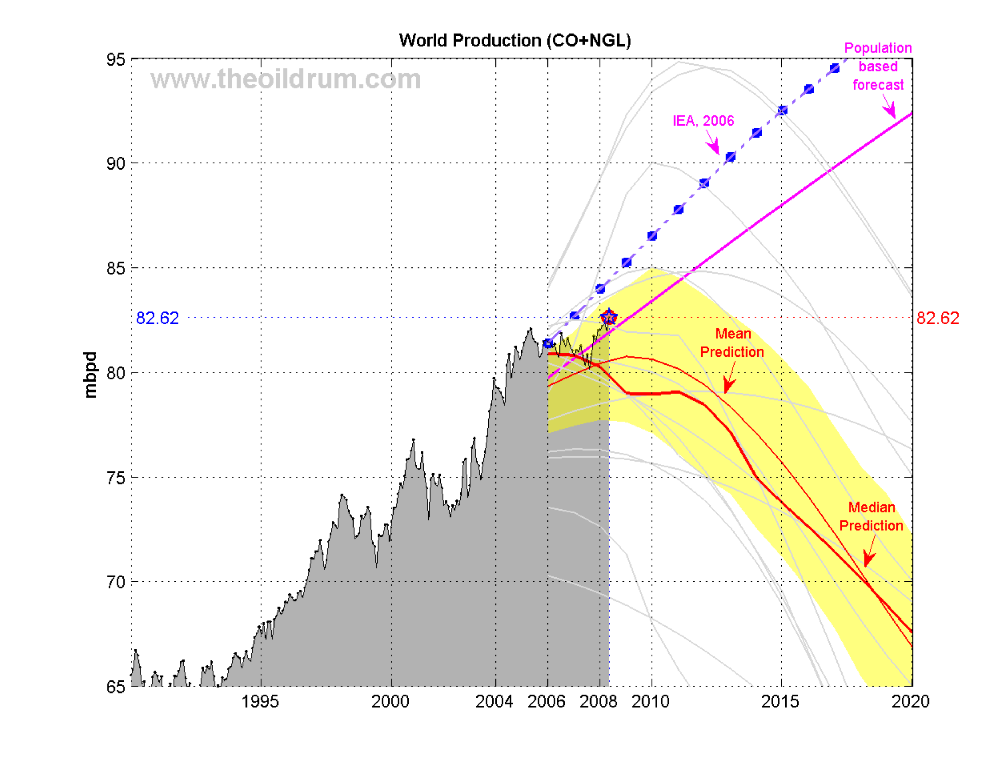
Figure 14 depicts projected world oil production to 2020. These figures are based on conventional crude oil resources and natural gas liquids (CO + NGL). They do not include unconventional oil resources such as shale oil, oil from tar sands, ultra-deep water oil or polar oil. These oil sources are not included because they are much more expensive to extract, in monetary terms but also in energy terms. In other words, a large amount of energy inputs are required to extract energy outputs from say, tar sands in north western Canada. Hence the net energy gain is lower, and these energy sources may not be as important in raising productivity and population ceilings.
Based on these projections, the 3.2 billion people that are dependent on oil in the sum-of-energies population model are in serious jeopardy in the next fifty years as the world’s remaining oil resources are consumed, and world population could suffer a precipitous decline.
Figure 14: Projected World Oil Production

Scenario 3: Fossil Fuel Decline and a New Energy Source

This scenario follows from Ester Boserup’s observations that many of humankind’s technological innovations have resulted from population pressures, or increased population densities. According to Boserup, demand-induced innovation led to the shift from hunter-gatherer societies to agricultural societies and from the use of wood to coal. One could speculate that a shortage of fossil fuels caused by population pressures would lead to yet more innovation and the discovery of newer and better sources of energy. From our vantage point though, it is not clear what these innovations might be or what new sources of energy would be capable of replacing fossil fuels.
A higher quality energy source, say fission, could lead to further productivity improvements, reducing the pressure on existing resources and further raising the ceiling on population size. But fission still lies closer to the realms of science fiction than science.
A lower quality energy source, like solar or wind power, is less efficient. It has less ability to perform work and to raise productivity. Another problem with low quality energy sources is that their net energy is low - they require a large proportion of energy in, to get some energy out - in contradistinction to oil and gas, which have high net energy values. A switch to a lower quality energy source from fossil fuels will put further pressure on other remaining energy sources, such as wood and coal. This could lead to further pressures on land and other resources and hence lower the population ceiling. Low quality energy resources do not support large populations.
Nuclear power is not the answer. To replace diminishing oil and gas (which currently provides the world with 60% of its energy resources) with nuclear power (which currently provides 5.6%) would not only require vast amounts of capital but would require vast amounts of high quality energy. In a period of declining oil and gas resources, existing energy sources would be getting scarcer.
Perhaps a new high quality source of energy will be found. This would then add a new energy component to population growth. This may lead to a raised population ceiling and an initial burst of population growth as population grows to occupy the space between the previous ceiling and the new ceiling. Then growth may slow again as a new equilibrium is reached.

Peak People: The Interrelationship between Population Growth and Energy Resources | Energy Bulletin

11 January 2012

Economic Downside of GMO Seed Industry

monsanto_rain
People say if farmers don't want problems from Monsanto, just don't buy their GMO seeds.
Not so simple. Where are farmers supposed to get normal seed these days? How are they supposed to avoid contamination of their fields from GM-crops? How are they supposed to stop Monsanto detectives from trespassing or Monsanto from using helicopters to fly over spying on them?
Monsanto contaminates the fields, trespasses onto the land taking samples and if they find any GMO plants growing there (or say they have), they then sue, saying they own the crop. It's a way to make money since farmers can't fight back and court and they settle because they have no choice.
And they have done and are doing a bucket load of things to keep farmers and everyone else from having any access at all to buying, collecting, and saving of NORMAL seeds.
[...]

THE BAD SEED
For decades, the Monsanto Corporation of St. Louis has been slowly dominating the world's supply of seed for staple crops (corn, soybeans, potatoes) -- a business plan that Monsanto's critics say is nothing short of diabolical. Monsanto says it is just devilishly good business.

Monsanto has spent over $30 billion in recent years buying numerous U.S. seed companies. As a result, two firms, Monsanto and Pioneer (recently purchased by DuPont), now control the U.S. seed business. Monsanto specializes in genetically modified seeds -- seeds having particular properties that Monsanto has patented.

The U.S. government is very enthusiastic about these new technologies. From the viewpoint of U.S. foreign policy, genetically modified seeds offer a key advantage over traditional seeds: because genetically modified seeds are patented, it is illegal for a farmer to retain seed from this year's crop to plant next year. 

To use these patented seeds, farmers must buy new seeds from Monsanto every year. Thus, a farmer who adopts genetically modified seeds and fails to retain a stock of traditional seeds could become dependent upon a transnational corporation. 
Nations, whose farmers are dependent upon corporations for seed, might forfeit considerable political independence. The Clinton/Gore administration has been aggressively helping Monsanto promote new, untested gene-altered products, by-passing U.S. health and safety regulations.
[...]
Monsanto: THE BAD SEED

Genetically modified seed giant Monsanto is notorious for suing farmers [PDF] in defense of its patent claims. But now, a group of dozens of organic farmers and food activists have, with the help of the not-for-profit law center The Public Patent Foundation, sued Monsanto in a case that could forever alter the way genetically modified crops are grown in this country. But before you can understand why, it's worth reviewing an important, but underreported aspect of the fight over GMOs. 

One of the many downsides to genetically engineered food is the fact that modified genes are patented by the companies that isolate them. This is not typically part of the story that gets much attention when you read about all those great (but nonexistent) magic seeds that will grow faster, better, cheaper, etc. and seem to forever remain "just around the corner."

As any music or movie lover knows from experience, patent and copyright law in this country is a mess. You only need to look at the music industry's successful campaign to sue random consumers over file-sharing to know that. Fun fact: no fiction copyright granted after 1929 -- whether a movie, television show, or book -- will ever be allowed to expire because that was the year of Mickey Mouse's "birth" and Disney has convinced Congress that Mickey should never fall into the public domain. That's one screwed up way to go about protecting the interests of authors. And forget about the folks over at the U.S. Patent Office -- it's clear that they have no idea what they're doing anymore.

[...]

Reversing roles, farmers sue Monsanto over GMO seeds | Grist

Better living through chemistry? Hardly. Mnosanto is strongarming the agriculture industry in America. Industrialized agriculture has decreased the labor need for food, but what Monsanto is doing is an effort to control the food supply through economics. Companies like Monsanto are impervious to government regulation, mostly due to the industry stocking the regulatory agencies with industry leaders. The future of food looks bleak without a movement to localize agriculture again.


10 January 2012

The Geopolitical Implications Of “Peak Everything” By Richard Heinberg


Reprinted from POST CARBON INSTITUTE

From competition among hunter-gatherers for wild game to imperialist wars over precious minerals, resource wars have been fought throughout history; today, however, the competition appears set to enter a new—and perhaps unprecedented—phase. As natural resources deplete, and as the Earth's climate becomes less stable, the world's nations will likely compete ever more desperately for access to fossil fuels, minerals, agricultural land, and water.

Nations need increasing amounts of energy and raw materials to produce economic growth, but the costs of supplying new increments of energy and materials are burgeoning. In many cases, lower-quality resources with high extraction costs are all that remain. Securing access to these resources often requires military expenditures as well. Meanwhile the struggle for the control of resources is re-aligning political power balances throughout the world.

This game of resource "musical chairs" could well bring about conflict and privation on a scale never seen before in world history. Only a decisive policy shift toward resource conservation, climate change mitigation, and economic cooperation seems likely to produce a different outcome.

America's best shot at expanding its oil interests lie in the deep oceans and the Arctic.[7] However, both military maneuvering and engineering-mining efforts will see diminishing returns as costs rise and payoffs diminish. 

Arctic borders map 

Climate change is likely to exacerbate geopolitical rivalry with China, although it's important to recognize that climate risks will not be evenly apportioned. Unstable states will become more unstable, poor nations poorer. Many of the areas of greatest geopolitical risk are also most at risk for impacts from climate change. Equatorial regions are most likely to suffer from extreme drought and occasional catastrophic flooding, while some northern temperate regions may see some transitory benefit from warming—though unpredictable weather will plague nearly every region. With the melting of Arctic ice, new mineral and energy resources in the northernmost portions of the planet will become accessible, as will new trade routes; this may lead to a "Cold Rush" of economic and military exploitation and open a new theater for international conflict.[8]


Jintao and Obama at APEC

The world's governments engage continually in both cooperative and competitive behavior, though sometimes extremes of these tendencies come to the fore—with all-out conflict exemplifying unbridled competition. Geopolitics typically involves both cooperative and competitive strategies, with its long-term goal centering on the furtherance of national interest (including increased control of territory and access to resources). Recent decades have generally seen increasing international cooperation, showing up in the expansion of trade, the proliferation of treaties and conventions, and the development of international institutions for justice and conflict resolution. The UN, WTO, World Bank, International Criminal Court, as well as regional economic (e.g., Shanghai Cooperation Organization, or SCO) and military (e.g., NATO) cooperation groups exemplify this trend. While some of these efforts appear to be geopolitically motivated, others seem to be genuine attempts to reduce both international tensions and global environmental problems while advancing human rights.

This trend toward increasing international cooperation could see a reversal in coming years and decades. As noted above, history is replete with instances of resource scarcity fomenting conflict.[9] In such cases, competitive advantage typically resides either with nations that have domestic resources and the ability to defend them; or with nations that develop a vigorous, flexible, and motivated military force able to take advantage of other nations' weaknesses in order to seize control of their resources.

[...]

22 December 2011

Home Rainwater Collection System: First Rain


Last night's rainfall filled up both of our 200 gallon tanks, with the overflow of one going to a 1,500 gallon tank. Wunderground lists total rainfall as 0.59 inches for this area. Not bad for the first collection, though we still want to add a couple more 1,500 gallon tanks to the system.


This got me wondering how much rain we can actually collect. Here is the formula:

Rainwater collection from roofs can be calculated using the following formulas:
  • 1 inch of rain on a 1000 square feet roof yields 623 gallons of water; or
Helpful Rainwater Collection Formula


We added on a 700 sq ft addition, making the total near 1,500 sq ft of roof that collects into this system. So, the math on that would be 1,500 X 623 / 1,000 = 934 gallons collected from 1 inch of rainfall for our system. Eventually the front of the house will be added to the system. We are too close to the Austin metro to drill a well, so this is the next best thing.

Since last night's rainfall was only 0.59, the math would be 0.59 X 934 = 551 gallons. Not bad at all. Even with the cost of a couple more 1,500 gallon tanks, this is still very practical, with the current setup saving enough money to pay for itself in a couple of years.

18 December 2011

Home Rainwater Collection System

We have been wanting to do rainwater collection since moving in to our home. After adding on another 900 sq ft to the house, we increased our collection potential significantly. After doing the math, we found that the volume collected will have the potential to exceed half of what we draw from the municipal supply for watering the lawn and gardens. The double-bonus is that the entire system including gutters will pay for itself in water savings in about two years.

We started with two 200 gallon Poly-Mart tanks at gutter downspouts, one on either side. They were made locally and sold by another local business, TanksForLess, which is a bonus in our permaculture efforts. Greg at Big Rain Seamless Gutters did a great job with the gutters and the downspouts into the tanks.

Here is the new design for the 200 gallon tank, with a fitting halfway up the side, good for adding a faucet for filling a bucket, etc. I believe the upper overflow is a 3.5" size, but haven't set that end up yet, since we don't have an overflow tank for storage at that end yet.

Each tank will also have a ball valve with a garden hose fitting for easy access, though getting down from 1.5" or 2" takes some creativity.

At the far end of the NW corner of the yard is a 1,500 gallon tank, with room next to it for another to match.

The composter will have to move when we get a second tank in this corner.

There is a good 2-3' drop from the house to the low end of the yard where we set the first of our 1,500 overflow tanks that will serve as the primary storage. We plan on adding another 1,500 next to it, with a pair at the other end of the yard near the gardens and future greenhouse.

Digging the trenches was fun. We had to rent a trencher for that part, since we have lots of limestone just under the surface. It still took the better part of a day to dig two trenches of about 200' total, so the trencher bucked like a wild mustang and wore me out as much as it would have dug by hand, but in less time.
Future plans might include a 2,500 gallon Poly-Mart tank at the other end where we have more open space near the gardens. We may even add gutters to the front of the house to collect for the front gardens, but the homeowner's association doesn't make sustainability project easy.

15 December 2011

Unsustainable Industrialized Urbanization

In Earth's past, mortality rates were significantly different from today, making larger families necessary for the unit's survival. Even just a century ago in this country, a significantly larger portion of our population lived off the land in rural areas. They lived in a way that was more sustainable, mostly due to the lower population volume. The chance for children to reach adulthood was mush slimmer compared to today, so parents tended to have more children to increase the odds of a family surviving to the next generation. A large family also meant that the work required to provide the resources for the family's survival could be spread across the family, with more children meaning that a farm could be sustained by a family, raising the crops and livestock required to feed the family. As populations became urbanized and lost that ability to provide for themselves and the independence it rewarded, we shifted to a reliance upon the industrialization of agriculture through fossil fuels. As we come to realize the limitations of those fossil fuels, we should also recognize that we could potentials see that urbanization as a risk to the modern urbanized lifestyle.

09 December 2011

Overpopulation and Resource Consumption

I see overpopulation as one of the greatest environmental risks we deal with today. Problems like overuse of resources and pollution are direct results of that growth. Werner says that there are five main concepts in population growth and resource consumption that need to be addressed:
  1. overpopulation is a leading environmental problem,
  2. exponential population growth and development leads to faster depletion of resources,
  3. population grows exponentially,
  4. why population prediction is difficult,
  5. population is not evenly distributed throughout the world.
As the population increases, the carrying capacity is stretched, requiring further growth to come with efficient use of resources and space, as well as reductions in waste and pollution. In terms of energy, wasteful countries like the US will require significant changes in how we live as the global population continues to increase. The Human Population Growth we experience comes with a price; limitations on our planet to support those increases. I believe that de-urbanization and de-industrialization can be a part of the solution to meeting that challenge, but education needs to be at the front, teaching people everywhere about environmental limitations and risks to our efforts to maintain civilization.

04 December 2011

Energy, Population Growth, and Transition

Along the lines of a massive energy crisis that comes after the peak in production, I believe imagine that localization would return, both in economic and social terms. I have been writing about this sort of situation for a few years now, seeing a change coming in the future. But that collapse can open the way to a rebirth. Our society has become accustomed to quick fixes and convenience without great concern for sources or environmental impacts. Population growth has been tied to energy availability, with a boom coming during the beginning of the industrial revolution.


http://3.bp.blogspot.com/_XRzC81zNSrw/S7o1lS1RzSI/AAAAAAAAAfM/vSj70tp-t0Y/s1600/world_population_growth.jpg

The problem with that boom is that eventually a bust will follow, just as in economics. Since we know that we are past peak oil, we can also consider that we are beyond peak coal, and probably past peak natural gas. I believe that this is true as evident in the methods of mining and extraction used today. Strip-mining for coal creates massive devastation on the environment, leaving little more than wasteland behind, a far cry from early mining methods. Fracking (hydraulic fracturing) for natural gas brings massive pollution and possibly geological instability to regions where this practice is active (increasing at a massive rate). Fracking also destroys many local water sources, leaving the environment incapable of sustaining life. If there resources were plentiful, would we be destroying the world trying to extract every last bit possible?

http://www.usnews.com/dbimages/master/4992/GR_PR_SaudiHarvest.png

What we need is to proactively address this situation by reducing reliance upon those resources while we can, before a collapse of the availability of those resources brings our society to a grinding halt, as we saw in 1973 Oil Embargo (caused by economics related to oil producers' lack of faith after the end of the Gold Standard, rather than by a lack of supply). Reducing reliance upon foreign resources can being back independence if a similar situation occurs again. Without a transition to sustainable energy, we are oil addicts at the mercy of the suppliers.

http://drew3000.net/wp-content/uploads/2007/11/gasline.gif

03 December 2011

Cost of Nonrenewable Energy Sources

Think about it this way; the costs of using nonrenewable energy sources are significantly more expensive, though the true costs are generally not realized until the resource becomes limited, usually before it becomes impractical. Unless we diversify energy sources now, when we hit the peak production of resources like oil, we will start to see increases in costs and reductions in availabilities, just as with Peak Oil. The reality is that we have likely passed the peak of oil discovery and it's usage continues to increase despite that decrease.

As production begins to decline, I am only surprised that we continue to find consumption increasing in the face of that stark reality. Some say we have recently passed that peak in production, which makes me think that we passed the peak in discovery a generation or two in the past. That realization makes me think we are long overdue to cease reliance upon oil as a sustainable energy source.


Oil Discoveries

02 December 2011

Biomass Energy

https://blogger.googleusercontent.com/img/b/R29vZ2xl/AVvXsEiwOof14srDDDqBFZmSVS7l_g2-kifZ0nM1yeonqNTHYIrAMtrpeVFne5rsR1DUTISJGvmBIBbqL0bsZ-L2Tg4ZM0JcVNBljBT2ul5HDIa4PUphd6IdJGSGQsfM_jlPjJxuI_qCpyhEM-k/s1600/biomass_co2_cycle.jpg 
  
Biomass is organic material that is often discarded as waste, byproducts of industry. This includes everything from paper to food waste to sawdust and grass clippings. These materials decompose naturally, though has potential energy stored that can be utilized. By burning biomass, we can use that energy to heat homes and offices. As biomass decomposes, it releases methane naturally. We can capture that gas in landfills and use it to supplement methane extracted from the ground. We can do similar things with manure produced on large farms, turning that waste into energy to reduce overall waste and and to reduce reliance upon extracted nonrenewable resources.
Biomass is matter usually thought of as garbage. Some of it is just stuff lying around -- dead trees, tree branches, yard clippings, left-over crops, wood chips (like in the picture to the right), and bark and sawdust from lumber mills. It can even include used tires and livestock manure.
Your trash, paper products that can't be recycled into other paper products, and other household waste are normally sent to the dump. Your trash contains some types of biomass that can be reused. Recycling biomass for fuel and other uses cuts down on the need for "landfills" to hold garbage.
This stuff nobody seems to want can be used to produce electricity, heat, compost material or fuels. Composting material is decayed plant or food products mixed together in a compost pile and spread to help plants grow.

The Energy Story - Chapter 10: Biomass Energy

30 November 2011

Renewable vs Nonrenewable Resources

Renewable resources consist of energy sources like, wind, solar, geothermal, and tidal. These sources are not reduced significantly by their usage. Those energy resources are readily accessible, though reliance upon nonrenewables keeps us from transitioning to those more practical energy sources. As we pass the peak energy realities of nonrenewable energy sources like oil and coal, we see more and more of a need to make that transition to avoid a collapse. The peak of finite resources is the top production or discovery level of those resources, where they enter a decline, but consumption sadly continues on, often continuing it's increase.

In contrast, nonrenewable resources like oil, coal, and natural gas take such a significant amount of time to produce that there is no practical replenishment without our lifetime. Even obvious limitations on clean water for consumption can make that resource's limitations nearly nonrenewable. If we use all that there is available, that resources can be considered depleted. Those resources take significant time to replenish, so our reliance and usage must be responsible.

Peak Oil

Life After the Oil Crash


We consume four times as much oil as we discover today. At that rate, we will most certainly run out of oil eventually, most likely in a few generations at most.

28 November 2011

Earth's Population Carrying Capacity

http://www.cosmosmith.com/images/population_reciprocal.jpg

When scientists talk about overpopulation, they are usually referring to a population exceeding its biological carrying capacity which is defined as "the maximum number of animals that a specific habitat or area can support without causing deterioration or degradation of that habitat. Likewise, human overpopulation is when the number of people can not be permanently maintained without depleting resources and without degrading the environment and the people's standard of living. One might consider that if we were to consume less, we may be able to live within the carrying capacity of the planet. However, we should not reduce our consumption or degrade our lifestyle in order to claim that the human race is not overpopulated. Especially not as our number continues to increase.

Some may argue about how much vacant room there still is on Earth to hold billions and billions of more people. However, one must consider the fact that people are all made up of atoms of matter, and that matter which comprises our bodies has had to come from the earth itself. The majority of the matter in our bodies is in the form of water. At the rate our population is presently growing, within 1200 years, our oceans would be entirely converted into people as more and more water is required to build the bodies of people. This is not even considering the water required for drinking, washing, irrigating crops, sea life, etc.

Hypothetically, if the human population continued to grow at our present rate, the mass of people would be equal to the mass of the earth within 1600 years. In 2300 years at this rate, the mass of people would fill up our entire solar system, and if you were able to create matter from nothing in order to make people, in roughly 5300 years a great sphere of humanity with a radius of over 150 light-years would be expanding faster than the speed of light.

These are not predictions of things that may happen. Limitations will halt our growth much sooner. The intent is instead to illustrate how rapidly our population is growing and to express that this obviously can not continue. The growth occurs so suddenly that the population can become unmanagable without sufficient warning, after it is too late to prevent catastrophe. In short, we are in great danger of using up both space and resources.

Wonder about how much more human population can increase? Not much, since our world can only likely see small increases before we hit the limits of sustainable growth and expend our resources. I hope we never get that far...

Earth's Population Carrying Capacity

Free Energy vs Energy Industry Profits

Converting solar to electric energy is not the complicated part, it is changing the focus of the energy industry as a whole. With so much focus and corporate profit on maintaining the current fossil fuel-based energy system, change needs to be localized, as does the reduction on those fossil fuels. In electric energy, transmission is the greatest loss of energy in the process. Creating vast solar arrays in regions when the sun is constant does capture and convert a great deal of energy into electricity for use, but being nowhere near the point of use makes it a highly inefficient solution, just as coal plants are today, wasting much of the energy produced in transporting it where it will be used. Localizing production of solar energy is one highly efficient way to capture that energy and utilize it right at the point of use. Storage systems are still a necessity if that energy is not put to use immediately upon conversion, so batteries or similar devices are still a necessity.

Other supplemental systems that take advantage of electromagnetic currents of the planet are another option for localized energy conversion into a form we can use anywhere, without the need of massive, inefficient power plants. John Bedini developed his monopole device to do just that, reduce reliance upon inefficient sources and work toward a new era of inexpensive energy. Further back, Nikola Tesla experimented in capturing and converting energy without relying on inefficient sources that degraded the environment. Changing the way that people use and capture energy is the greatest hurdle, but that is easier than forcing the energy industry to move toward sustainable solutions. Free energy is not something that big oil or coal companies are willing to invest in, and they have a history of using the government's monopoly on force to silence these innovations, simply to avoid losing profits.

Save Water by Converting Your Toilet to Dual Flush with This $20 Retrofit Kit


Last year we covered the basics behind converting your toilet to a dual flush but since then an easier and cheaper option has hit the market. Using the HydroRight Drop-In Dual Flush Converter ($18.80 at Amazon) you can convert just about any toilet to dual flush in about five minutes using no tools.
The video from the manufacturer above uses an eight year-old kid to emphasize how easy to install the kit. All you really need to do is turn off the water using the valve behind the tank, remove the flapper and toilet handle, replace those with the new ones from the HydroRight kit, and turn the water back on.
The manufacturer claims that most users will recoup the cost of the retrofit kit within two months of water bills and that within a year you'll save enough water to fill a swimming pool.
If you're looking to make your home more efficient the retrofit kit seems to be a safe bet; the small cost offers a nearly immediate return-of-investment.

HydroRight

Save Water by Converting Your Toilet to Dual Flush with This $20 Retrofit Kit - Lifehacker

16 November 2011

PBS Nature Braving Iraq Documentary

This is a great documentary on the rebuilding of Iraq's natural marsh wetlands after being nearly destroyed by Saddam Hussein's government during his reign. One of the reasons for it's destruction was cultural; to destroy the people who lived in this region, their sustainable environment was destroyed.

Braving Iraq ~ Introduction | Nature | PBS

Since the 2003 invasion of Iraq, news about the fate and future of this Middle Eastern country has been at the forefront of our national consciousness, making an impact on our daily lives, appearing in every newspaper and news program, the subject of endless numbers of personal and political discussions. But if you think you’ve heard every imaginable story about life within Iraqi borders, think again. There is at least one major element in this geopolitical drama that the American media has mostly overlooked, and it lies at the cross section of regional politics and the natural environment. NATURE’s Braving Iraq unravels this tale about what was once one of the richest and most important wetlands in the world – from its virtual destruction by a ruthless dictator to its exciting, new prospects for a miraculous recovery.

As recently as the 1980’s, Iraq’s Mesopotamian Marshes were reminiscent of the Garden of Eden – indeed, many biblical scholars believe they are one and the same. Fed by the combined waters of the Tigris and the Euphrates rivers, this enormous marshland of over 6,000 square miles dominated southern Iraq. For more than 7,000 years, these wetlands provided a bountiful home for both wildlife and humans. A large population of indigenous people, the Ma’dan Tribes known as Marsh Arabs, had thrived there for centuries. But in the 1990’s, due to political conflict, Saddam Hussein attempted to eradicate them – not through systematic extermination, but by destroying the marshes on which they depended for survival. Massive canals were dug, diverting river water away from the wetlands and towards the Persian Gulf. Huge embankments were built to prevent water from entering the marshes. What had been a green paradise twice the size of the Everglades shrank to less than 10% of its original size. Most of it was transformed into a parched, lifeless desert. The wildlife and the people were forced to leave.

But the story did not end there. Due to the imagination and the efforts of a coalition of individuals, restoration of the marshes has become more than a dream. Civil strife, serious security incidents and droughts make for slow progress, but various groups are chipping away at the embankments, trying to successfully flood the marshes once again. Azzam Alwash, an engineer raised on the banks of the Euphrates, left Iraq for America to escape from Saddam’s regime, but he has returned to undertake one of the largest habitat recreation projects in the world. Filmmakers David Johnson and Stephen Foote follow Azzam, chronicling his efforts to breathe new life into the green paradise he remembers from his childhood, while also navigating the inherent dangers of working in a dangerous and politically volatile region.

Is there any hope that such a massive ecosystem can be brought back to life? Have the exiled rare birds of the marsh, such as the marbled teal and the Basra reed warbler, survived? And will they return to their old territory? Success is uncertain, but some Iraqis feel that the fate of the country itself is tied to the fate of the marshes – and as small signs of hope for natural recovery begin to appear, Iraq’s political future seems to brighten as well.

Video: Braving Iraq: An Excerpt from "Nature" | Watch Need to Know Online | PBS Video

28 October 2011

Senators Raise ‘Serious Concerns’ About State Department Study on Tar Sands Oil Pipeline | Tar Sands Action

Three key senators today questioned the U.S. State Department about its dealings with a Canadian company seeking U.S. approval to build a crude oil pipeline from Canada to the Gulf of Mexico.

The State Department is responsible for deciding whether to approve the billion-dollar Keystone XL pipeline project. TransCanada, the company trying to build the pipeline, reportedly was permitted to screen private firms bidding to perform an environmental impact study.

“We find it inappropriate that a contractor with financial ties to TransCanada, which publicly promotes itself by identifying TransCanada as a ‘major client’, was selected to conduct what is intended to be an objective government review,” the senators said.
http://cdn.lightgalleries.net/4bd5ec0174be3/images/tar_sands_ex_-37-1.jpg 
Anyone still think that this process is any less destructive to our environment than oil rigs that spill into our oceans or fracking that destroys the water table? These companies and our supporting government are just bowing to the almighty dollar, discarding environmental concerns.

Senators Raise ‘Serious Concerns’ About State Department Study on Tar Sands Oil Pipeline | Tar Sands Action

Environmental groups have raised new concerns about the close ties between Barack Obama, Hillary Clinton and lobbyists for the controversial Keystone XL project to carry crude from the tar sands of Alberta to the refineries of Texas.

Friends of the Earth said on Thursday they were expanding their freedom of information request for emails between State Department officials and the pipeline company after learning of seven more pipeline lobbyists who had worked on Obama and Clinton's presidential campaigns, or had ties to Bill Clinton.
http://www.oldottawasouth.ca/images/stories/OOS_tarsands_big.jpg

How long until we are literally mining in our own backyards for even more limited natural resources?
Environmental groups trying to block the pipeline had initially focused on the role of Paul Elliott. Elliott, the main lobbyist in Washington for TransCanada pipeline company, had been a senior official on Clinton's campaign in 2008."The presence of so many former Clinton associates on the lobbying roster for polluter clients on a high-profile controversy suggests a clash with the repeated campaign pledges of greater transparency and tougher dealings with lobbyists by Secretary Clinton's boss, President Obama," the blog said.


Concern over close ties between Obama, Clinton and tar sands

NY Times Leading Media Fight Against Fracking

Hydraulic fracturing, or "fracking," got a clean bill of health this week in the first scientific look at the safety of the oil and production practice.
But the headlines about the study did not always reflect that. Many, such as "Scientific Study Links Flammable Drinking Water to Fracking," pointed toward the fracturing process as a culprit. Even the press release accompanying the study was titled "Hydrofracking Changes Water Wells."
The NY Times is probably singularly responsible for the new PR barrage of pro-mining industry processes in the States. The efforts against the industry are due to concerns over destruction of the water supply in the upper Hudson river valley. Imagine what would happen if the NYC metro were unable to meet the clean water needs of the entire population. We could never truck in enough drinking water to sustain the population, the metro would be wiped out.
People in the oil and gas industry commonly say "fracking" to describe just one part of the whole gas exploration and production process. Chemical-laced water and sand are blasted underground to break apart rock and release gas. Purists would say it is not really even part of "drilling" but actually the "completion" phase. The study released this week, done by scientists at Duke University, suggested that gas drilling causes methane gas to leak into people's water and sometimes their homes (Greenwire, May 9). But methane contamination is not caused by injecting chemicals down the well. It is caused by bad well construction during drilling.
But to many outsiders, particularly industry critics, fracking and drilling are the same thing. Advances in fracturing technology made possible the current shale gas drilling boom, so they have taken to lumping all shale gas production under the banner "fracking," deeming it a new form of natural gas drilling.
http://www.desmogblog.com/sites/beta.desmogblog.com/files/blogimages/Natural_Gas_Fracking_0.jpeg
The study released this week, done by scientists at Duke University, suggested that gas drilling causes methane gas to leak into people's water and sometimes their homes (Greenwire, May 9). But methane contamination is not caused by injecting chemicals down the well. It is caused by bad well construction during drilling.
Environmentalists and other industry critics consider this distinction to be nothing more than word games concocted by oil and gas lobbyists. Whatever you call it, they say, gas production is fouling air and water. Spills and methane contamination fall under existing state and federal regulations. Fracturing, by contrast, received a specific exemption from the Safe Drinking Water Act from a Republican Congress and then-President George W. Bush in the 2005 energy bill.

Baffled About Fracking? You're Not Alone - NYTimes.com