05 July 2011

Chrysler, GM, Toyota criticize EPA's ethanol-blend fuel proposal

Ah, ethanol. Big investment, small return. Thanks god for government subsidized ignorance. Good for big business, but that's about it. 
Automakers including Chrysler, GM and Toyota criticized an Environmental Protection Agency plan to allow gasoline containing up to 15 percent ethanol to be used in cars and trucks in the U.S., saying it may void warranties.

More: http://www.autonews.com/article/20110705/OEM05/307059860/1186

Oil Supply: Peak Oil and the Role of Enhanced Oil Recovery

"Peak Oil" is a reality that will continue to play a critical role in the lives of billions of people who live in the 195 countries of the world who depend on oil. Matthew Simmons, one of the leading and most knowledgeable advocates of Peak Oil before his untimely death in 2010, wrote a highly acclaimed book, Twilight in the Desert that discussed the oil industry in depth and also provided substantial proof of dangerously shrinking oil reserves in Saudi Arabia. Mr. Simmons' bottom line was simply, Peak Oil is real and we must take definitive action.
Most of the economies of the world have been built on the availability of "cheap oil", but unfortunately cheap oil no longer exists. In the late 1990's, oil sold for around $10 a barrel, but today oil is selling for around $100 a barrel and is expected to trend much higher in the years ahead.
The world currently consumes approximately 85 million barrels of oil per day or over 31 billion barrels of oil per year – or as author Peter Tertzakian states in his wonderful book on the oil industry, "One Thousand Barrels of Oil Per Second". The world actually uses about 1,000 barrels of oil per second—a staggering reality. The figures for the United States are about 22.5 million barrels of oil per day, or 7.5 billion barrels of oil per year. By the year 2025, the International Energy Agency (IEA) forecasts that the world demand for oil will grow by 50% – from 31 billion barrels of oil per year to over 47 billion barrels.. The big question is whether this is even possible? However, if this increase is possible where will this additional oil (energy) come from? The answers to those two questions are not exactly clear today—but they may be matters of life and death for millions of people—a sobering thought.
When Peak Oil arrives it doesn't mean that there is no more oil available. It simply means that there will be less oil available, demand cannot continue to be continuously satisfied, and only the most prosperous and wealthiest countries of the world will be able to afford the high cost of oil. However, someday (perhaps as early as the end of the 21st Century) there will be no more oil to be recovered because we all agree the supply of global oil is finite.

Oil Edge

More: http://peakoil.com/production/oil-supply-peak-oil-and-the-role-of-enhanced-oil-recovery/

Oil Prices Climb Back to Pre-Reserve Release Levels

Let's burn up all of our reserve oil just to keep from having to pay a little bit more right now. Yeah, that makes lots of sense. Let's artificially drive costs down, who cares what it will do down the road!
Crude raced higher Tuesday as energy bulls pushed Nymex oil back toward the $100-a-barrel mark, prices last seen before world governments said they would release crude from their reserves last month.
West Texas Intermediate jumped 2.1 percent to $96.89 a barrel on the New York Mercantile Exchange, decidedly above the $94.45 close of June 22, the day before the announcement on the release of 60 million barrels from reserves.
Brent crude on the ICE futures exchange finished $2.25 higher at $113.63 a barrel, and just below the June 22 high of $114.21. Brent touched $114.44 Tuesday.
"I think we could probably test that $100 mark again. I also think for it to be sustained up there, you'd have to have something a little more going on, like geopolitical problems or some demand pickup," said Anthony Grisanti, president of GRZ Energy.
Some traders said the price gains Tuesday came from speculation that demand could tighten if the world economy improves, but others pointed to momentum and technical factors.
The WTI August futures contract broke above its 200-day moving average of $96.18.
On June 22, the day before the announcement by the International Energy Agency that crude would be released from strategic reserves, it was at $95.41. It hit a low close of $90.84 on June 27.
"The volume is very light. The market is very quiet," said Addison Armstrong of Tradition Energy. "After repeated attempts to break through the 200-day moving average on August WTI, it broke through there this morning. A settlement above that would be constructive for further price gains for the remainder of the week. That's what's going on today, particularly with the dollar higher and equities staying unchanged."
Armstrong said Brent has already experienced a similar move. Brent, which more reflects international oil markets, hit a low of $102.28 on June 27.
"Brent's 200-day moving average was $101.96. The sell-off halted just above the 200-day and since then, we've been off to the races," said Armstrong.
Another bullish technical message was also at work for WTI. "There was an inverse head and shoulders on the charts, with the neckline at $96 (WTI)," said Michael Fitzpatrick, editor of the Energy Overview newsletter.
"We tested there several times...It formed a head around $88 to $90."
"It means that we've come a long way since those big sell offs in early May, and the bears are starting to lose some of their power, and the momentum is shifting back toward the bulls," said Fitzpatrick.
He said the market reacted positively to the Greek debt deal, and WTI could head to the $102 range. "That pushed it back toward technical levels and momentum just took over," he said.
But the market faces other near term hurdles, including Friday's June jobs report, widely expected to be weak.
Armstrong believes the IEA and U.S. Department of Energy could dip back into reserves to try to control rising prices. The IEA said the initial release was to make up for lost Libyan production. But Fitzpatrick said the criticism against the move was significant enough to crimp further actions.
"It would be like intervention in he currency markets in the 1980s. The intended purpose was to psychologically drive down prices and every time they intervened it almost expressed their desperation...it would be like putting gasoline on a burning fire," said Fitzpatrick.


German court hears case against euro bailouts

(Reuters) - Germany's top court prepared on Tuesday to hear a legal challenge to the euro zone bailouts, but its finance minister said he was certain that aid payments had not violated German or European law.

The Karlsruhe-based Constitutional Court convened to consider a lawsuit brought by six eurosceptic plaintiffs against German contributions to the rescues of Greece, Ireland and Portugal.

The court is not likely to block the German government's participation in bailouts altogether, or force the government to withdraw its commitments to current rescue plans, legal experts say.

But most experts, including government sources, say they expect the court to impose conditions making it harder for the government to provide fresh aid. For example, parliament's lower house may be given a bigger say in approving future bailouts.
More Here..

Help End The Fed

On June 22nd several cities held End The Fed flash mob rallies. When I arrived at the Fed I was surprised to find a small army of NYPD surrounding the building. Purchase high quality, full color glossy "Bernanke Bucks" to spread the word about the Federal Reserve in your own area or please make a donation to help us purchase 10,000 End The Fed and Ron Paul 2012 flyers to be distributed on Wall St. and around New York City this summer!

01 July 2011

Great Recession cooks Friedman and Keynes

Great idea. Let's give mare freedom to a group that is already free of oversight and does not have to answer to the People. End the Fed!

Commentary: Two great theories, neither up to today's task

NEW YORK (MarketWatch) — Some of the biggest names in economics gathered at the University of Chicago in November 2002 for a 90th birthday celebration of the brightest star of them all. Milton Friedman, a Nobel laureate and seminal thinker, was returning to the university where he had made his name.

One of the speakers was a Federal Reserve governor, Ben S. Bernanke. In a scholarly address, he endorsed Friedman's view that the Fed was instrumental in causing the Great Depression with a tight monetary policy that turned a contraction into something much, much worse.


More Here..


Companies Abandoning California at an Accelerated Rate « A Geek With Guns

So, Kalifornia's government is slowly imploding and collapsing. It's been going that way for decades, so I find it humorous that so many are surprised. The latest attempt by the state has been to increase taxes to balance the budget, but the private businesses are fighting back, by leaving the state.
Governments need to learn that the only way to effectively eliminate their debt is to spend less money. People will survive without government services but they won’t take loosing 90% of their earnings.
Wow, could it really be that simple?

More at: Companies Abandoning California at an Accelerated Rate « A Geek With Guns

China’s Oil Demand Up 8% YOY

China’s apparent oil demand in May reached 39.4 million metric tons (mt) or an average of 9.31 million barrels per day (b/d), which was 8% higher year on year, as state-owned enterprises continued to increase output to meet local market supply needs, according to a Platts analysis based on recent statistics released by the Chinese government.

Still, May’s apparent oil demand was lower than April’s oil demand at 9.37 million b/d. It was also the second consecutive month of single-digit demand growth following the October 2010 to March 2011 period of monthly demand growth in excess of 10%.

“China’s crude oil imports and refinery throughput continued to grow last month, albeit at a slower pace,” said Calvin Lee, Platts senior writer, China. “More importantly, demand appears to have dropped another notch last month, contributing to rising inventories.”

Chinese refiners processed a combined 38.47 million mt of crude oil in May, or an average of 9.1 million b/d, equating to a 7.5% increase year over year.

Tasked by the central government to maintain adequate supplies of refined products in the local markets, domestic refineries continued to run at a rapid pace last month in a bid to prevent any oil shortages in the country. Yet, May’s throughput was only marginally higher than April’s crude runs at 9.09 million b/d.

With China refineries experiencing very low or negative margins, the Chinese companies are not well motivated to process more crude to meet the potential diesel demand surge, industry consultancy FACTS Global Energy said in a brief earlier this month.

In the meantime, net product imports last month were only 930,000 mt, or an average of 0.21 million b/d. Thus, net imports in May were the lowest this year, reflecting the fact that Chinese companies’ appetite for imports has ebbed due to high prices in the global markets.

According to an estimate released earlier this month by the National Development and Reform Commission (NDRC), China’s consumption of refined products in May grew 5.2% year on year to 20.19 million mt. But consumption was down 28,000 mt from April.

Coupled with increased production, the May drop in consumption helped to boost inventories and oil product stocks at month’s close were one million mt greater than a year ago, the country’s top economic planning agency said in its monthly industry report.

A month ago, NDRC reported that consumption of oil products in April grew at a faster pace of 8.3% year over year to 20.4 million mt. Oil product inventories at the end of April were 450,000 mt more than a year earlier.

In a separate report earlier this month, the NDRC said China’s state-owned oil majors Sinopec and PetroChina held in storage by late May more than 13 million mt of refined products, a level which the NDRC termed as a “reasonable level.”

“A recent supply crunch appears to have dissipated for now. But it could be a different story if power shortages worsen, forcing industrial users to fall back on diesel power generators, and peak summer demand for transportation fuels cause another tightening in supply,” Lee said.

RigZone

European Financial Collapse Defrauded by Foreign Banks

Greece is on the verge of collapse, which could crash the EU in a big way. Goldman Sachs helped the Grecian government cook their books in regard to their debt in order to slip into the EU, but that debt had to go somewhere. It has been slipping back onto the books over the last couple of years and will likely lead to a default, which will do massive damage to the country, probably to the EU, likely the world as well.
Goldman Sachs helped the Greek government to mask the true extent of its deficit with the help of a derivatives deal that legally circumvented the EU Maastricht deficit rules. At some point the so-called cross currency swaps will mature, and swell the country's already bloated deficit.
The only way that this will yield a positive result is if individual nations let go of globalization goals and focus on localized recoveries.

This credit disguised as a swap didn't show up in the Greek debt statistics. Eurostat's reporting rules don't comprehensively record transactions involving financial derivatives. "The Maastricht rules can be circumvented quite legally through swaps," says a German derivatives dealer.
http://www.spiegel.de/international/europe/0,1518,676634,00.html
“Greece and Ireland are among countries in an ‘intolerable’ economic situation, which may lead to bailouts or even an exit from the euro area by the end of next year, according to Standard Bank Plc…
“‘Countries like Ireland and Greece may not be able to grow out of the current crisis,’ [Steve Barrow, head of Group of 10 foreign-exchange strategy at the bank] said in a telephone interview today. ‘With interest-rate cuts, exchange-rate depreciation and significant fiscal support all off limits for these countries, bailouts or even pullouts from EMU may happen next year.’”

The Constitution and the Debt Limit

It's a sad commentary on the state of affairs in Washington that the only occasions on which the United States Constitution is invoked with any reverence by the political establishment is when it appears to support the expansion of federal power. The topic du jour in the capital is the 14th Amendment, and whether it authorizes President Obama, in effect, to ignore the congressionally-imposed debt ceiling
Read more...


The Lifeboat Hour at The Lifeboat Hour


An original mix of music with madness, laughter with loss, skills with sorrow, community with calamity, love with grief, and joy in the moment.

The Lifeboat Hour - 06/26/11

The State Of The Economy


The U.S. economy is like a rubber band that is being pulled in several different directions at the same time.  Everyone knows that at some point it is going to snap, but nobody is quite sure exactly when it is going to happen.  Right now, the state of the economy is not good, and it is going to get a whole lot worse.  Sadly, most Americans don't even understand the economic fundamentals well enough to be able to ask the right questions to our politicians.  Today, the United States consumes far more wealth than it produces every single month.  That means we are continually getting poorer.  U.S. debt is also rising at a far greater rate than U.S. GDP is.  On an individual level, if your assets were going down every single month and if you were going into more debt every single single month it would be easy to understand what was happening.  However, most Americans can't really seem to grasp what is taking place on a national level.  Our politicians and the mainstream media just keep telling them that everything is going to be okay and they just keep believing it.

These days our leaders are resorting to increasingly desperate measures in order to help revive the economy.  On Thursday, Barack Obama decided to release 30 million barrels of oil from the U.S. strategic oil reserve.
Yes, that will drive down oil prices for a few days, but what is going to happen someday if we actually need to use that strategic oil reserve?
But in many ways you can't blame Obama for trying.  He desperately wants to get reelected and he knows that his campaign will be highly dependent on the state of the economy.  Look for Obama to pull out all the stops as we get closer to the fall of 2012.
Sadly, the truth is that it almost does not matter what the Democrats or the Republicans do at this point.  The long-term trends are so powerful now that it would take a miracle to reverse them. We are facing an "economic tsunami" that is just going to keep on destroying middle class America.
If you went to a store today, and there were two somewhat similar products sitting on the shelf and one cost ten times more than the other one, which one would you buy?
Well, that is the situation facing American workers today.  They have been pushed into one giant globalized labor pool, but big corporations are allowed to pay workers on the other side of the globe slave labor wages.  It costs ten times more (at least) to hire a blue collar American worker than it does to hire a blue collar worker in most areas of Asia.
As a result of the globalization of labor, we have seen a mass exodus of jobs out of the United States, and wages for many of the jobs that remain have been significantly depressed.
There simply are not nearly enough jobs for all Americans at this point.
Recent college grads are finding this out.  A new study that was conducted by Rutgers University discovered that over 30 percent of all those that graduated from college between 2006 and 2010 were not able to get a job within six months of graduation.
But unemployment is only part of the story.  There are millions upon millions of Americans that are "underemployed" today.
There are hordes of highly educated, hard working Americans that are working temporary or part-time jobs at close to minimum wage because that is all they can get.
With good jobs being so scarce, American families are finding it more difficult than ever to make ends meet.
One recent survey found that 9 out of 10 U.S. workers do not expect their wages to keep up with the rising cost of basics such as food and gasoline over the next year.
I talked about the rising cost of food in my recent article entitled "Why Are Food Prices Rising So Fast?"  Today, one out of every seven Americans is already on food stamps, and if the cost of living keeps rising this quickly we are going to see millions more of our fellow citizens clamoring for government assistance.
The decline of the American consumer is having other effects as well.
For example, pre-orders for Christmas toys from China are way down.
It looks like this holiday season is not going to be as "merry" as usual.
It would be nice if we could say that the economy is improving, but that simply is not the case.
American households are in a far different place than they were prior to the recent recession.
For example, did you know that home values in the United States have plummeted $6.6 trillion since the peak back in 2007?
U.S. homeowners have taken the brunt of that decline.  According to the Federal Reserve, average home equity has fallen from 61 percent in 2001 to 38 percent in the first quarter of 2011.
That is a colossal shift.
If U.S. homeowners only own 38 percent of their homes, then who owns the rest?
The banks do.
Doesn't that just make you feel all warm and fuzzy inside?
Health care is another area where American families are getting squeezed.
Today, the United States spends more on health care per person than any other country in the world.
Sadly, we are also one of the sickest populations on the planet.
What is up with that?
Once upon a time the United States had a middle class that was the envy of the entire globe.
Now it is being ripped to shreds at every turn.
Today, approximately half of all Americans say that they could not come up with $2,000 within 30 days without selling away some possessions.
The vast majority of us are basically flat broke and surviving from month to month.
Meanwhile, our vaunted financial system just may be on the verge of another meltdown.
There has been all sorts of volatility in the marketplace recently and there are all kinds of signs that Wall Street is about to go into panic mode.
For example, Moody's recently warned that it may downgrade the debt ratings of Bank of America, Citigroup and Wells Fargo.
Barclays Capital, Goldman Sachs, Bank of America, JPMorgan Chase and Morgan Stanley are all either already laying workers off or are rumored to be considering it.
Frank Davis, director of sales and trading with LEK Securities, says that there is a lot of pessimism on Wall Street right now....
"There's a lot of emotion in this market at the moment, and the conversations among traders are nearly all leaning toward the bear side"
As the financial system spins out of control, the Federal Reserve is increasing the number of workers that it is "embedding" at the big Wall Street banks.
I guess the Fed wants to keep a closer eye on things as they come crashing down.
Sadly, so much of this would be much easier to fix if our nation was not drowning in debt.
Since Barack Obama was elected, the national debt has increased by nearly 4 trillion dollars. If you and I went out today and started repaying that 4 trillion dollars at a rate of one dollar per second, it would take over 120,000 years to do it.
Most Americans have a hard time comprehending these kinds of numbers. Janet Tavakoli tried to put our debt situation into perspective in her latest column....
David Walker, the former U.S. comptroller general, says it's even worse than that. When he takes into account future obligations for Medicare, Social Security, Federal debt, Military retirement, Civil servant retirement, and more, we owe $546,663 per household. That doesn't even include your local debt -- it may not be as bad as if you lived in Illinois, but it's substantial nonetheless -- and personal debt including mortgages and consumer debt that average more than $120,000 per household.
But you don't have to toss wild numbers around to get an idea of how much trouble we are in.
As I have written about recently, there is increasing evidence all around us that the collapse of society is accelerating.  We are seeing disturbing reports of civil unrest pop up all over the U.S. at an alarming rate.
According to a CBS affiliate in Chicago, earlier this week approximately 50 young people conducted a shocking mob robbery of a drug store located on the Magnificent Mile in Chicago....
Some 50 young people barged into a Walgreens at Michigan and Chicago on the Magnificent Mile on Tuesday afternoon. They took bottled drinks and sandwiches off the shelves, then ran off, CBS 2′s Suzanne Le Mignot reports.
When large groups of young people get together and agree to commit crimes that should be a huge red flag for all of us.
We are a nation that is deeply, deeply divided.  Hatred is growing and the love of most Americans is growing cold.
As I have written about previously on "The American Dream", the American people are actually encouraged to hate one another these days....
The truth is that the "establishment" is constantly trying to divide us and get us fighting with one another.  They pit the Republicans against the Democrats (even as though control both sides).  They pit one race against another.  They pit one gender against another.  We are told that the rich are against the poor, the north is against the south, urban is against rural and that there are even "generational battles" going on.  Frustration and hate are rapidly growing in the United States today, and a lot of that frustration and hate is unfortunately aimed at the targets that the mainstream media has programmed all of us to hate.  Meanwhile, those at the top of the pyramid who are controlling the whole game love it when we are divided because we can never become united and challenge their control.
We need to come together as a nation.  If we don't, we are going to face an unprecedented nightmare when the economy collapses.
So what do you think about the state of the economy?  Please feel free to leave a comment with your opinion below....


Shell Game

The entire U.S. financial system has become a gigantic shell game.  While it is still in motion, a shell game can be mesmerizing to watch.  But when it ends the consequences can be painful.  So exactly what is a shell game?  According to Wikipedia, a shell game "is portrayed as a gambling game, but in reality, when a wager for money is made, it is a confidence trick used to perpetrate fraud."  Sadly, that is exactly what is happening on the global stage today.  The Federal Reserve is like a con artist that is desperately trying to stay one step ahead of everyone else.  The folks at the Fed know that the debt that the U.S. government has accumulated is not sustainable and will eventually collapse.  They also know that the U.S. dollar is eventually going to become essentially worthless.  But for now the Federal Reserve is putting on a grand show and is trying to keep everyone believing that the game is fair and legitimate.
The Federal Reserve's much ballyhooed "QE2" program has come to an end, and most Americans still don't even understand what "quantitative easing" is.
Basically, what the Federal Reserve did was zap hundreds of billions of dollars into existence out of thin air and used them to buy U.S. government debt.
It is kind of like if you are playing poker with someone and they reach under the table and pull out a gigantic pile of chips which they add to their own stack.
In the process, the big banks made a ton of money because they are the ones that the Federal Reserve was buying U.S. Treasuries from and the U.S. government was happy because all of the new government debt being issued was getting soaked up by the system.
Of course all of this is one giant Ponzi scheme, but up to this point the Federal Reserve has gotten away with it.
Meanwhile, average Americans were getting the short end of the stick because all of this new money has been causing the price of food and the price of gas to go up.
But now QE2 has come to an end.
So does that mean that  "quantitative easing" is going to be completely over?
No, not really.  The shell game continues.
The Federal Reserve has announced that it is going to continue to purchase U.S. government debt using the proceeds from maturing debt that it already owns.  It is being projected that the Federal Reserve will purchase 300 billion dollars in U.S. government debt over the next 12 months using this method.
This isn't being called "quantitative easing", but that is essentially what it is.  In fact, one CNN article is calling it "QE2.5"....
QE2 is just about done. But the Federal Reserve will still be buying massive amounts of long-term Treasuries.
In fact, the Fed's purchases over the next year will likely be at least $300 billion. That's half the size of QE2 -- even if QE3 never takes place.
But "quantitative easing" is just one example of a shell game run by the Fed.  There have been lots more.
For example, during the financial crisis the Federal Reserve started loaning gigantic amounts of cash to the big banks for next to nothing.
The big banks took a lot of this cash and invested it in U.S. Treasuries.  U.S. Treasuries typically only pay a couple of percentage points, but when you can borrow massive amounts of nearly free money suddenly they become extremely profitable.
Instead of loaning out large amounts of money to all of us to get the economy rolling again, the big banks just parked huge amounts of cash in U.S. Treasuries and watched the risk-free profits come rolling in.
In this way, the Federal Reserve helped big banks make a ton of money and they supported the exploding federal government debt load at the same time.
The chart below shows that the amount of U.S. government securities owned by the banks has increased exponentially since the beginning of the financial crisis.  This is not an accident....
The Federal Reserve does lots of stuff like this.  They know that they will probably never get audited and they know that the American people don't understand all of this financial stuff, so they get away with it.
But what if something came along and suddenly interrupted the shell games that the Fed is playing?
Well, that is exactly what this debt ceiling debate threatens to do.
If the U.S. defaults, even for a short time, all of the financial shell games and Ponzi schemes are going to be greatly jeopardized.
If Congress does not raise the debt ceiling by August 2nd, the U.S. government will start defaulting, and that would unleash a tremendous amount of chaos.
A recent USA Today article described some of the things that might happen if the government was not able to borrow any more money later this summer....
If Social Security, Medicare, Medicaid, unemployment benefits, payments to defense contractors and interest payments on Treasury bonds were exempt, that would be all the government could afford for the month. No money for troops or veterans. No tax refunds. No food stamps or welfare. No federal salaries or benefits.
In addition, financial markets all over the world would be severely rattled.  If the default only lasted a couple of days it would not be bad, but if the U.S. ended up defaulting on debts for weeks or months it really would be cataclysmic.
The International Monetary Fund warned this week that a failure to raise the debt ceiling by August 2nd would be a "severe shock" to global financial markets.
In this case, the IMF is actually right.  In fact, a "severe shock" would be an understatement.
The managing director of Standard & Poor's has told Reuters that if the U.S. starts defaulting, the credit rating on U.S. Treasury bonds that are supposed to mature on August 4th will go all the way down from AAA to D....
Chambers, who is also the chairman of S&P's sovereign ratings committee, told Reuters on Tuesday that U.S. Treasury bills maturing on August 4 would be rated 'D' if the government fails to honor them. Unaffected Treasuries would be downgraded as well, but not as sharply, he said.
"If the U.S. government misses a payment, it goes to D," Chambers said. "That would happen right after August 4, when the bills mature, because they don't have a grace period."
A lot of Americans believe that Congress should just refuse to raise the debt ceiling and let the whole system crash.  But the reality is that most Americans simply have no idea how much of a financial disaster that would be for the entire globe.
Yes, the U.S. national debt is completely and totally out of control.  Yes, something must be done about it urgently.
But defaulting on our debts and wrecking global financial markets is not going to solve much of anything.
Sadly, even if we do not default on our debts this year, the reality is that the U.S. government debt bubble is going to collapse one way or another eventually.
The path that we are currently on is not even close to sustainable.
Even as our debt expands exponentially, the U.S. economy is being systematically dismantled and we are becoming poorer as a nation.
As I have written about previously, jobs and businesses are leaving the United States at a staggering rate because of cheap labor overseas and because of ridiculous regulations.  The business environment in this country has become incredibly toxic.
Stanford University's David Cheriton was instrumental in helping Sergey Brin and Larry Brin develop Google.  Now he is warning that the anti-business policies of Barack Obama and the U.S. Congress are wrecking the economy....
"When you look at, say, Larry and Sergey of Google, they made billions of dollars, but they contributed many more billions of dollars to the US economy. And so we should be empowering these people; we should be cultivating more of the next generation of those types. And yet, I think there's almost a hostile attitude towards people who have been successful in this country."
As I wrote about the other day, the rate of new business creation in the United States has been declining steadily since the 1980s.  We won't have a chance at a real economic recovery until the creation of small businesses is encouraged once again.
But today businesses of all sizes are trying to avoid U.S. taxation.  Right now, the United States has the highest corporate tax rate in the entire world.  Sadly, all businesses have a great deal of incentive to avoid incorporating in the United States.
A recent article in The Wall Street Journal talked about this phenomenon....
As savvy investors and entrepreneurs search for ways to minimize the impact of the U.S. tax system, with its relatively high rates and global reach, they are increasingly incorporating overseas, tax experts say. Some private-equity firms have relocated U.S. companies or divisions to tax-haven countries. U.S. multinational companies have spun off foreign subsidiaries in tax havens. U.S. start-ups are even beginning life offshore.
Large numbers of really good companies are fleeing the United States.
What we are doing is not working.
So what is the answer?
Well, as I have said before, we need to entirely scrap the current tax system and come up with something that works in the 21st century.
But we all know that is not going to happen.
Meanwhile, our economy continues to unravel.  According to the Department of Labor, the unemployment rate rose in 210 metro areas during the month of May, and it only declined in 131 metro areas.
Consumer confidence in this country has hit a seven-month low, and average Americans are becoming increasingly anxious about the state of the economy.
Unfortunately, most of our politicians don't seem to have any answers and the Federal Reserve is just trying to keep their shell games going.
Every single day the U.S. economy is getting weaker.  Every single day we are going into more debt.  Every single day we get closer to the collapse of the entire system.
Time is running out.
I hope you are making good use of the time you still have left.


22 June 2011

All Eyes On Bernanke

"The average interest earning on a savings account in the bank is around 0.10 percent, therefore, a $100,000 savings account earns you $100.00 in a year. Many people are now wondering if they should just keep there money under the mattress." sounds like sound advice to me. Converting it to gold or silver, which increases as the dollar devalues, is probably an even more sound investment. 

Almost every trader and investor will be waiting patiently for the Federal Open Market Committee(FOMC) interest rate decision, that announcement is expected to be released this afternoon. The Federal Reserve Bank Chairman, Ben Bernanke, will hold his second press conference after the Fed funds rate decision is announced. Therefore, the major stock indexes could remain range bound until all of these events take place.


Many traders and investors are expecting the Federal Reserve to leave the Fed funds rate unchanged at zero to a quarter percent. This rate is the overnight lending rate to the large financial institutions such as J.P. Morgan Chase & Co.(NYSE:JPM), Wells Fargo & Co.(NYSE:WFC), Bank of America Corp.(NYSE:BAC), and Citigroup Inc.(NYSE:C). These banks can basically borrow unlimited capital at zero percent. This important lending rate has been at this level since December 2008. This is the reason why bank customers hardly earn any interest on their savings account. In essence, savers get punished for not taking risk these days. The average interest earning on a savings account in the bank is around 0.10 percent, therefore, a $100,000 savings account earns you $100.00 in a year. Many people are now wondering if they should just keep there money under the mattress.


Many traders and investors are wondering if Chairman Ben Bernanke will hint that he will start another quantitative easing program soon. Currently, the Federal Reserve is scheduled to end its $600 billion quantitative easing program on June 30, 2011. This program has helped to create cash reserves on the banks balance sheets. These banks can then take this money and invest in stocks, commodities, and other market instruments helping to inflate the stock markets higher. Last summer, when the stock market faced its most severe correction and a possible double dip recession, Ben Bernanke announced his current QE-2 program and the stock markets skyrocketed higher. We can only wonder if QE-3 will be announced soon if the major stock indexes continue to slump.


Nicholas Santiago


A Review of Peak Oil Dangers

How can (the myth of) infinite growth continue when our energy sources that drive growth are either leveling off or in decline? The cost of most goods and services are directly related to energy costs, so a decline in oil production translates to an increase in the costs of those goods and services. If oil production decreases dramatically, then many of those goods and services may become too inefficient to maintain availability. Here are excerpts from an article at peakoil.com that gives some insight into the situation:

Global oil production (crude oil plus condensate) has been on a plateau / in decline for 7 years resulting in high energy prices that are feeding inflation, eroding family budgets and crippling the World economy. It is time for the international political community to awaken to the risks posed by Peak Oil. A British Government report published last week under a Freedom of Information Act (FOIA) request makes clear that civil servants working at the UK department of Energy and Climate Change (DECC) seem very aware of the risks posed by peak oil, and yet the British Government seems happy to continue to ignore warnings.

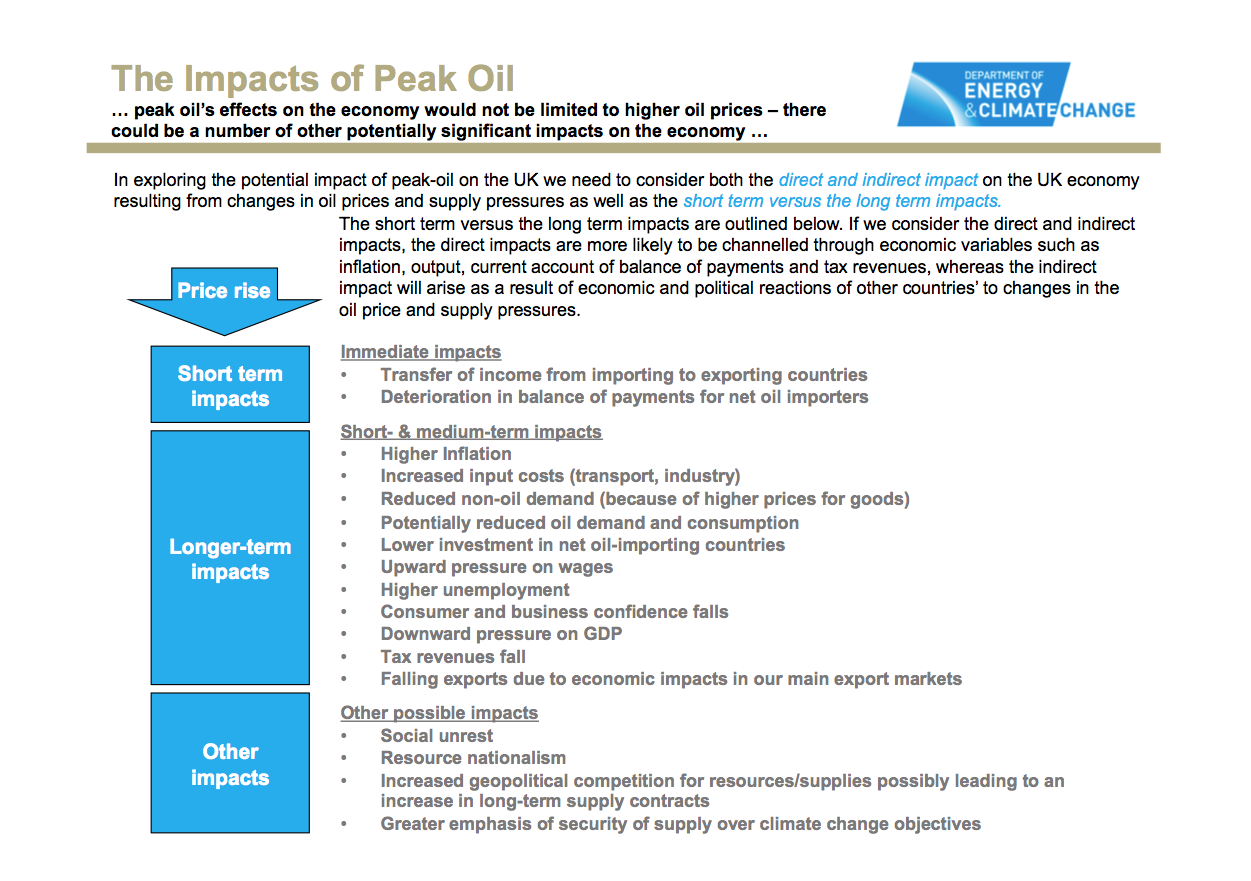
Last week The UK Guardian "newspaper" carried a story about an internal UK government report on peak oil that the government failed to make public and was eventually released under a Freedom of Information Act (FOIA) request made by French student Lionel Badal. The report, in form of a data and text rich Power Point presentation landed in my inbox (hat tip to Jerome) and I was quite amazed by the content. Slide 16 in particular caught my attention:

Of the 17 bullet points on the slide 16 have come to pass in the UK and in the neighbouring countries of Europe (click on slide to enlarge and open in separate window). Given that the research was conducted in 2007 and the report compiled in 2009 this conveys amazing insight by the DECC civil servants. Many may argue for different causes for the peak oil symptoms listed by DECC. But given the length of the list, near perfect correlation between forecast and events and the fact that global oil production has not increased for seven years, is it not safe to now draw the conclusion that peak oil lies at the heart of the UK and global economic woes?
Two important items are missing from the list and when these are taken on board the story is complete.

Methodology and observations

There are four main agencies reporting on global oil production:
1. The Energy Information Agency (EIA) in Washington that is a US Government agency.
2. The International Energy Agency (IEA) in Paris that is an OECD agency.
3. The BP statistical review of world energy, produced by BP, the UK based international oil company
4. The Joint Oil Data Initiative (JODI) that is a voluntary form of NGO.
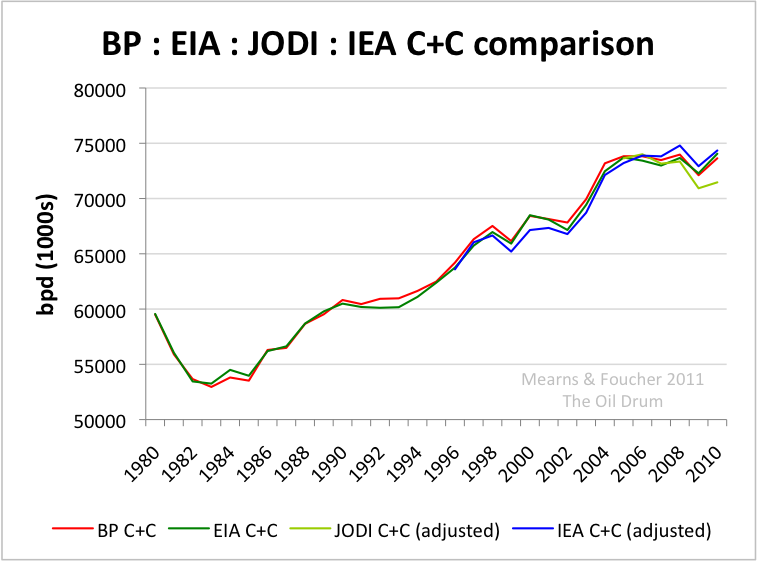
These agencies may gather information in different ways and they also report data in different ways using different categories and definitions of oil. The EIA reports monthly production data for crude oil + condensate (C+C) that includes synthetic crude oil produced from tar sands in Canada and Venezuela for all countries and giving a world total. JODI also reports C+C but only for 90 countries accounting for around 90% of global production. In the first post in this mini series, Dr Sam Foucher filled in the missing countries from the JODI data using EIA data giving an adjusted JODI proxy for global production that may then be compared with the EIA global total. BP report annualised average daily production data for C+C+NGL (natural gas liquids) and these data are not directly comparable to C+C reported by EIA and JODI. TOD commenter KLR deducted NGL data reported by the EIA from the BP data to get a BP proxy for C+C that is plotted in the chart up top.

Key Observations

The two previous posts in this series here and here examined the divergence between the EIA and JODI data since 2009 (see chart). Introducing BP and IEA data to the mix shows good agreement with the EIA and may tend to argue that these three sources provide the most reliable data. However, it may be the case that the EIA, BP and IEA are obtaining their data from the same source which remains unknown but rumored to be IHS. The source of JODI data is known to be direct reporting by national governments to JODI and it remains intriguing that the JODI data, which are based on government statistics, are diverging from the rest. The latest JODI production data reported for March 2011 shows production below 70 mmbpd. That is 6 mmbpd below the equivalent IEA data.
A production plateau was reached in 2004. The JODI data suggest that production may now be in decline whilst the EIA, BP and IEA data suggest that production remains on the range bound plateau. The difference here is really immaterial since high energy prices post 2007 caused by a failure to raise production to meet demand are traumatising the global economy.
The Oil Drum
Dinosaurs never believe you when you tell them that their extinction is imminent.

More at: http://peakoil.com/production/peak-oil-the-clear-and-present-danger/
21 June 2011

Jenkies! Velma Against the Undead

It looks like Velma and Scooby are the only survivors of Mystery, Inc. Now they continue the fight against the living dead instead of unmasking that mean Old Man Withers. Besides, what good is a collapse without zombies?
This was not the original post scheduled for this afternoon, but when The Blot saw Threadless had released this Scooby-Doo themed t-shirt yesterday I knew I had to blog about it ASAP! “We’ve Got Some Work To Do Now” is pure awesome! It takes place in a post-apocalyptic world over run by zombies and features the sole survivors of Mystery, Inc., Velma and Scooby, as they prepare to battle the undead.

Threadless - We've Got Some Work To Do Now Scooby-Doo and Zombie Themed T-Shirt by Travis Pitts
More: The Blot Says...: Threadless - “We’ve Got Some Work To Do Now” Scooby-Doo Themed Zombie T-Shirt

17 June 2011

Prophets of Doom Documentary with Michael C. Ruppert

Michael Ruppert returns in a new documentary on the heels of Collapse. He and others help us understand the components of our modern world that are unsustainable and lead us on a path toward a massive collapse beyond anything we have seen in recent history.


Is it really that difficult to believe that infinite growth is a myth? Debt is spiraling upward and completely beyond the reach of potential solutions. Population growth is directly tied to cheap energy. With oil being responsible for most global growth, the withering supply will also have an effect on the population. Care to wager a guess as to it's impact?

15 June 2011

Michael Ruppert's Lifeboat Hour on the Progressive Radio Network

The Coming Economic Hell For American Families

Tens of millions of American families are about to go through economic hell and most of them don't even realize it. Most Americans don't spend a whole lot of time thinking about things like "monetary policy" or "economic cycles".  The vast majority of people just want to be able to get up in the morning, go to work and provide for their families.  Most Americans realize that things seem "harder" these days, but most of them also have faith that things will eventually get better.  Unfortunately, things aren't going to get any better.  The number of good jobs continues to decline, the number of Americans losing their homes continues to go up, people are having a much more difficult time paying their bills and our federal government is drowning in debt.  Sadly, this is only just the beginning.
Since the financial collapse of 2008, the Federal Reserve and the U.S. government have taken unprecedented steps to stimulate the economy.  But even with all of those efforts, we are still living in an economic wasteland.
So what is going to happen when the next wave of the economic crisis hits?
During one recent interview, Peter Schiff made the following statement....
If you look at the economic relapse that's going on right now, look at Friday's abysmal job numbers, look at the housing numbers, understand that all of this is taking place with record monetary and fiscal stimulus. What happens if we remove those supports?
At the end of June, the Federal Reserve's quantitative easing program is slated to end.  The U.S. Congress and state legislatures from coast to coast are talking about budget cuts.  The amount of borrowing and spending that has been going on is clearly unsustainable, but will the U.S. economy start shrinking again once the current "financial sugar high" has worn off?
Already, all sorts of bad economic news has been coming out and all kinds of economic indicators are turning south.  The American people are becoming increasingly restless.  One new poll has found that 59 percent of the American people disapprove of Barack Obama's handling of the economy (which is a new high).  According to another recent poll, 63% of Americans say that they feel "not good" or "bad" about how the U.S. economy is performing.
If most Americans had good jobs, could afford their mortgages and could pay their bills, the economy would not be such a big issue.
Unfortunately, times are really tough for American families right now and they are about to get a lot tougher.
*Jobs*
The official unemployment rate just went up to 9.1 percent, but that figure only tells part of the picture.
There are some areas of the country where it seems nearly impossible to find a decent job.  Millions of Americans have fallen into depression as they find themselves unable to provide for their families.
According to CBS News, 45.1 percent of all unemployed Americans have been out of work for at least six months.  That is a higher percentage than at any point during the Great Depression.
Just two years ago, the number of "long-term unemployed" in the United States was only 2.6 million.  Today, that number is up to 6.2 million.
Can you imagine being out of work for 6 months or more?
How would you survive?
Just look at the chart below.  What we are going through now is really unprecedented.  The average duration of unemployment in this country is now close to 40 weeks....
So will things get any better soon?  Well, there were only about 3 million job openings in the United States during the month of April.  Normally there should be about 4.5 million job openings.  The economy is slowing down once again.  Good jobs are going to become even more rare.
There are millions of other Americans that are "underemployed".  All over the United States you will find hard working Americans that are flipping burgers or working in retail stores because that is all they can get right now.
Most temp jobs and most part-time jobs don't pay enough to be able to provide for a family.  But there are not nearly enough full-time jobs for everyone.
Sadly, the number of "middle class jobs" is about 10 percent lower than a decade ago.  There are simply less tickets to the "good life" than there used to be.
*Homes*
But without good jobs, the American people cannot afford to buy homes.
Without good jobs, the American people cannot even afford the homes that they are in now.
U.S. home prices have fallen 33 percent since the peak of the housing bubble.  That is more than they fell during the Great Depression.
This decline in housing prices has caused a lot of problems.
28 percent of all homes with a mortgage in the United States are in negative equity at this point.  There are millions of American families that are now paying on mortgages that are for far more than their homes are worth.
Millions of American families literally feel trapped in their homes.  They can't afford to sell their homes, and if they simply walk away nobody will approve them for new home loans for many years to come.
Many Americans are sticking it out and are staying in their homes until they simply can't pay for them anymore.
As the number of good jobs continues to decline, the number of Americans that are losing their homes continues to rise.
For the first time ever, more than a million U.S. families lost their homes to foreclosure in a single year during 2010.
If the economy slows down once again and millions more Americans lose their jobs this problem is going to get a lot worse.
*Bills*
Even if they aren't losing their homes yet, millions of other Americans families are finding it increasingly difficult to pay the bills.
Wages have been very flat over the past few years and yet the cost of most of the basics just seems to keep going up and up.
According to Brent Meyer, a senior economic analyst at the Federal Reserve Bank of Cleveland, the cost of food and the cost of energy have risen at an annualized rate of 17 percent over the past six months.
Have your wages gone up by 17 percent over the past six months?
As 2009 began, the average price of a gallon of gasoline in the United States was $1.83.  Today it is $3.77.
American families are finding that their paychecks are going a lot less farther than they used to, but Ben Bernanke keeps insisting that we have very little inflation in 2011.
Most Americans don't care much about economic statistics - they just want to be able to do basic things like take their children to the doctor.
According to one recent survey, 26 percent of Americans have put off doctor visits because of the economy.
Sadly, soon a lot more American families will not be able to afford to go to the doctor.
According to one recent survey, 30 percent of all U.S. employers will "definitely or probably" quit offering employer-sponsored health coverage once Obamacare is fully implemented in 2014.
As the economic situation has unraveled, an increasing number of people are being forced to turn to the federal government for assistance.
One out of every six Americans is now enrolled in at least one anti-poverty program run by the federal government.
Some of the hardest hit members of our society have been our children.  Today, one out of every four American children is on food stamps.
Back in the old days, a large percentage of American families were self-sufficient, but that is no longer the case.
Back in 1850, approximately 50 percent of all Americans worked on farms.
Today, less than 2 percent of Americans do.
So these days when American families can't feed themselves what do they do?
They turn to the federal government of course.
At the moment, approximately 44 million Americans are on food stamps.
But our federal government cannot afford to spend money like this forever.
According to a recent USA Today analysis, the U.S. federal government took on $5.3 trillion in new financial obligations during 2010.  USA Today says that the U.S. government now has $61.6 trillion in financial obligations that have not been paid for yet.
Wow!
Who is going to end up paying that bill?
So with so much bad news, are our leaders alarmed?
Not really.
According to Federal Reserve Chairman Ben Bernanke, "growth seems likely to pick up somewhat in the second half of the year."
Yeah, we'll see how that prediction works out.
Others are not so sure that everything is going to turn out okay.
Recently, James Carville warned that we could literally see rioting in the streets if the economic situation does not turn around soon.  Just check out the last part of the video below....

The truth is that America is in decline.  Just like with all of the great empires of the past, our empire is starting to crumble too.
A recent article in the Guardian touched on some of the reasons for America's decline....
The experience of both Rome and Britain suggests that it is hard to stop the rot once it has set in, so here are the a few of the warning signs of trouble ahead: military overstretch, a widening gulf between rich and poor, a hollowed-out economy, citizens using debt to live beyond their means, and once-effective policies no longer working. The high levels of violent crime, epidemic of obesity, addiction to pornography and excessive use of energy may be telling us something: the US is in an advanced state of cultural decadence.
The economic news is only part of the puzzle.  This country has rejected the ancient wisdom that was passed down to us and we have rejected the principles of our founding fathers.
We have piled up the biggest mountain of debt in the history of the world and yet somehow we expected that everything would turn out okay.
Well, everything is not going to turn out okay.
All of this debt is going to come down on us like a ton of bricks and the U.S. economy is going to continue to fall apart.  Millions of American families are going to lose their jobs and their homes.
Economic hell is coming.
You better get ready.


Stock Prices Have Fallen For Six Weeks In A Row

Well, it's official.  U.S. stock prices have fallen for six weeks in a row.  So will next week make it seven?  The last time stocks declined for seven weeks in a row was back in May 2001 when the "dot-com" bubble was bursting.  At this point, the Dow has declined by approximately 5 percent since the beginning of June.  Things don't look good.  So exactly what is going on here?  Well, it is undeniable that the recent mini-bubble in stocks has been too good to be true.  The S&P 500 had surged nearly 30 percent since last September.  Much of this has been fueled by the Federal Reserve's latest round of quantitative easing, but now that is coming to an end in a few weeks and investors are a bit spooked.  Meanwhile, wars and revolutions are sweeping the Middle East, Japan is dealing with the damage caused by the tsunami and by Fukushima, Europe is trying to figure out how to bail out Greece again and the U.S. debt crisis is continually getting worse.  In addition, wave after wave of bad economic news is certainly not helping the mood on Wall Street.  In many ways, a "perfect storm" is developing and many are now extremely concerned about what the rest of 2011 is going to bring for Wall Street.
QE2 is slated to conclude at the end of June, and many investors are deeply disappointed that it does not appear that we are not going to see QE3 right away.  Many fear that the end of quantitative easing will pop the current mini-bubble in stocks and commodities.  At the moment, financial markets are more jittery than they have been in a long time.
Frank Davis, director of sales and trading with LEK Securities, says that there is a lot of pessimism on Wall Street right now....
"There's a lot of emotion in this market at the moment, and the conversations among traders are nearly all leaning toward the bear side"
So what are some of the signs that this downturn on Wall Street may turn into a full-blown crash?
Well, according to the Wall Street Journal, junk bonds are being sold off at an alarming rate right now.  Does the following quote from the Journal remind anyone of 2008 at least a little bit?....
A steep decline in prices of bonds backed by subprime mortgages has spread through the riskiest segments of the credit markets, ending rallies in high-yield corporate bonds and commercial real-estate debt.
Also, many of the big Wall Street banks are already laying off workers.  In a previous article I wrote about the potential for Wall Street to go into "panic mode", I noted that Goldman Sachs, Bank of America, JPMorgan Chase and Morgan Stanley are all laying people off or are considering staff cuts.
The truth is that the big banks on Wall Street are not nearly as stable as most people think that they are.  Moody's recently warned that it may downgrade the debt ratings of Bank of America, Citigroup and Wells Fargo.
Another major story on Wall Street right now is oil.  OPEC recently announced that oil production levels will not be raised, even though the price of oil has been hovering around $100 a barrel.
World oil supplies are very tight right now.  In fact, the globe actually consumed 5 million barrels per day more oil than it produced during 2010.  This was possible because the difference was apparently made up by drawing down reserves.
But if oil supplies are this tight already, what is going to happen if a major war (as opposed to all of the minor wars that are already happening) erupts in the Middle East?
The world is sitting on the edge of a financial disaster.
It is important to keep in mind that Europe is also in far worse financial condition than it was just prior to the financial collapse of 2008.
It is being reported that German finance minister Wolfgang Schaeuble is convinced that a "full-blown" financial meltdown by Greece is a very real possibility. The cost of insuring Greek debt has soared to a brand new record high, and officials all over Europe are in panic mode.
But financial problems are not just happening in Greece.  The largest bank in France has just cut in half the amount of cash that customers can withdraw from ATMs each week.
Most Americans don't spend much time thinking about the financial condition of Europe, but the truth is that what happens in Europe is going to play a major role in the months and years ahead.
Of course most Americans already know that the U.S. government is a financial mess.
As the "debt ceiling deadline" of August 2nd draws closer, the U.S. government has been raiding retirement funds in order to stay under the debt limit.
Many investors are quite nervous about what may happen if the U.S. government actually does start defaulting on debt on August 2nd.
Others claim that the U.S. government is already in default.
The only Chinese agency that gives credit ratings on sovereign debt says that the U.S. government "has already been defaulting" and the Chinese government has been repeatedly warning that the U.S. needs to get its finances in order.
In any event, this debt ceiling drama will get resolved one way or another.
The bigger question is this....
How is the U.S. government going to respond when the next financial crash happens?
Back in 2008, the Federal Reserve and the U.S. government took unprecedented steps to prop up Wall Street.
But can they really do that again if we see another major crash in 2011 or 2012?
Many believe that things will be totally different this time around.  Just check out what Jim Rogers recently told CNBC....
"The debts that are in this country are skyrocketing," he said. "In the last three years the government has spent staggering amounts of money and the Federal Reserve is taking on staggering amounts of debt.
"When the problems arise  next time…what are they going to do? They can't quadruple the debt again. They cannot print that much more money. It's gonna be worse the next time around."
Jim Rogers is right about that.
The next time we see a collapse on the scale of 2008 it is going to be a much bigger mess.
Global financial markets are extremely vulnerable right now and there are a whole host of potential "tipping points" which could push them over the edge.
The Federal Reserve and the U.S. government more or less used up all of their ammunition on the 2008 crisis.
If we see another collapse in 2011 or 2012 there is not going to be much of a safety net available.
The entire world financial system is simply swamped with way too much debt.  The world has never seen anything even remotely close to the gigantic mountains of debt that have been accumulated around the world today.
The current global financial system is not sustainable.  More crashes are inevitable.  A lot of people are going to get steamrolled.
Hopefully you will not be one of them.


20 May 2011

Marriage under Assault in Federal Courts: Why It Matters | The Foundry

Marriage under Assault in Federal Courts: Why It Matters | The Foundry

Efforts to restrict the right to marriage from homosexuals is akin to that of racism, but this is legislated. The government is attempting to set laws that exclude a groups of individuals and deny them rights. The only other time in America's history I can recall this happening was under the Chinese Exclusion Act.
http://en.wikipedia.org/wiki/Chinese_Exclusion_Act

While I believe that the government has not right to legislate certain aspects of our lives, including marriage, I believe they are invalidating the separation of church and state by taking a traditional religious perspective on legislating who can be married. If you have religious beliefs on marriage, good for you. Those are your beliefs and you are entitled to them. What you are not entitled to is forcing your views on another human. That is bigotry, plain and simple.

Gays have just as much right to be married and miserable as straights. Anyone putting that much effort in to trying to prevent it should probably concentrate on their own relationships. Views that gays don't make good parents (I think everyone understands that they don't have the ability to create biological children) is simply ignorant and ill-conceived. An attempt to legislate away the rights of another is a failure of freedom, and it chips further away at the strength of America.

19 May 2011

Keynes and Hayek - The Boom and the Bust

Here are a couple of tasty treats explaining economics in a more palatable manner. John Maynard Keynes was a British economist who worked toward minimizing the negative impacts of recessions and depressions. Friedrich August von Hayek was an economist who thought that markets should be free, rather than to sustain the state. Hayek felt that application of Keynes's policies would give too much power to the state and would lead to socialism. Gee, ya think?


Our Obese Federal Govt. Needs to Go on a Strict Diet

Our Obese Federal Govt. Needs to Go on a Strict Diet
Written by Sam Blumenfeld for the New American

The author makes some very valid points about the history of how America went from a country of independent citizens to one with a large percentage of people who are now incapable of doing for themselves. America has trained many of it's children to rely on government handouts, teaching them to play the system.

The total worth of all American billionaires is $1.3 trillion. So if the government confiscated the total worth of all these billionaires it would not even pay for half of Obama’s budget. In addition, we have a national debt of $14.3 trillion. To keep the government as fat as possible, it has had to borrow trillions of dollars.
To reign in this massive excess, we need to reduce the scope and authority of the government. It needs to be limited in what it provides the citizens, allowing the People to regain strength and independence.

Our government in Washington needs to be put on a strict weight loss program that will reduce its size. We can no longer afford to support this humongous fat slob that the Democrats want to make fatter. It’s time to put the federal government on a strict diet that will reduce its size and bring down its weight to a level commensurate with what is needed.

04 May 2011

Barack Obama's Birth Certificate Scandal

The media attention surrounding Obama's birth certificate has been astounding. It was difficult for a while to have media attention on anything else. First, his Live Birth certificate was released, then his Long Form certificate.
In 2008, in response to media inquiries, the President’s campaign requested his birth certificate from the state of Hawaii. The state sent the campaign the President’s birth certificate, the same legal documentation provided to all Hawaiians as proof of birth in state, and the campaign immediately posted it on the internet. That birth certificate can be seen here (PDF).
When any citizen born in Hawaii requests their birth certificate, they receive exactly what the President received. In fact, the document posted on the campaign website is what Hawaiians use to get a driver’s license from the state and the document recognized by the Federal Government and the courts for all legal purposes. That’s because it is the birth certificate. This is not and should not be an open question.
The President believed the distraction over his birth certificate wasn’t good for the country. It may have been good politics and good TV, but it was bad for the American people and distracting from the many challenges we face as a country. Therefore, the President directed his counsel to review the legal authority for seeking access to the long form certificate and to request on that basis that the Hawaii State Department of Health make an exception to release a copy of his long form birth certificate. They granted that exception in part because of the tremendous volume of requests they had been getting. President Barack Obama's long form birth certificate can be seen here (PDF):
Correspondence with the Hawaii State Department of Health can be seen here (PDF).
At a time of great consequence for this country – when we should be debating how we win the future, reduce our deficit, deal with high gas prices, and bring stability to the Middle East, Washington, DC, was once again distracted by a fake issue.  The President’s hope is that with this step, we can move on to debating the bigger issues that matter to the American people and the future of the country.
http://www.whitehouse.gov/blog/2011/04/27/president-obamas-long-form-birth-certificate?utm_source=wh.gov&utm_medium=shorturl&utm_campaign=shorturl

Here is the Certificate of Live Birth, image courtesy Snopes:
 http://msgboard.snopes.com/politics/graphics/birth.jpg

 Here is the "official" Certificate of Live Birth posted on the White House site.

http://whitehouse.gov/sites/default/files/rss_viewer/birth-certificate.pdf

Why is the "official" Live Birth certificate from the White House a low-quality copy? Why does it have a URL from Snopes at the bottom?

And the Long Form Live Birth certificate.


http://whitehouse.gov/sites/default/files/rss_viewer/birth-certificate.pdf

Any original document would have been simply scanned and released in it's unedited form. It would simply be a single layer of raster (pixels) art saved as a PDF file. The thing to be critical about is the fact that the Live Birth certificate is exactly that, a single layer image, but the Long Form is heavily modified. The information in the document states that it was created in Mac OS X 10.6.7 as well.


Here is a video that shows what happens when one opens the official PDF file in Adobe Illustrator:


It appears that Snopes is more credible in providing Obama's Live Birth certificate than the White House, so the administration posted the one they found on the Snopes site.

It also appears that the Long Form certificate for some reason was altered or cleaned up. This is the only reason that there would be visible layers in the file. The quality of the works implies minimum experience of graphic design software, such as you might find as Kinko's.